1506 Ergebnisse
Predicting the Properties of Additively Manufactured Parts

In this paper, thermo-mechanical-metallurgical simulations of Ti-6Al-4V parts produced by SLM are validated against experimental measurements. The work involves the simulation of the SLM process and the prediction of location-specific microstructural features (such as grain size, morphology characteristics and phase fractions). A framework for more generally predicting the mechanical properties of printed parts is then presented. This involves the implementation of a novel mapping between microstructural quantities and tensile properties at each material point. The results demonstrate the potential that the powerful new features of Abaqus2017 have for simulating AM processes.

Customer Papers
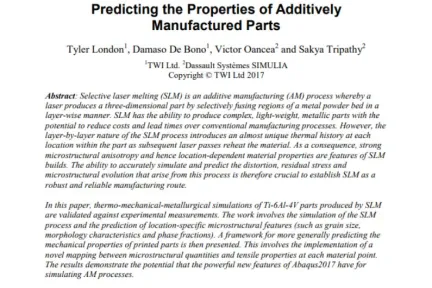
Predicting the Properties of Additively Manufactured Parts
Finite Element Simulation of the Multi Jet Fusion Process using Abaqus

Although additive manufacturing was first developed in the 1980’s, the technology is mainly applied for prototyping and tooling. The printing process is not well understood and controlled to be confidently used for printing of load bearing parts. Due to the complex geometry and the layer by layer printing process, parts as printed may show distortion, residual stress, delamination and failure that render the part unusable at the moment that it comes out of the machine. Finite element simulations of additive manufacturing can be very effective in understanding the cause of these defects and predicting the in-service performance of the printed parts. However, most finite element codes are not designed for simulating additive manufacturing processes.

Customer Papers
Finite Element Simulation of the Multi Jet Fusion Process using Abaqus
Application of Artificial Damping Method to Practical Instability Problems

The buckling of a real, thin-walled shell is typically a local phenomenon, and it may be triggered by a small, local disturbance. Regarding these problems, a very slight imperfection can be the starting point from which local deformation is initiated and developed and, consequently, overall structural stability is lost. Therefore, it has been very difficult to pursue an analysis using the conventional approach, which is typically represented by the arc-length method. In this study, we provide an explanation for the artificial damping method from which we can overcome the difficulty in performing the analysis due to local instability.

Customer Papers

Application of Artificial Damping Method to Practical Instability Problems
A High-Fidelity Model for a Hydraulic Set of Expandable Liner Hangers

Finite-element analysis (FEA) has been applied to the development of expandable liner hangers (ELHs), helping optimize designs and reduce both development time and cost. In FEA models, displacement, or force, is prescribed on a fixed surface, which is accurate for mechanical expansion, but an approximation for hydraulic expansion. The difficulties for an accurate representation of hydraulic expansion include modifying the pressure boundary and determining the expansion pressure a posteriori by the force it takes to push the cone. This paper proposes a model to represent the hydraulic expansion process accurately without including fluid in the model. The model accounts for both the dependence of hydraulic-expansion pressure on expansion force and the varying pressure surface.

Customer Papers

A High-Fidelity Model for a Hydraulic Set of Expandable Liner Hangers
LIVING HEART HUMAN MODEL: PACEMAKER LEAD INSERTION AND CARDIAC CYCLE SIMULATION

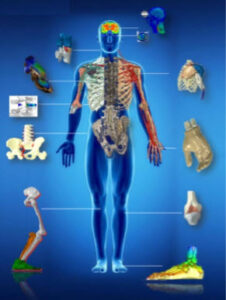
The SIMULIA Living Heart Human Model provides a unique testing environment where a pacemaker lead can be virtually inserted and mechanically deformed during the cardiac cycle. Once the mechanical deformation results are obtained, the long-term durability of the implant can be assessed. The virtual nature of the test provides a physiologically accurate methodology to test new and existing devices without exposing patients to un-necessary risk.

Solution Briefs

LIVING HEART HUMAN MODEL: PACEMAKER LEAD INSERTION AND CARDIAC CYCLE SIMULATION
Leak-before-break Leakage and Heat Transfer Simulation Of Aircraft Bleed Air System Ducts

For the safe design of aircraft bleed air system ducts and assessment of ducts with minor cracks found in the quality inspection, it is required to understand and predict the crack behavior and leak-before-break air leakage. A leak before break is desired so a leak can be detected and a repair made before a structural failure. Measuring the leaked air temperature is a widely used technique to detect the leakage flow. The ground maintenance team uses thermal imagining and temperature probe, while the on-board system uses temperature sensor wires to detect the hot air leakage. In this study, the Extended Finite Element Method (XFEM) is used to evaluate if an initial crack will grow into unstable failure.

Customer Papers

Leak-before-break Leakage and Heat Transfer Simulation Of Aircraft Bleed Air System Ducts
Design of a Prototype of an Olive Oil Extraction Machine for Home Use

The mechanical methods used to extract virgin oils from olives are of two types: the discontinuous system and the continuous system. In any case, the system defined as "continuous" is composed of several steps, not all of which are completely continuous, due to the presence of the batching device. The aim of this work was to design a prototype of a home olive oil extraction machine with a heating device to be placed immediately before the filtration step to facilitate solid / liquid separation. This strategy represents the first step towards the transformation of the step of mixing a discontinuous operation into a continuous real process. The design, analysis and simulation were done using Catia and Abaqus.

Customer Papers

Design of a Prototype of an Olive Oil Extraction Machine for Home Use
Experimental and Numerical Study for Analyzing the Incompatibility between Materials used in the Restoration of Heritage Building in Morocco

This research work study the modeling the mortar-block assembly for analyzing the potential occurrence of mechanical problems at interfaces as the consequence of an eventual incompatibility. The study considers a heritage building located in Morocco. In this recent study the authors test the effect of non linear behavior of materials and interface. The goal of the modeling works is to compare the repartition of internal solicitations between the original situation and the restored one in order to quantify the risk, for materials that should be conserved, associated with the “stress shielding” phenomenon and to justify the particular attention to be paid for the choice of a specific mortar for interventions to be carried out on the concerned building. One concrete numerical example using Abaqus code will be treated and showed on this paper.

Customer Papers

Experimental and Numerical Study for Analyzing the Incompatibility between Materials used in the Restoration of Heritage Building in Morocco
Failure is Good: Perforation Patterns and Stretchy Paper Towels

Engineering analyses are often targeted to help design parts and systems that provide a margin of safety against failure. More sophisticated models that include plasticity, damage, and failure help the analyst assess the part or system’s ability to continue to serve its intended function safely in a partially-damaged state. However, at Kimberly-Clark we like failure—specifically when consumers are tearing a paper towel off the roll (known as “dispensing” in the parlance of consumer packaged goods). By utilizing Abaqus, the essential roles the mechanical behavior (including failure) of the towel and the perforation pattern have in dispensing has become clearer.

Customer Papers

Failure is Good: Perforation Patterns and Stretchy Paper Towels
Using Abaqus to Model Permanent Set in Rubber: Assessment and Sensitivity Study

Permanent set in applications using rubber is a common problem. Modeling of this phenomenon is available in the literature; however, the permanent set material models are not widely used because of their limitations and lack of validation. Recently, one permanent set model was implemented using Abaqus. To validate this model in actual applications, it was assessed through a series of button compression set tests at three temperatures. The sensitivity of the permanent set model to multiple hyperelastic models was studied. Some minor issues were observed in the application of the model with regard to field temperature, and a workaround solution was identified. The model was otherwise verified and validated through compression set test results.

Customer Papers

Using Abaqus to Model Permanent Set in Rubber: Assessment and Sensitivity Study
Anisotropic Viscous Flow Simulation in Abaqus

The flow behavior of fiber filled material systems is of interest in polymeric composites processing. Specifically, applications such as injection molding and compression molding are concerned with determining the final fiber orientation state. As applications move towards increased fiber length and volume fractions seeking enhanced mechanical performance, significant anisotropy is introduced in the viscous response during processing. However, commercially available tools for molding simulation do not account for strongly coupled anisotropic flow. A method is presented in which Abaqus/Standard and Abaqus/Explicit are utilized to perform coupled anisotropic viscous flow simulation and fiber orientation analysis using a developed UMAT and VUMAT respectively.

Customer Papers

Anisotropic Viscous Flow Simulation in Abaqus
260 Ergebnisse

Kundengeschichten

145 Ergebnisse
2 Ergebnisse

SIMULIA Selbstlernprogramm

Wir bieten Hunderte von Selbstlernmodulen an, damit jeder nach seinen eigenen Vorstellungen lernen kann

Blogs

Lesen Sie die neuesten Nachrichten und Innovationen unserer Experten auf dem SIMULIA Blog.

696 Ergebnisse

Vernetzen Sie sich mit SIMULIA

Erfahren Sie, was SIMULIA für Sie tun kann

Lassen Sie sich von unseren SIMULIA Experten zeigen, wie unsere Lösungen eine nahtlose Zusammenarbeit und nachhaltige Innovation in Unternehmen jeder Größe ermöglichen.

Erste Schritte

Wir bieten Kurse und Schulungen für Studierende, Hochschulen, Fachleute und Unternehmen an. Finden Sie die passende SIMULIA Schulung. 

Hilfe anfordern

Hier finden Sie Informationen zu Software- und Hardware-Zertifizierungen, Software-Downloads, Anwenderdokumentation, Support-Kontakten und Serviceangeboten