1506 Ergebnisse
A Revolutionary Framework to Enable High-Fidelity Multiscale Modeling

The present work provides a new way to carry out multiscale modeling. This method is based on the Mechanics of Structure Genome, a recently developed theory, which can predict effective properties from a Structure Genome, defined as the smallest mathematical building block of the structure, and local strains and stresses from global response at the structure level. A custom toolset is developed to connect the multiscale modeling code to Abaqus/CAE, utilizing its pre- and post-processing capabilities of creating model, meshing and visualization. Three examples, including beam, plate and 3D solid structures, are presented.

Customer Papers
A Revolutionary Framework to Enable High-Fidelity Multiscale Modeling
FEA Modeling for Thermal Well Casing Connection Evaluation Programs

This paper starts with a review of the evaluation program requirements for thermal well casing connections, and presents Finite Element Analysis (FEA) modeling considerations in support of ISO/PAS 12835:2013 thermal connection qualification programs. The paper covers a few key topics for such FEA modeling, including the structural and material modeling, determination of biased test population, impact of material properties, impact of make-up torque, and the determination of a stiff-length factor for the testing program. The paper also presents the use of FEA modeling to guide the design evaluation and optimization of thermal well casing connections based on an assessment of predicted demand (loading) and capacity (response) relative to performance criteria for sealability.

Customer Papers

FEA Modeling for Thermal Well Casing Connection Evaluation Programs
Bird Strike and Novel Design of Fan Blades

The intent of this project was to find an appropriate bird substitute model and evaluate how engine blade properties can be tweaked to better handle bird strikes. Several bird geometries and material models were evaluated using the Lagrangian and smoothed particle hydrodynamic (SPH) modeling approaches. The SPH method was found to be more efficient for modeling a bird. All simulations were performed using Abaqus 2016. The material model for the calibrated bird model was best represented using a tabulated equation of state with 10% porous gelatin. The results for the hemispherical-ended cylinder with a length-to-diameter ratio of 1.6 correlated well with experimental results.

Customer Papers

Bird Strike and Novel Design of Fan Blades
Simulation of Semi-Crystalline Composites in the Extrusion Deposition Additive Manufacturing Process

A UMATHT user subroutine was developed in Abaqus to combine a non-isothermal dual crystallization kinetics model with a statistical melting model in order to describe the simultaneous solidification/re-melting behavior of 3D printed parts during the Extrusion Deposition (ED) process. This subroutine is described in detail. Results indicate that crystallization behavior is significant and strongly dependent on the utilized polymer. As an outlook, the interaction with a second UMAT user subroutine that will be employed to predict residual stresses and deformations is explained.

Customer Papers

Simulation of Semi-Crystalline Composites in the Extrusion Deposition Additive Manufacturing Process
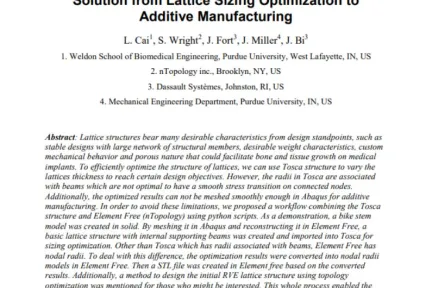
Solution from Lattice Sizing Optimization to Additive Manufacturing

Lattice structures bear many desirable characteristics from design standpoints, such as stable designs with large network of structural members, desirable weight characteristics, custom mechanical behavior and porous nature that could facilitate bone and tissue growth on medical implants. To efficiently optimize the structure of lattices, we can use Tosca structure to vary the lattices thickness to reach certain design objectives. However, the radii in Tosca are associated with beams which are not optimal to have a smooth stress transition on connected nodes.

Customer Papers

Solution from Lattice Sizing Optimization to Additive Manufacturing
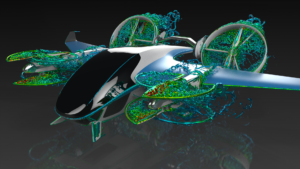
Tackling the Challenges of Deployable Thin-Film Space Structures with Abaqus

In order to support challenging requirements for space science missions, NASA and its industry partners are turning to deployable thin-film structures. A good example is the sunshield for the James Webb Space Telescope (JWST). The sunshield provides the necessary screening from external light and heat sources required to ensure proper functioning of the telescope. It is comprised of multiple layers of very thin (0.001-0.002 inch) Kapton film and has a deployed planform area roughly equivalent to a tennis court. In order to fit within the launch vehicle payload envelope of course this large-area structure must be stowed in a folded configuration then deployed to full plan-form once on orbit.

Customer Papers
Tackling the Challenges of Deployable Thin-Film Space Structures with Abaqus
Finite Element Analysis of Structural Silicone of Warped Insulated Glass Units

The second half of the twentieth century has ushered in new advancements in the field of architectural and civil engineering. One such material that is increasing being put to novel uses in building structures is architectural glass. Even though glass has been used in building facades since a very long time, the complexity of modern structures demands use of powerful design and analysis tools to achieve the desired goals. The current paper discusses one such application of insulated glass in a serpentine all-glass wall at the base of a building in Dallas, TX. The challenge in designing the glass to the required standards of safety come from the fact that each piece of glass is different and is warped to achieve an organic contour.

Customer Papers

Finite Element Analysis of Structural Silicone of Warped Insulated Glass Units
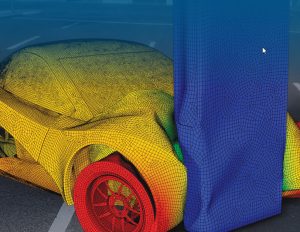
Finite Element Analysis of the Asiana Airlines Flight 214 Crash

This report synthesizes the results of a Finite Element Analysis (FEA) modeling the Asiana Airlines Flight 214 crash, at San Francisco International Airport (SFO). The goal was to reproduce the movement of the aircraft and to validate how truthfully the method of FEA could represent the real crash dynamically. At first, only rigid elements were used to represent the model with the purpose of using the maximum number of rigid elements in order to save processing time. Secondly, a combination of rigid and deformable elements were used, in order to find the weak spots during impact. Thirdly, cohesive elements were introduced at the weak spots, located at the turbine, tail and wheels, in order to model part separation during impact.

Customer Papers

Finite Element Analysis of the Asiana Airlines Flight 214 Crash
Implementation CAD and EF Composite Parts for Aerospace Industry

The objective of this study was to investigate the use of composite as an alternative in the aircraft wing and thus help to reduce the weight of the plane. In general, the composite material is used in the aviation industry to reduce the overall weight as much as possible in order to improve aircraft maneuver performance, decrease aircraft manufacturing and operational costs while keeping the stress levels under a certain value (static or fatigue allowable). The wing structure is design in CATIA V5, and the skin of wing is applied with CATIA composite design. Then the model is exported to Abaqus to calculate, simulate and optimize.

Customer Papers

Implementation CAD and EF Composite Parts for Aerospace Industry
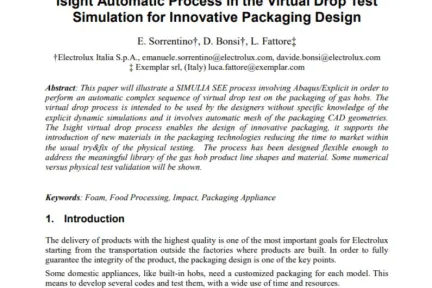
Isight Automatic Process in the Virtual Drop Test Simulation for Innovative Packaging Design

This paper will illustrate a SIMULIA SEE process involving Abaqus/Explicit in order to perform an automatic complex sequence of virtual drop test on the packaging of gas hobs. The virtual drop process is intended to be used by the designers without specific knowledge of the explicit dynamic simulations and it involves automatic mesh of the packaging CAD geometries. The Isight virtual drop process enables the design of innovative packaging, it supports the introduction of new materials in the packaging technologies reducing the time to market within the usual try&fix of the physical testing. The process has been designed flexible enough to address the meaningful library of the gas hob product line shapes and material. Some numerical versus physical test validation will be shown.

Customer Papers

Isight Automatic Process in the Virtual Drop Test Simulation for Innovative Packaging Design
Solution from Lattice Sizing Optimization to Additive Manufacturing

Lattice structures bear many desirable characteristics from design standpoints, such as stable designs with large network of structural members, desirable weight characteristics, custom mechanical behavior and porous nature that could facilitate bone and tissue growth on medical implants. To efficiently optimize the structure of lattices, we can use Tosca structure to vary the lattices thickness to reach certain design objectives. However, the radii in Tosca are associated with beams which are not optimal to have a smooth stress transition on connected nodes.

Customer Papers

Solution from Lattice Sizing Optimization to Additive Manufacturing
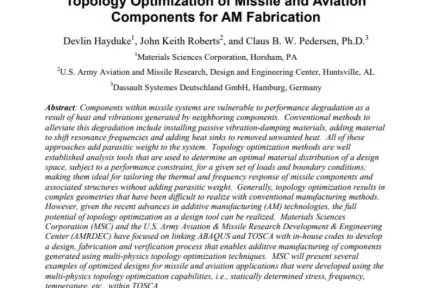
Topology Optimization of Missile and Aviation Components for AM Fabrication

Components within missile systems are vulnerable to performance degradation as a result of heat and vibrations generated by neighboring components. Conventional methods to alleviate this degradation include installing passive vibration-damping materials, adding material to shift resonance frequencies and adding heat sinks to removed unwanted heat. All of these approaches add parasitic weight to the system. Topology optimization methods are well established analysis tools that are used to determine an optimal material distribution of a design space, subject to a performance constraint, for a given set of loads and boundary conditions; making them ideal for tailoring the thermal and frequency response of missile components and associated structures without adding parasitic weight.

Customer Papers

Topology Optimization of Missile and Aviation Components for AM Fabrication
260 Ergebnisse

Kundengeschichten

145 Ergebnisse
2 Ergebnisse

SIMULIA Selbstlernprogramm

Wir bieten Hunderte von Selbstlernmodulen an, damit jeder nach seinen eigenen Vorstellungen lernen kann

Blogs

Lesen Sie die neuesten Nachrichten und Innovationen unserer Experten auf dem SIMULIA Blog.

696 Ergebnisse
People, profit and planet

definition of sustainability: meet present needs without compromising future needs -UN World Commission...

Article

People, profit and planet

Vernetzen Sie sich mit SIMULIA

Erfahren Sie, was SIMULIA für Sie tun kann

Lassen Sie sich von unseren SIMULIA Experten zeigen, wie unsere Lösungen eine nahtlose Zusammenarbeit und nachhaltige Innovation in Unternehmen jeder Größe ermöglichen.

Erste Schritte

Wir bieten Kurse und Schulungen für Studierende, Hochschulen, Fachleute und Unternehmen an. Finden Sie die passende SIMULIA Schulung. 

Hilfe anfordern

Hier finden Sie Informationen zu Software- und Hardware-Zertifizierungen, Software-Downloads, Anwenderdokumentation, Support-Kontakten und Serviceangeboten