1506 Ergebnisse
Lessons Learned in Part Design from Topology Optimization through Qualification

Topology optimization is a powerful method in the field of manufacturing, but currently lacks any sort of guiding workflow. This paper introduces a first iteration workflow for using topology optimization as a design method within a digital manufacturing framework. Unlike traditionally designed and machined parts, topology optimized and additively manufactured parts lack definitive standards for processing and qualification. Content will cover advantages, challenges, and best practices for using topology optimization as a design method for additive manufacturing. As additive manufacturing and topology optimization technologies mature, new design workflow processes, similar to those described in this paper, will become more standardized and accepted within engineering industries.

Customer Papers
Lessons Learned in Part Design from Topology Optimization through Qualification
Improved Thermal Stress Prediction in Quenched Cylindrical Bodies through a Dynamic Convection Coefficient Library

The transient temperature distribution of a quenched solid is driven by the convection coefficient at the wetted interface and the temperature difference between the component and quenching fluid. During finite element analysis, accurate applications of the convection coefficient is especially difficult due to the temporal evolution of the coefficient during the quenching process. For example, excursions through multiple regimes such as nucleate boiling followed by turbulent and/or laminar thermal boundary layers are common. During simulation efforts, a constant-valued coefficient is often used in lieu of the dynamic coefficient that accurately represents the convective boundary.

Customer Papers

Improved Thermal Stress Prediction in Quenched Cylindrical Bodies through a Dynamic Convection Coefficient Library
Improving Consumer Experience with Squeezable Containers

Packaging trends indicate that the consumer is demanding not only a visually appealing package but also one that has a functional benefit after purchase. Challenges to that outcome include adequate top load and dent resistance at the lightest possible weight. Products like ketchup, mayonnaise, salad dressing, dish and hand soap are a few types that need to meet these performance characteristics. This study examined existing commercial packages and analyzed the design features that can be modified to improve container squeezability. These geometric features involve structural components like ribs in the panel area and also the vertical and horizontal profile of the container design.

Customer Papers

Improving Consumer Experience with Squeezable Containers
Sensitivity of Predicted Temperature in a Fillet Weld T-Joint to Parameters Used in Welding Simulation with Prescribed Temperature Approach

Abaqus can be used to simulate welding processes, but the procedure can be time consuming due to a large number of steps necessary to generate weld beads and the associated thermal loads and convective film interactions. Recent development of the Abaqus Welding Interface (AWI) addresses these challenges, as the AWI utility automatically creates all of those steps. While the AWI procedure is quite straightforward, its accuracy can be expected to be highly dependent on the magnitude of several parameters defined in AWI: torch temperature, temperature ramping option, and deposited weld “chunk” length. This paper presents a sensitivity study of temperature fields to these parameters using a case study of a T-joint fillet weld.

Customer Papers

Sensitivity of Predicted Temperature in a Fillet Weld T-Joint to Parameters Used in Welding Simulation with Prescribed Temperature Approach
Simulation of Polymeric Composites Additive Manufacturing using Abaqus

Additive manufacturing, specifically the extrusion deposition process, involves the progressive addition of material at elevated temperatures following a prescribed machine path at prescribed speed. Utilizing the newly available features of Abaqus 2017, specifically element activation and event series, progressive element activation is performed by implanting the user subroutine UEPActivationVol. In this work, the system at Purdue University for extrusion deposition of highly filled, high temperature thermoplastics is modeled through a user subroutine suite which coordinates element activation according to machine instructions, assigns appropriate local coordinate systems for using anisotropic material properties, and sets relevant initial state variables for user material models.

Customer Papers

Simulation of Polymeric Composites Additive Manufacturing using Abaqus
A Computational Framework for the Analysis of an Aero-Thermochemical-Elastic Eroding Nozzle

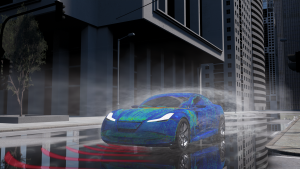
A multiphysics simulation capability has been developed that incorporates mutual interactions between aerodynamics, structural response from aerothermal loading, ablation/pyrolysis, heating, and surface-to-surface radiation to perform high-fidelity, fully coupled aerothermoelastic ablation simulations, which to date had been unattainable. The multiphysics framework couples CHAR (a 3D implicit charring ablator solver), Loci/CHEM (a computational fluid dynamics solver for high-speed chemically reacting flows), and Abaqus/Standard to create a fully coupled aerothermoelastic charring ablative solver.

Customer Papers
A Computational Framework for the Analysis of an Aero-Thermochemical-Elastic Eroding Nozzle
Validation of XFEM-based Simulation Capabilities for Fluid-driven Fractures in Permeable Media

The eXtended Finite Elements Method (XFEM) refers to a simulation technique where a fracture is modeled via splitting of special enriched finite elements during the course of a simulation. XFEM, unlike Cohesive Zone Method (CZM), allows simulating nucleation and growth of a fracture along an arbitrary, solution-dependent path without re-meshing the material in the bulk. In this work, we have used 2D XFEM coupled with pore-pressure degrees of freedom to simulate a variety of boundary value problems related to fluid-driven (hydraulic) fractures in a permeable medium. Specifically, through these simulations, we investigate the influence of critical geomechanical and operational parameters on hydraulic fracturing.

Customer Papers

Validation of XFEM-based Simulation Capabilities for Fluid-driven Fractures in Permeable Media
Simulation of Residual Stresses and Distortions in a 17-4 PH Part Produced by Laser Powder Bed Fusion

Mitigation of residual stresses and distortions in additive manufactured parts is of great interest to industry. In this study, an arch-shaped geometry is simulated using the general purpose finite element code Abaqus in order to predict stresses and distortions for a laser powder bed fusion (LPBF) manufacturing process. A sequential thermal-mechanical coupling is adopted, in which temperatures are predicted first and then used as inputs in the static stress analysis. The printed part is modeled as an elasto-visco-plastic material, whose parameters are estimated using high temperature mechanical measurements from the literature. The layer-by-layer printing process is simulated by progressive element activation in conjunction with a moving heat source. After removal from the build plate, the simulations predict an outward distortion of the arch legs which qualitatively matches experimental observations of a similar geometry.

Customer Papers

Simulation of Residual Stresses and Distortions in a 17-4 PH Part Produced by Laser Powder Bed Fusion
State of the Art Hytrel material modeling development for the design of Jounce Bumper

This paper describes the behavior and subsequent constitutive modelling of a Hytrel thermoplastic elastomer (TPC-ET) for a so-called Jounce bumper, which is a part of the vehicle’s shock absorber system. This component is subjected to large deformations (up to 100% strain) with significant permanent set and loss of stiffness. The objective of the analysis is to predict the component behavior after cyclic loading to obtain the load-displacement response curve of the Jounce bumper in operational conditions. The possibilities and limitations of the hyper-elastic model, including permanent-set and Mullins’ effect are discussed and numerical results compared to the test data from an actual component.

Customer Papers

State of the Art Hytrel material modeling development for the design of Jounce Bumper
Numerical Analysis of Ballistic Impact Damage in Layered Isotropic Plates

The work presents a numerical procedure employed for the simulation of high-velocity impact phenomena at Weldox 460 E steel plates. Parameters which affect the plate impact resistance have been analyzed in this work. These include projectile nose shape, impact velocity and incidence angle, and the target plate thickness and configuration. The impact velocities are in the range of 75 to 550 m/s, whereas the mass of the impactor is approximately 0.2 kg. The thickness of the stationary target plates has been varied from 10 to 20 mm.

Customer Papers

Numerical Analysis of Ballistic Impact Damage in Layered Isotropic Plates
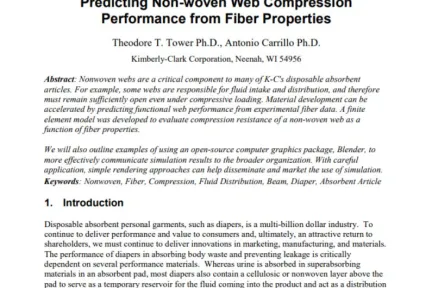
Predicting Non-woven Web Compression Performance from Fiber Properties

Nonwoven webs are a critical component to many of K-C's disposable absorbent articles. For example, some webs are responsible for fluid intake and distribution, and therefore must remain sufficiently open even under compressive loading. Material development can be accelerated by predicting functional web performance from experimental fiber data. A finite element model was developed to evaluate compression resistance of a non-woven web as a function of fiber properties. We will also outline examples of using an open-source computer graphics package, Blender, to more effectively communicate simulation results to the broader organization. With careful application, simple rendering approaches can help disseminate and market the use of simulation.

Customer Papers

Predicting Non-woven Web Compression Performance from Fiber Properties
The Role of Finite Element Analysis in the Development of a 60mm Sensor Mortar Projectile

Reconnaissance projectiles are being developed by the U.S. military with increasing frequency to facilitate a variety of emerging needs. One of those needs includes long range deployment of these projectiles, while maintaining the survivability of electronic sensors and other components. To help fill this need, a completely new remotely deployable 60mm sensor mortar projectile was designed and developed by ARDEC. Through the use of finite element analysis (FEA), the design cycle was drastically reduced to the point where first article prototypes successfully survived live fire testing at Yuma Proving Ground. This paper will give an overview of the design, and the key role that FEA played in developing a successful design at a reduced development cost and short project schedule.

Customer Papers

The Role of Finite Element Analysis in the Development of a 60mm Sensor Mortar Projectile
260 Ergebnisse

Kundengeschichten

145 Ergebnisse
2 Ergebnisse

SIMULIA Selbstlernprogramm

Wir bieten Hunderte von Selbstlernmodulen an, damit jeder nach seinen eigenen Vorstellungen lernen kann

Blogs

Lesen Sie die neuesten Nachrichten und Innovationen unserer Experten auf dem SIMULIA Blog.

696 Ergebnisse

Vernetzen Sie sich mit SIMULIA

Erfahren Sie, was SIMULIA für Sie tun kann

Lassen Sie sich von unseren SIMULIA Experten zeigen, wie unsere Lösungen eine nahtlose Zusammenarbeit und nachhaltige Innovation in Unternehmen jeder Größe ermöglichen.

Erste Schritte

Wir bieten Kurse und Schulungen für Studierende, Hochschulen, Fachleute und Unternehmen an. Finden Sie die passende SIMULIA Schulung. 

Hilfe anfordern

Hier finden Sie Informationen zu Software- und Hardware-Zertifizierungen, Software-Downloads, Anwenderdokumentation, Support-Kontakten und Serviceangeboten