1506 Ergebnisse
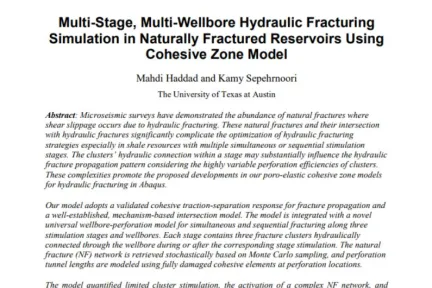
Multi-Stage, Multi-Wellbore Hydraulic Fracturing Simulation in Naturally Fractured Reservoirs Using Cohesive Zone Model

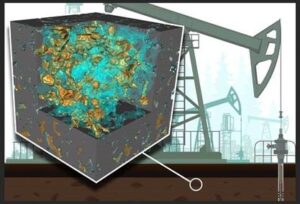
The model quantified limited cluster stimulation, the activation of a complex NF network, and fluid infiltration depending on the stimulation scenario, wellbore pressure drop, randomly distributed perforation lengths, and fracturing fluid viscosity. The complex stimulation patterns is featured by further control on cluster stimulation in the sequential fracturing case compared to the simultaneous case especially in the presence of non-uniform shaped-charge perforations. This improved model enhances the reliability on numerical simulations for hydraulic fracturing design.

Customer Papers
Multi-Stage, Multi-Wellbore Hydraulic Fracturing Simulation in Naturally Fractured Reservoirs Using Cohesive Zone Model
Dynamic Simulation Methodology of Half-toroidal IVT Variator System with Feedback Control

Dynamic simulation methodology of a half-toroidal IVT variator system using a traction drive was developed. The rheological properties of a traction fluid dependent on surface pressure, sliding velocity, and contact surface temperature were identified from four-roller test apparatus by considering Hertzian pressure distribution on traction surface. Since a half-toroidal CVT variator system was required to analyze simultaneously the vibration, deformation, and contact behavior, Abaqus/Explicit solver was used. Additionally, this approach provides arbitrary control of the variator speed ratio, a mechanical sensor-less control logic that combined a state estimation observer with feedback control was also coupled with the solver. These methods made it possible to quantify the torque capacity and power transmission efficiency of a half-toroidal variator, and also enabled visualization of the friction force spinning behavior on traction surface.

Customer Papers

Dynamic Simulation Methodology of Half-toroidal IVT Variator System with Feedback Control
High Rise Elevators – Challenges and Solutions in Ride Comfort Simulations

This presentation is focused on in-car vibrations and shows how KONE uses ABAQUS in the chain of multi-physic computation. The ride comfort depends on the elevator design, running parameters, installation quality and the building behavior. From finite element point of view the important issues that induce guide rails variable movement are: misalignment of the guide rails which typically are in the range of millimeters with a 10 cm distance between the peaks and lengths over 500 meters, suspension, compensating and travelling ropes introducing variable mass acting on the sling as a function of car position, air-flow induced forces caused by the counterweight passage at high speed and sway shape and magnitude of the building.

Customer Papers

High Rise Elevators – Challenges and Solutions in Ride Comfort Simulations
Development of the High-performance Bushing Model using Abaqus

To obtain sufficient accuracy for vehicle dynamic performance simulation, it is necessary to consider bushing amplitude and frequency dependency as well as preload effects in the rubber bushing model. FE models are capable of reproducing these characteristics though it is difficult to obtain sufficient calculation accuracy within practical computation time. This paper proposes a new low DOF bushing model by utilizing the user subroutine functionality of Abaqus. The new bushing model exhibits high computational performance while maintaining precision.

Customer Papers
Development of the High-performance Bushing Model using Abaqus
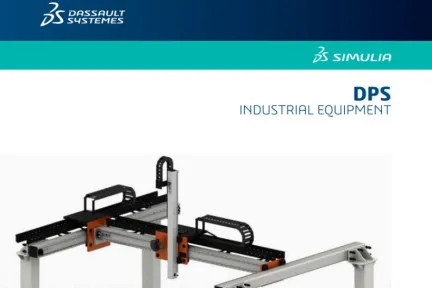
DPS INDUSTRIAL EQUIPMENT

As automation becomes more widespread across many industries, predicting and fine-tuning complex machine behavior is increasingly critical for optimizing performance. International engineering software provider Digital Product Simulation (DPS) was looking to develop a methodology for simulating the interaction of electronic controls with factory hardware.

Tech Notes

DPS INDUSTRIAL EQUIPMENT
Process Modeling and Validation for Metal Big Area Additive Manufacturing

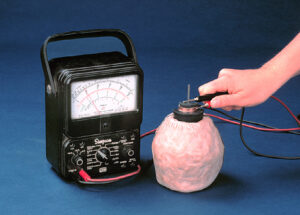
Metal Big Area Additive Manufacturing (mBAAM) is a new additive manufacturing (AM) technology based on the metal arc welding. A continuously fed metal wire is melted by an electric arc that forms between the wire and the substrate, and deposited in the form of a bead of molten metal along the predetermined path. Objects are manufactured one layer at a time starting from the base plate. The final properties of the manufactured object are dependent on its geometry and the metal deposition path, in addition to depending on the basic welding process parameters.

Customer Papers
Process Modeling and Validation for Metal Big Area Additive Manufacturing
A Study of Durability Improvement of Balance Shaft Module

The balance shaft clamping bolts in the recent engines tend to have the loosening problem by increased engine power. In this paper, a CAE procedure is introduced to predict loosening angle of bolts, wear, durability of the drive shaft. The procedure is performed through two analysis steps. In the first step, the multi-body dynamic simulation is used to obtain more accurate loading boundary conditions applied to the finite element model for the following step. Next, the finite element analysis is performed to predict the durability of the drive shaft through the calculation of the safety factor. Through this CAE procedure, design guidelines leading up to good BSM reliability has been obtained as a result of this activity.

Customer Papers
A Study of Durability Improvement of Balance Shaft Module
Influence of Surrounding Powder Bed and Build Platform on Thermal Cooling Characteristics in 3D Printed Parts via Selective Laser Melting

Selective laser melting (SLM) leads to high cooling rates and correspondingly high residual stresses, which can distort the printed part on the printing platform and even lead to part cracking and consequent print failure. The temperature profile and cooling rates during the SLM process are influenced by the surrounding powder bed and building platform, which can act as a significant heat sink depending on part design and platform arrangement. The new functionality of the Abaqus additive manufacturing simulation framework allows for separate modelling of solid (laser exposed) material, powder bed (not exposed) and platform (not exposed), as well as evolving heat transfer surfaces for the AM part. In this paper we highlight the influence of the surrounding powder bed and platform on the thermal characteristics of the printed part.

Customer Papers

Influence of Surrounding Powder Bed and Build Platform on Thermal Cooling Characteristics in 3D Printed Parts via Selective Laser Melting
BIOMECHANICS OF CRANIOFACIAL FRACTURES: A SIMULATION STUDY

In this study a 3D finite element model of the skull is created using CT scan data. All complexities of the skull geometry are simulated using ABAQUS. This numerical model is then subjected to frontal, lateral. vertical, occlusal and angulated impact conditions. Impact analysis is done and weak areas susceptible to fracture and hence failure are identified. Further fracture fixations of various designs and materials used in craniofacial fracture fixations are placed in different fracture situations in the virtual model and subjected to different impact conditions. This will enable the study of fracture and stability of the fracture of the skull under cranio facial fracture conditions.

Customer Papers

BIOMECHANICS OF CRANIOFACIAL FRACTURES: A SIMULATION STUDY
Development of the Subroutine Library 'UMMDp' for Anisotropic Yield Functions

The working group of JANCAE was launched from the idea of providing a multidisciplinary forum for steel researchers, design engineers, and software engineers through the medium of advanced finite element codes. The subroutine library is called the Unified Material Model Driver for Plasticity (UMMDp). This paper introduces the development of UMMDp and discusses a simulation of a drawing and redrawing process using some yield functions for its applications with Abaqus.

Customer Papers

Development of the Subroutine Library 'UMMDp' for Anisotropic Yield Functions
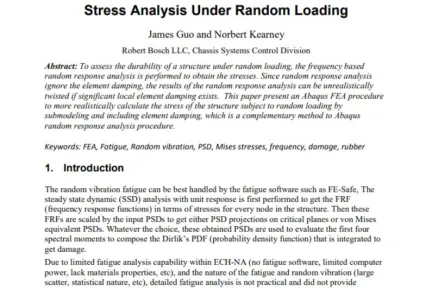
Stress Analysis Under Random Loading

To assess the durability of a structure under random loading, the frequency based random response analysis is performed to obtain the stresses. Since random response analysis ignore the element damping, the results of the random response analysis can be unrealistically twisted if significant local element damping exists. This paper present an Abaqus FEA procedure to more realistically calculate the stress of the structure subject to random loading by submodeling and including element damping, which is a complementary method to Abaqus random response analysis procedure.

Customer Papers

Stress Analysis Under Random Loading
260 Ergebnisse

Kundengeschichten

145 Ergebnisse
2 Ergebnisse

SIMULIA Selbstlernprogramm

Wir bieten Hunderte von Selbstlernmodulen an, damit jeder nach seinen eigenen Vorstellungen lernen kann

Blogs

Lesen Sie die neuesten Nachrichten und Innovationen unserer Experten auf dem SIMULIA Blog.

696 Ergebnisse

Vernetzen Sie sich mit SIMULIA

Erfahren Sie, was SIMULIA für Sie tun kann

Lassen Sie sich von unseren SIMULIA Experten zeigen, wie unsere Lösungen eine nahtlose Zusammenarbeit und nachhaltige Innovation in Unternehmen jeder Größe ermöglichen.

Erste Schritte

Wir bieten Kurse und Schulungen für Studierende, Hochschulen, Fachleute und Unternehmen an. Finden Sie die passende SIMULIA Schulung. 

Hilfe anfordern

Hier finden Sie Informationen zu Software- und Hardware-Zertifizierungen, Software-Downloads, Anwenderdokumentation, Support-Kontakten und Serviceangeboten