1506 Ergebnisse
ZOLLNER ELECTRONIK AG INDUSTRIAL EQUIPMENT

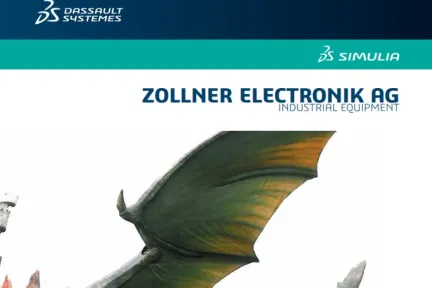
Zollner Electronik AG engineers were tasked with designing a fully functional, fire-breathing mechatronic dragon for the German Further Drachenstich festival. The team used SIMPACK multi-body simulation software from Dassault Systèmes’ SIMULIA to generate and solve 3D models that predicted and visualized motion, coupling forces, and stresses on the entire flexible system.

Tech Notes
ZOLLNER ELECTRONIK AG INDUSTRIAL EQUIPMENT
Personalized Medical Devices Contact Lens

Personalized medical devices require 3 enabling technologies: biometric measurements, automated simulation and customized manufacture. Every customized device be it an external prosthetic or an implantable device will follow a similar workflow. For the purpose of this paper, a customized contact lens design will be investigated. A contact lens in essence is an optical suction cup which corrects the abnormalities of the patient’s vision. The lens interfaces with the anterior surface of the cornea by way of a suction pressure. This suction pressure is balanced by the energy stored in the deformed shape of the contact lens. The lens is free to move on the cornea finding its equilibrium position which will be unique for each eye.

Customer Papers

Personalized Medical Devices Contact Lens
Cylinder Head Water Jacket Fatigue Optimization Workflow

The water jacket is an integral part of the engine, ensuring that liquid coolant can flow efficiently over the cylinder heads. However, this structure is also very susceptible to fatigue because of the high pressure and loading frequency to which it is exposed. This paper describes a process we developed to optimize the fatigue durability of a cylinder head water jacket using multiple products from the Simulia portfolio.The results of this study provided excellent design guidance for the sample part and yielded a workflow that could be applied to optimize the durability of other complex components.

Customer Papers

Cylinder Head Water Jacket Fatigue Optimization Workflow
Comparison of ALE, CEL and SPH for Self-piercing riveting

SPR (Self-piercing riveting) is a cold forming process that is used to fasten together two or more sheets of different materials mechanically with a rivet. Also SPR emulates the results and quality of spot welding without many of the risks, such as toxic fumes, sparks and noise. Thus circumstanced, this technique is widely used on the various filed especially within automobile industry. SPR, in particular, is excellent for lightweight manufacturing and for precise working while dramatically reducing cost and production time. The process deformation depends on the sheet size, shape of die, material flow, stiffness, etc. Also material deformation in both of rivet and workpiece sheets is tremendous large, for instance thinning, necking, shear and penetration.

Customer Papers

Comparison of ALE, CEL and SPH for Self-piercing riveting
Reliability Based Design Optimization of Subsystems / Component using Monte Carlo Simulation of Isight

With the advent of CAE high fidelity simulations, both non parametric and parametric optimization methods are gaining rapid momentum in order to find the optimum design that satisfies the performance requirements. Usually, each input design variable such as material property, load and manufacturing processes of a component / sub-system will have uncertainties which have to be accounted while performing the optimization. Since, the output parameters of mechanical sub-systems are highly nonlinear and sensitive to variation of input design variables. The Monte Carlo Simulation (MCS) method of Isight has been used to define variation of input design variables thereby to assess the risk factor of the optimum design.

Customer Papers

Reliability Based Design Optimization of Subsystems / Component using Monte Carlo Simulation of Isight
Front-End Loader Linkage Durability Analysis Using Load Input from True-Load

This document describes the use of Abaqus/CAE, Abaqus/Standard, True-Load, and Verity weld analysis in fe-safe software to evaluate the durability of a front-end loader linkage. Dynamic field loading for FEA of construction equipment is not always easily replicated by traditional linear static loading methods. Wolf Star Technologies True-Load software along with unit load FEA in Abaqus was used to determine time history loads for a field operation with dynamic loading that resulted in fatigue failures of the linkage. The time history loading was then used in fe-safe to compare the durability of design alternatives and determine a design that met the simulation criteria. The methodology greatly improved the confidence of the design developed through simulation because the field loading was accurately reproduced.

Customer Papers

Front-End Loader Linkage Durability Analysis Using Load Input from True-Load
Mechanical Testing of FDM Parts for Process Simulation

In this study, the relationship between the layer-by-layer build process and the resulting mechanical properties is investigated. The build orientations are selected based on the assumption that the printed parts demonstrate orthotropic behavior, in which the properties will vary in the primary directions orthotropic to the build layer plane. This assumption is validated by mechanical testing of tensile and Iosipescu (shear) specimens fabricated with layer-by-layer orientations orthotropic to the loading axes. Properties that are obtained from the mechanical testing include tensile modulus, tensile strength, shear modulus and Poisson’s ratio.

Customer Papers

Mechanical Testing of FDM Parts for Process Simulation
Fatigue Crack Propagation Comparison of a Hydropower Main Inlet Valve Using 3D Crack Meshes in a Full Model Versus a Sub-mode

Fatigue crack propagation of a surface crack in a hydropower main inlet valve is evaluated and compared by two approaches using Abaqus/Standard. Crack propagation is modeled using a series of 3D crack meshes to compute the crack front stress intensity values, used to compute the crack growth rates. The first approach inserts the crack mesh into the global model and connects it with tied contact, solving the combined mesh including the crack. The second approach uses a sub-model containing just the crack, where the boundary displacements are obtained from the uncracked global model results. The two methods are introduced and compared.

Customer Papers

Fatigue Crack Propagation Comparison of a Hydropower Main Inlet Valve Using 3D Crack Meshes in a Full Model Versus a Sub-mode
Fatigue Life Prediction of Welds in Motorcycle Frames on a Rough Road

Motorcycle production is increasing with strong demand for commuter models. These models are used for commuting and transporting goods with total demand in excess of 40 million units per year mostly in Asia. For production efficiency and lower cost, frames are made by welding steel pipes together forming different welded joints. The welded joints are used to make the frame compact and to provide necessary stiffness. With most welded parts, the most prone to fatigue failure is at or near the weld. Although reinforcing or strengthening can be done, cracks will just grow on different parts of the weld or joint. Thus, the need for simulation is very important to investigate the problem and consider proper design early in the development stage. This paper compares the Hot Spot Stress method and Equivalent Structural Stress Method (Verity method) to predict fatigue life of the welded joint.

Customer Papers

Fatigue Life Prediction of Welds in Motorcycle Frames on a Rough Road
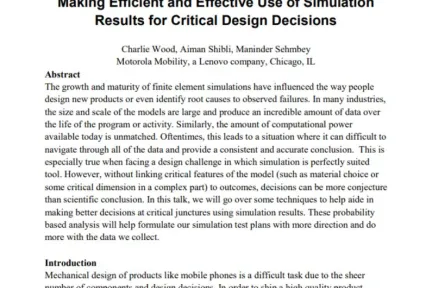
Making Efficient and Effective Use of Simulation Results for Critical Design Decisions

Mechanical design of products like mobile phones is a difficult task due to the sheer number of components and design decisions. In order to ship a high quality product, teams manage every little dimension, round, tolerance gap and material choice. Finite element simulations have proven over time to be an unmatched tool in its ability to avoid failures and aide in the design process. This is especially true when designing for drop events, which can be catastrophic. Finite element analysis tools allow us to simulate these types of events and optimize the design to improve the probability of survival. In some regions of the world, network carriers require certain minimum reliability performances to ensure low field failure rates. It is our goal as simulation engineers to ensure we not only meet these specification, but we provide unmatched quality and reliability to our customers around the world.

Customer Papers

Making Efficient and Effective Use of Simulation Results for Critical Design Decisions
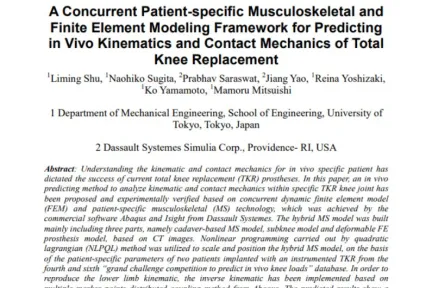
A Concurrent Patient-specific Musculoskeletal and Finite Element Modeling Framework for Predicting in Vivo Kinematics and Contact Mechanics of Total Knee Replacement

Understanding the kinematic and contact mechanics for in vivo specific patient has dictated the success of current total knee replacement (TKR) prostheses. In this paper, an in vivo predicting method to analyze kinematic and contact mechanics within specific TKR knee joint has been proposed and experimentally verified based on concurrent dynamic finite element model (FEM) and patient-specific musculoskeletal (MS) technology, which was achieved by the commercial software Abaqus and Isight from Dassault Systemes. The hybrid MS model was built mainly including three parts, namely cadaver-based MS model, subknee model and deformable FE prosthesis model, based on CT images.

Customer Papers

A Concurrent Patient-specific Musculoskeletal and Finite Element Modeling Framework for Predicting in Vivo Kinematics and Contact Mechanics of Total Knee Replacement
260 Ergebnisse

Kundengeschichten

145 Ergebnisse
2 Ergebnisse

SIMULIA Selbstlernprogramm

Wir bieten Hunderte von Selbstlernmodulen an, damit jeder nach seinen eigenen Vorstellungen lernen kann

Blogs

Lesen Sie die neuesten Nachrichten und Innovationen unserer Experten auf dem SIMULIA Blog.

696 Ergebnisse

Vernetzen Sie sich mit SIMULIA

Erfahren Sie, was SIMULIA für Sie tun kann

Lassen Sie sich von unseren SIMULIA Experten zeigen, wie unsere Lösungen eine nahtlose Zusammenarbeit und nachhaltige Innovation in Unternehmen jeder Größe ermöglichen.

Erste Schritte

Wir bieten Kurse und Schulungen für Studierende, Hochschulen, Fachleute und Unternehmen an. Finden Sie die passende SIMULIA Schulung. 

Hilfe anfordern

Hier finden Sie Informationen zu Software- und Hardware-Zertifizierungen, Software-Downloads, Anwenderdokumentation, Support-Kontakten und Serviceangeboten