有 1506 个结果
Accelerating the Development of Expandable Liner Hanger Systems using Abaqus

Developing an expandable liner hanger system for the oil and gas industry represents an engineering challenge. Finite element analysis (FEA) using Abaqus can be effective at reducing development time and cost, and for optimizing the design with fewer prototypes. This paper summarizes the use of Abaqus/Explicit for FEA of an expandable liner hanger system that comprises an adjustable swage to expand the hanger body, slip ring to hang, and a packer to seal in a variable-diameter casing. Using the Abaqus-based FEA results, potential designs were evaluated on performance parameters such as required expansion force, hanging capacity, wickers penetration, and seal integrity.

Customer Papers
Accelerating the Development of Expandable Liner Hanger Systems using Abaqus
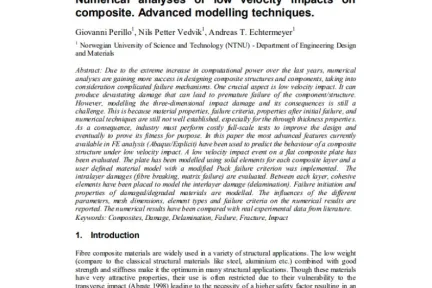
Numerical analyses of low velocity impacts on composite. Advanced modelling techniques.

Due to the extreme increase in computational power over the last years, numerical analyses are gaining more success in designing composite structures and components, taking into consideration complicated failure mechanisms. One crucial aspect is low velocity impact. It can produce devastating damage that can lead to premature failure of the component/structure. However, modelling the three-dimensional impact damage and its consequences is still a challenge. In this paper the most advanced features currently available in FE analysis (Abaqus/Explicit) have been used to predict the behaviour of a composite structure under low velocity impact.

Customer Papers

Numerical analyses of low velocity impacts on composite. Advanced modelling techniques.
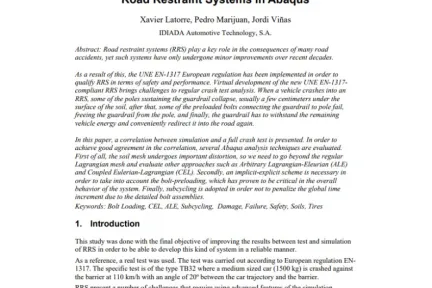
Road Restraint Systems in Abaqus

In this paper, a correlation between simulation and a full crash test is presented. In order to achieve good agreement in the correlation, several Abaqus analysis techniques are evaluated. First of all, the soil mesh undergoes important distortion, so we need to go beyond the regular Lagrangian mesh and evaluate other approaches such as Arbitrary Lagrangian-Eleurian (ALE) and Coupled Eulerian-Lagrangian (CEL). Secondly, an implicit-explicit scheme is necessary in order to take into account the bolt-preloading, which has proven to be critical in the overall behavior of the system. Finally, subcycling is adopted in order not to penalize the global time increment due to the detailed bolt assemblies.

Customer Papers

Road Restraint Systems in Abaqus
Incremental Finite Element Model for Component Interaction Investigation of a Full-Depth Deck Panel System

Prefabricated Bridge Elements and Systems (PBES) are widely used in accelerated bridge construction (ABC). One such example is the Parkview Bridge located in Kalamazoo, Michigan. The bridge has four spans with AASHTO Type III girders and full-depth deck panels that are post-tensioned in the longitudinal direction after grouting the joints between panels and forming the longitudinal joint with cast-in-place concrete. Structural system behavior is further complicated due to skew and the continuous nature of the post-tensioned deck panels that are connected to the girders using a discrete stud system and grouted haunches.

Customer Papers

Incremental Finite Element Model for Component Interaction Investigation of a Full-Depth Deck Panel System
Off-highway Diesel Engines - Reducing Cost, Improving Quality and Shortening Development Cycles at Caterpillar using Advanced Virtual Validation

This presentation will demonstrate how Abaqus can be used to drive design decisions at an early stage in the engine development process. Caterpillar is committed to using virtual validation methods within its engine design and development process. This has several benefits, namely, reducing the cost of numerous design iterations, ensuring that designs are durable and fit for purpose and also compressing the time between concept and production. Caterpillar has employed virtual methods for over 35 years, using a mix of commercial FE software supported by internal codes. Abaqus has been used within Caterpillar from 1995 and since then has become the core FE code for engine analysis.

Customer Papers

Off-highway Diesel Engines - Reducing Cost, Improving Quality and Shortening Development Cycles at Caterpillar using Advanced Virtual Validation
Finite element simulation for the impact of Root Morphology on pulling-out process

The Finite Element Method (FEM) has been used in recent years to simulate various root anchorage effects. This study aims at using the FEM to demonstrate the impact of individual root models in anchorage process with consideration to different rooting patterns and to estimate the stress distribution in soil during the pulling out process. The FEM was used to carry out the 3D simulations of root pulling-out in unsaturated sandy silt soil. The anchorage model consists of a root system embedded in a soil block. Six root patterns were used and individual roots were removed to determine their contribution to anchorage

Customer Papers

Finite element simulation for the impact of Root Morphology on pulling-out process
Pipeline Dynamics with Flowing Contents in Abaqus/Standard

Increasing demand for the supply of oil and gas creates great challenges in the design of subsea pipelines. Pipelines that traverse a rough seabed terrain or lay over pipe supports may have large spans of up to several hundred metres where there is no contact between the pipeline and seabed. The behaviour of these is often investigated within Abaqus using dynamic analyses of models primarily constructed of pipe elements. Pipelines that transport multi phase flow potentially involve slugging issues. Slugging issues occur due to the variation of the content density of the pipe which can introduce changes in the loading and inertia of the pipeline giving rise to pipeline fatigue failure.

Customer Papers

Pipeline Dynamics with Flowing Contents in Abaqus/Standard
Numerical Simulation of Fluid-Structure Interaction in the Design Process for a New Axial Hydraulic Pump

With the help of numerical simulation a new high-pressure hydraulic axial pump has been developed at Gdansk University. The pump is used in different applications demanding high power, e.g. construction machinery or military applications. Its unique feature is the total independence of a pressure switching mechanism, which saves weight and provides the possibility to control the pump by computer. Prototypes have been built and tested, for example in lifting devices on ships in an extreme temperature environment. However, when the pressure changes from high to low via a commutative bushing harmful pressure peaks were observed.

Customer Papers

Numerical Simulation of Fluid-Structure Interaction in the Design Process for a New Axial Hydraulic Pump
TMF Lite Process Development

A simplified manifold transient thermal analysis method has been developed and used in engine design and validations. Traditionally full-blown manifold transient thermal analysis has been performed using CFD and it will take weeks for completion. In this simplified method, a user subroutine film.f is used to define the htc and gas temperature at manifold surfaces so that the transient thermal analysis can be performed in Abaqus quickly. The method is designed to reduce the simulation time significantly by sacrificing some accuracy. The simulation time has been reduced from weeks to days. It proved to be a good alternative to full scale CFD analysis when many design versions need to be compared at the early design stage.

Customer Papers

TMF Lite Process Development
Dynamics of a Completion String in a Fluid Filled Wellbore

In oil and gas well field operations, downhole completion tasks require overpull or slack off on the tubing string at the rig floor. After a completion tool is run to position, typically overpull or slack off is used to overcome locking and locating mechanisms (shear pins, collets, etc.) to release the tool (e.g. packer) so that it can be set. The mechanical manipulation of the equipment, however, can induce significant sudden movement of the completion tubing string near the tool’s locking mechanis m. The rapid movement of the tubing string causes large relative motion and “piston effect” forces between tool components and fluid present in the wellbore.

Customer Papers

Dynamics of a Completion String in a Fluid Filled Wellbore
有 246 个结果

客户成功故事

有 150 个结果
有 6 个结果

SIMULIA 自学

我们提供数百个自学模块,以便您能够在方便的时间不断学习

博客

欢迎阅读 SIMULIA 博客,了解最新报道以及我们专家的最新创新。

有 694 个结果

了解 SIMULIA 可以为您做些什么

与 SIMULIA 专家交谈,了解我们的解决方案如何在各种规模的企业中实现无缝协作和可持续创新。

启动开发

课程面向学生、学术界、专业人士和企业开放。查找适合您的 SIMULIA 培训。

获得帮助

查找有关软硬件认证、软件下载、用户文档、支持联系人和服务项目的信息