有 1506 个结果
Use of a Discrete Mesoscopic Finite Element Approach Implemented in Abaqus/Explicit to Investigate the Bending and Folding of Fiber-Reinforced Composite Materials during the Manufacturing Process

During the manufacturing of fabric-reinforced composite parts using a matched-die compression molding process or resin transfer molding, the fabric may experience local in-plane compressive loads that cause out-of-plane deformations. The waves that form from such out-ofplane motion can result in resin-rich pockets (during the infusion stage of a dry fabric) or the waves may be forced down into a fold by the tooling. Such defects can compromise the structural integrity of the formed composite part. A comparison of the simulation results to the experimental data shows the finite element model accurately captures this phenomenon. An additional model is presented to demonstrate the capability of the simulation tool to capture fabric folding.

Customer Papers
Use of a Discrete Mesoscopic Finite Element Approach Implemented in Abaqus/Explicit to Investigate the Bending and Folding of Fiber-Reinforced Composite Materials during the Manufacturing Process
Non-linear elastic models for composite materials

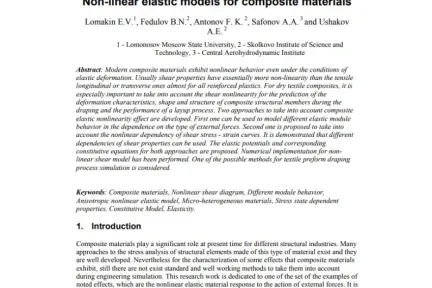
Modern composite materials exhibit nonlinear behavior even under the conditions of elastic deformation. Usually shear properties have essentially more non-linearity than the tensile longitudinal or transverse ones almost for all reinforced plastics. For dry textile composites, it is especially important to take into account the shear nonlinearity for the prediction of the deformation characteristics, shape and structure of composite structural members during the draping and the performance of a layup process. Two approaches to take into account composite elastic nonlinearity effect are developed.

Customer Papers

Non-linear elastic models for composite materials
Abaqus Analysis Methods on Highly Restrained Pipeline with Soil Berm Formation

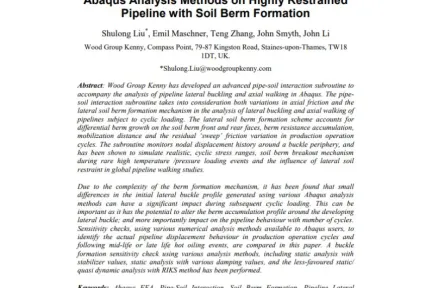
Wood Group Kenny has developed an advanced pipe-soil interaction subroutine to accompany the analysis of pipeline lateral buckling and axial walking in Abaqus. The pipesoil interaction subroutine takes into consideration both variations in axial friction and the lateral soil berm formation mechanism in the analysis of lateral buckling and axial walking of pipelines subject to cyclic loading. The lateral soil berm formation scheme accounts for differential berm growth on the soil berm front and rear faces, berm resistance accumulation, mobilization distance and the residual ‘sweep’ friction variation in production operation cycles.

Customer Papers

Abaqus Analysis Methods on Highly Restrained Pipeline with Soil Berm Formation
Simulation Lifecycle Management in the real world: Practical application in PRIME aerostructures

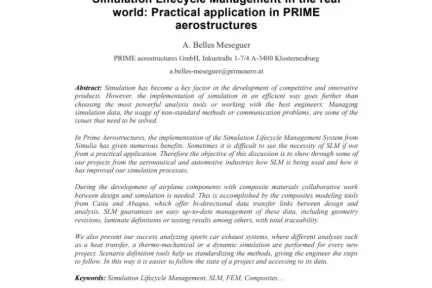
Simulation has become a key factor in the development of competitive and innovative products. However, the implementation of simulation in an efficient way goes further than choosing the most powerful analysis tools or working with the best engineers: Managing simulation data, the usage of non-standard methods or communication problems, are some of the issues that need to be solved. We also present our success analyzing sports car exhaust systems, where different analyses such as a heat transfer, a thermo-mechanical or a dynamic simulation are performed for every new project. Scenario definition tools help us standardizing the methods, giving the engineer the steps to follow. In this way it is easier to follow the state of a project and accessing to its data.

Customer Papers

Simulation Lifecycle Management in the real world: Practical application in PRIME aerostructures
Bird Strike Analysis for Impact-Resistant Design of Aircraft Wing Krueger Flap

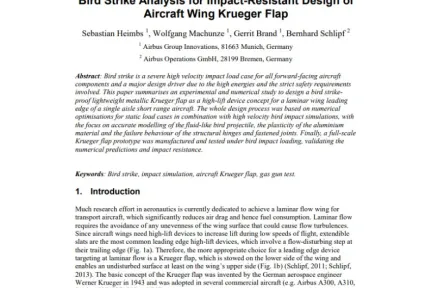
Bird strike is a severe high velocity impact load case for all forward-facing aircraft components and a major design driver due to the high energies and the strict safety requirements involved. This paper summarises an experimental and numerical study to design a bird strikeproof lightweight metallic Krueger flap as a high-lift device concept for a laminar wing leading edge of a single aisle short range aircraft. The whole design process was based on numerical optimisations for static load cases in combination with high velocity bird impact simulations, with the focus on accurate modelling of the fluid-like bird projectile, the plasticity of the aluminium material and the failure behaviour of the structural hinges and fastened joints.

Customer Papers

Bird Strike Analysis for Impact-Resistant Design of Aircraft Wing Krueger Flap
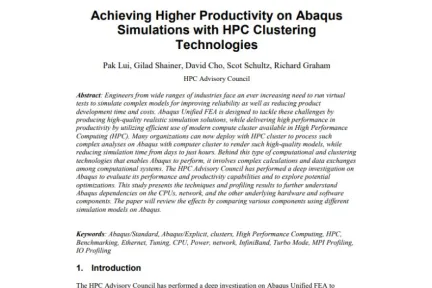
Achieving Higher Productivity on Abaqus Simulations with HPC Clustering Technologies

Engineers from wide ranges of industries face an ever increasing need to run virtual tests to simulate complex models for improving reliability as well as reducing product development time and costs. Abaqus Unified FEA is designed to tackle these challenges by producing high-quality realistic simulation solutions, while delivering high performance in productivity by utilizing efficient use of modern compute cluster available in High Performance Computing (HPC). This study presents the techniques and profiling results to further understand Abaqus dependencies on the CPUs, network, and the other underlying hardware and software components. The paper will review the effects by comparing various components using different simulation models on Abaqus.

Customer Papers

Achieving Higher Productivity on Abaqus Simulations with HPC Clustering Technologies
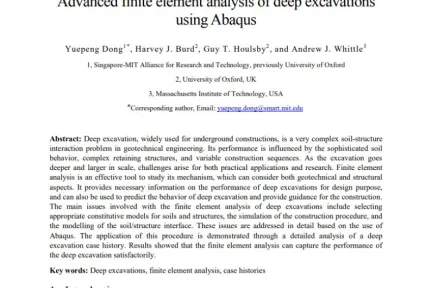
Advanced finite element analysis of deep excavations using Abaqus

Deep excavation, widely used for underground constructions, is a very complex soil-structure interaction problem in geotechnical engineering. Its performance is influenced by the sophisticated soil behavior, complex retaining structures, and variable construction sequences. As the excavation goes deeper and larger in scale, challenges arise for both practical applications and research. Finite element analysis is an effective tool to study its mechanism, which can consider both geotechnical and structural aspects. It provides necessary information on the performance of deep excavations for design purpose, and can also be used to predict the behavior of deep excavation and provide guidance for the construction. The main issues involved with the finite element analysis of deep excavations include selecting appropriate constitutive models for soils and structures, the simulation of the construction procedure, and the modelling of the soil/structure interface. These issues are addressed in detail based on the use of Abaqus. The application of this procedure is demonstrated through a detailed analysis of a deep excavation case history. Results showed that the finite element analysis can capture the performance of the deep excavation satisfactorily.

Customer Papers

Advanced finite element analysis of deep excavations using Abaqus
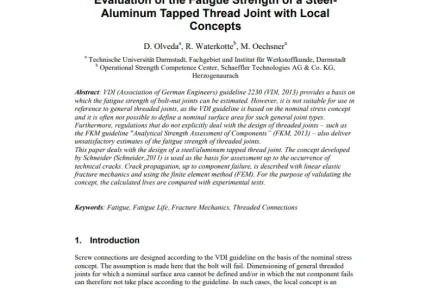
Evaluation of the Fatigue Strength of a SteelAluminum Tapped Thread Joint with Local Concepts

This paper deals with the design of a steel/aluminum tapped thread joint. The concept developed by Schneider (Schneider,2011) is used as the basis for assessment up to the occurrence of technical cracks. Crack propagation, up to component failure, is described with linear elastic fracture mechanics and using the finite element method (FEM). For the purpose of validating the concept, the calculated lives are compared with experimental tests.

Customer Papers

Evaluation of the Fatigue Strength of a SteelAluminum Tapped Thread Joint with Local Concepts
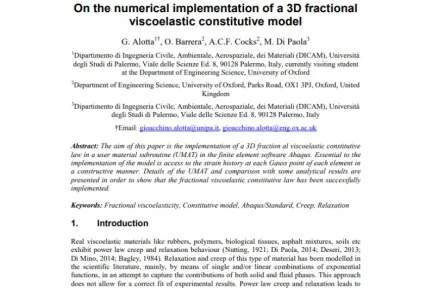
On the numerical implementation of a 3D fractional viscoelastic constitutive model

The aim of this paper is the implementation of a 3D fraction al viscoelastic constitutive law in a user material subroutine (UMAT) in the finite element software Abaqus. Essential to the implementation of the model is access to the strain history at each Gauss point of each element in a constructive manner. Details of the UMAT and comparison with some analytical results are presented in order to show that the fractional viscoelastic constitutive law has been successfully implemented.

Customer Papers

On the numerical implementation of a 3D fractional viscoelastic constitutive model
Experimental Validation of Simulation Capabilities for Hydraulic Fractures Propagating in a Porous Medium

The problem of a fluid-driven (hydraulic) fracture propagating in a porous medium is studied using recently co-developed capabilities in SIMULIA Abaqus Standard (“Abaqus”) for fully-coupled simulation of hydraulic fracturing. The hydraulic fracturing simulation capabilities are validated against lab-scale experimental results. A Polyaxial Test Cell (PTC) is set up for controlled hydraulic fracturing in fabricated rock samples allowing different testing conditions of confining stress, injection rate, and rock and fluid properties. Two representative regimes of fracture propagation (toughness/storage and viscosity/leak-off) are selected to compare against numerical simulations carried out in Abaqus.

Customer Papers

Experimental Validation of Simulation Capabilities for Hydraulic Fractures Propagating in a Porous Medium
A Numerical Investigation on the Bedding Resistance of Laterally Displaced Pipelines

The soil resistances in axial and lateral direction strongly affect the behavior of earthburied district heating pipes under variable operating temperatures. The state of knowledge regarding these resistance forces is summarized, and it is shown that almost no information exists regarding the cyclic effects on lateral soil resistances. However, for the safe design of a district heating network, the forces that soil can exert on the structure due to relative soil-pipe displacements are of particular interest. So, a numerical model has been developed, using the concept of hypoplasticity as an advanced constitutive model for noncohesive, granular materials.

Customer Papers

A Numerical Investigation on the Bedding Resistance of Laterally Displaced Pipelines
Use of FEA and Radial Basis Functions for Reliability-based Design and Assessment of Tubular Connection Sealability

One of the significant challenges in oil wells is to maintain adequate structural and sealing capacities of casing and tubing connections. In particular, unconventional wells, such as thermal and HPHT wells, require elevated standards to evaluate structural integrity and sealability of tubular connections. This paper presents a Reliability Based Design & Assessment (RBDA) methodology that characterizes system safety using a quantitative estimate of reliability. This paper also presents an FEA example of a generic premium connections to demonstrate the use of the proposed methodology.

Customer Papers

Use of FEA and Radial Basis Functions for Reliability-based Design and Assessment of Tubular Connection Sealability
有 246 个结果

客户成功故事

有 150 个结果
有 6 个结果

SIMULIA 自学

我们提供数百个自学模块,以便您能够在方便的时间不断学习

博客

欢迎阅读 SIMULIA 博客,了解最新报道以及我们专家的最新创新。

有 694 个结果
Blinded by Science!

Dassault Systèmes SIMULIA is excited to announce that it’s partnering with sister...

Article

Blinded by Science!

了解 SIMULIA 可以为您做些什么

与 SIMULIA 专家交谈,了解我们的解决方案如何在各种规模的企业中实现无缝协作和可持续创新。

启动开发

课程面向学生、学术界、专业人士和企业开放。查找适合您的 SIMULIA 培训。

获得帮助

查找有关软硬件认证、软件下载、用户文档、支持联系人和服务项目的信息