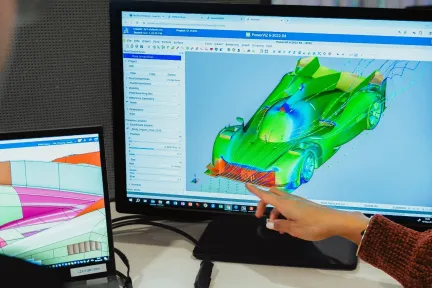
The primary objective of the present study is to investigate the impact of the recirculating flow that develops inside a closed, hemi-anechoic test chamber on the noise generation mechanisms of a drone rotor operated under static thrust conditions. To that end, Lattice-Boltzmann simulations are conducted for both an idealized, semi-infinite free-field and a confined, hemianechoic domain that models the test chamber, with the latter validated against experimental measurements. Comparison between simulations reveals a significant increase in rotor noisedue to confinement, up to 5 dBA in overall sound pressure level depending on microphone location, with negligible impact on aerodynamic performance. Blade-strip and beam-forming source identification techniques are utilized to determine those sound-generation mechanisms responsible for the increase in rotor noise. Leading-edge interactions between the vortical structures convected by the recirculating flow and the rotor’s blades are demonstrated to be directly responsible for the generation of unsteady loads that lead to significantly higher bladepassing frequency harmonic peaks. A small enhancement of the high-frequency self-noise contribution is also observed, whereas blade-tip vortex dynamics are largely unaffected by confinement so that the contribution of blade-vortex interaction noise is negligible.
Tech Notes