有 1511 个结果
Finite Element Simulation of Thermal Barrier Coatings in Rocket Engines

Rocket engines need to withstand extreme gas temperatures. To achieve this, the engine is lined with copper and cooled with liquid hydrogen. Nevertheless, creep processes can lead to damage and failure of the component. To avoid this, rocket engines can be protected with thermal barrier coatings. Standard coating systems as used in gas turbines are problematic because of larger thermal stresses between the copper substrate and the coating due to a large thermal mismatch. In this work, we use finite element simulations to study the stress evolution in a coating material tailored for application in a rocket engine. The influence of the thermal conductivity on the resulting stress state is discussed and general conclusions for the design of thermal barrier coatings in rocket engines are drawn.

Customer Papers
Finite Element Simulation of Thermal Barrier Coatings in Rocket Engines
Shrinkage Modeling of Thermoplastic Wing Rib

During manufacture of parts made of thermoplastic composites in the process of thermoforming liquid of resin transfers to solid-state with occurrence of residual stresses in part which may lead to distortion of the shape of the product. Transition from liquid to solid is called the crystallization process, the reverse process – melting. In order to predict products distortion mathematical modeling techniques are developed. Methods are allowed to evaluate the degree of warpage of the selected design solutions and on the basis of these data to change the process parameters or product design.

Customer Papers

Shrinkage Modeling of Thermoplastic Wing Rib
Piping Flexibility Analysis and the Development of PCS – Pipe Calculation System for Abaqus

The current framework for piping stress analysis is based on a simplified calculation method directly derived from experimental research performed over 60 years ago in the 1940s and 1950s. This framework was originally intended for hand calculations and, apart from minor changes and amendments, has been successfully employed by piping engineers since its development. As computational power increases and finite element analysis (FEA) becomes accessible for piping engineers, it has become clear that this framework is not well suited for complex FEA evaluation of piping. Advanced FEA procedures enable engineers to perform in depth evaluation of piping systems that are extremely difficult or even impossible to evaluate through traditional methods.

Customer Papers

Piping Flexibility Analysis and the Development of PCS – Pipe Calculation System for Abaqus
Multiscale Modeling of High Velocity Impact Damage on Composite Structures

A multiscale damage prediction procedure has been developed which employs Abaqus/Explicit to solve the problem at the structural level of composite structures. The multiscale framework has been established applying the user material subroutine VUMAT which is coupled with the micromechanical model. The procedure is based on a computationally enhanced version of the High Fidelity Generalized Method of Cells (HFGMC) micromechanical model. The twoscale approach enables calculation of the stress field within the unit cell, based on the constitutive behavior of each subcell and the unit cell morphology. As the stress distribution is determined for the representative unit cells, calculations of failure criteria and damage effects in the composite are performed at the micro-level.

Customer Papers

Multiscale Modeling of High Velocity Impact Damage on Composite Structures
Using the existing capability in Abaqus to model the draping & consolidation of composite preforms.

The work is concerned with the development of such a predictive model using a rebar-approach in Abaqus. In this approach, the fibres are held in a “shell” by some other means – perhaps stitched loosely or held by uncured prepreg resin. Any forming deformation rearranges the fibres and needs to do this against the frictional or other restraint offered internally by the “shell”. The anisotropic properties of the preform are naturally represented by the model. The model is used to solve some verification problems from the literature, as well as performing draping/forming analysis in a particular mould using a calibrated preform kinematic/mechanical model.

Customer Papers

Using the existing capability in Abaqus to model the draping & consolidation of composite preforms.
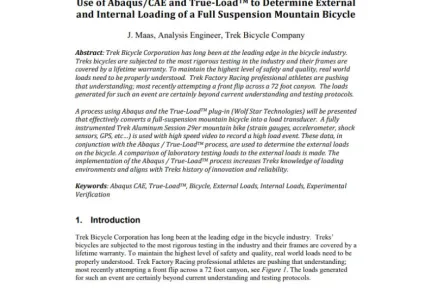
Use of Abaqus/CAE and True-LoadTM to Determine External and Internal Loading of a Full Suspension Mountain Bicycle

Trek Bicycle Corporation has long been at the leading edge in the bicycle industry. Treks bicycles are subjected to the most rigorous testing in the industry and their frames are covered by a lifetime warranty. To maintain the highest level of safety and quality, real world loads need to be properly understood. Trek Factory Racing professional athletes are pushing that understanding; most recently attempting a front flip across a 72 foot canyon. The loads generated for such an event are certainly beyond current understanding and testing protocols.

Customer Papers

Use of Abaqus/CAE and True-LoadTM to Determine External and Internal Loading of a Full Suspension Mountain Bicycle
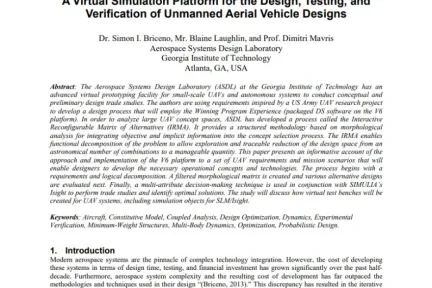
A Virtual Simulation Platform for the Design, Testing, and Verification of Unmanned Aerial Vehicle Designs

The Aerospace Systems Design Laboratory (ASDL) at the Georgia Institute of Technology has an advanced virtual prototyping facility for small-scale UAVs and autonomous systems to conduct conceptual and preliminary design trade studies. The authors are using requirements inspired by a US Army UAV research project to develop a design process that will employ the Winning Program Experience (packaged DS software on the V6 platform). In order to analyze large UAV concept spaces, ASDL has developed a process called the Interactive Reconfigurable Matrix of Alternatives (IRMA). The study will discuss how virtual test benches will be created for UAV systems, including simulation objects for SLM/Isight.

Customer Papers

A Virtual Simulation Platform for the Design, Testing, and Verification of Unmanned Aerial Vehicle Designs
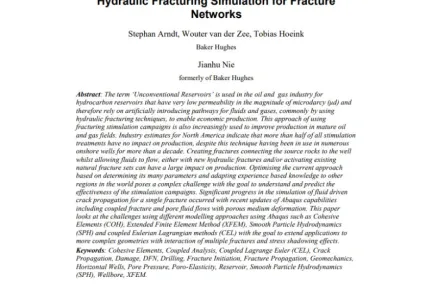
Hydraulic Fracturing Simulation for Fracture Networks

The term ‘Unconventional Reservoirs’ is used in the oil and gas industry for hydrocarbon reservoirs that have very low permeability in the magnitude of microdarcy (μd) and therefore rely on artificially introducing pathways for fluids and gases, commonly by using hydraulic fracturing techniques, to enable economic production. This approach of using fracturing stimulation campaigns is also increasingly used to improve production in mature oil and gas fields. Industry estimates for North America indicate that more than half of all stimulation treatments have no impact on production, despite this technique having been in use in numerous onshore wells for more than a decade.

Customer Papers

Hydraulic Fracturing Simulation for Fracture Networks
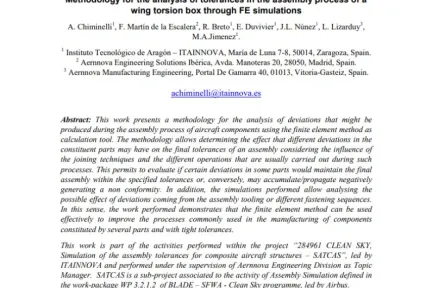
Methodology for the analysis of tolerances in the assembly process of a wing torsion box through FE simulations

This work presents a methodology for the analysis of deviations that might be produced during the assembly process of aircraft components using the finite element method as calculation tool. The methodology allows determining the effect that different deviations in the constituent parts may have on the final tolerances of an assembly considering the influence of the joining techniques and the different operations that are usually carried out during such processes. This permits to evaluate if certain deviations in some parts would maintain the final assembly within the specified tolerances or, conversely, may accumulate/propagate negatively generating a non conformity.

Customer Papers

Methodology for the analysis of tolerances in the assembly process of a wing torsion box through FE simulations
Strength and Fatigue Life Analysis of Leaf Springs used in Heavy Duty Trucks

A noticeable number of weight and cost reduction projects are performed with the help of highly improved computer aided engineering (CAE) tools within the vehicle engineering development activities. In this paper, a complete optimization study is applied to a leaf spring with 5 leaves used in the rear axle suspension systems of 6x4 heavy duty trucks by reducing the number of leaves down to 4 together with weight and cost reductions.

Customer Papers

Strength and Fatigue Life Analysis of Leaf Springs used in Heavy Duty Trucks
Modeling of Confined Inflatable Structures

This work presents the development of Finite Element (FE) models to simulate different stages of the design and operation of constrained inflatable structures. Such structures can be used, for example, for sealing segments of underground civil infrastructure such as large pipes or tunnels. In such applications, the confined inflatable structure is prepared for placement, either permanently or temporally, and left ready for deployment, inflation, and pressurization when needed. Once positioned and in operation, the inflatable may be subject to a number of possible loading scenarios and interaction with the surrounding confining environment, which must be evaluated beforehand.

Customer Papers

Modeling of Confined Inflatable Structures
Finite Element Analysis for Post-Cracking Design of Thermal Well Cements

This paper presents an FEA approach by using a damaged plasticity model to capture the complex thermal and mechanical behavior of cement material. The damaged plasticity model considers the thermal conductivity, tri-axial stress effect, strain-hardening due to plasticity, strain-softening due to cracking and cyclic loading responses. This paper also presents a post-cracking design concept as a new design basis to allow limited cement cracking, providing that the permeability of the cement remains within an acceptable limit. An illustrative example is presented to demonstrate the use of FEA approach and post-cracking design concept for the design of thermal well cements.

Customer Papers

Finite Element Analysis for Post-Cracking Design of Thermal Well Cements
有 250 个结果

客户成功故事

有 151 个结果
有 4 个结果

SIMULIA 自学

我们提供数百个自学模块,以便您能够在方便的时间不断学习

博客

欢迎阅读 SIMULIA 博客,了解最新报道以及我们专家的最新创新。

有 701 个结果

了解 SIMULIA 可以为您带来哪些价值

与 SIMULIA 专家交流,了解我们的解决方案如何在各种规模的企业中实现无缝协作和可持续创新。

开始使用

现为学生、学术机构、专业人士和企业提供各类课程与培训。查找适合您的 SIMULIA 培训。 

获取帮助

查找有关软硬件认证、软件下载、用户文档、支持联系人和服务项目的信息