有 1511 个结果
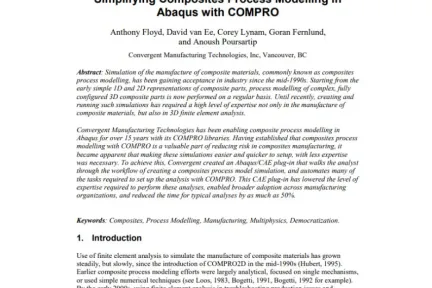
Simplifying Composites Process Modelling in Abaqus with COMPRO

Simulation of the manufacture of composite materials, commonly known as composites process modelling, has been gaining acceptance in industry since the mid-1990s. Starting from the early simple 1D and 2D representations of composite parts, process modelling of complex, fully configured 3D composite parts is now performed on a regular basis. Until recently, creating and running such simulations has required a high level of expertise not only in the manufacture of composite materials, but also in 3D finite element analysis.

Customer Papers
Simplifying Composites Process Modelling in Abaqus with COMPRO
Quality Control of PipeLay and Riser Dynamic Analysis

The increasing frequency in the use of Engineering Criticality Assessments (ECA) to determine weld quality in the installation of offshore pipelines and risers has put an increased focus on the importance of accurate predictions in dynamic stresses during installation and service. Over-predictions impose constrains to the installation campaign with high cost and safety implications. The response predictions of a pipe profile suspended from a vessel in random sea state with environmental loading and interaction with the seabed is a complex nonlinear problem. From a dynamic structural in place perspective the pipe catenary presents a near continuous spectrum of frequencies and modes of vibration. This has important dynamic numerical and structural relevance, implying excellent resonance transmissibility for any input forcing oscillation frequency.

Customer Papers

Quality Control of PipeLay and Riser Dynamic Analysis
Bond Model Development for Pretensioned Concrete Crossties with User Materials in Abaqus

Pretensioned concrete crossties are increasingly employed in railroad heavy haul and high speed lines. The bond between steel reinforcements and concrete affects several important performance measures of concrete ties, and bond modeling is a critical component in the analysis of concrete tie behavior using the finite element (FE) method. This paper summarizes the bond models developed at the Volpe Center for pretensioned concrete crossties and their implementation as user materials for cohesive elements in Abaqus. The bond models are macroscale or phenomenological and developed within the elasto-plastic framework. The steel reinforcement-concrete interface is homogenized and represented with a thin layer of cohesive elements sandwiched between steel and concrete elements.

Customer Papers

Bond Model Development for Pretensioned Concrete Crossties with User Materials in Abaqus
Finite Element Analysis for Understanding Oil and Gas Well Deformation Mechanisms

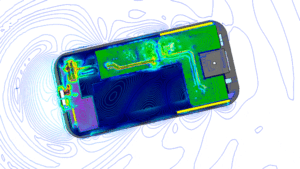
This paper presents several FEA models used to analyze different modes of casing deformation including casing collapse, buckling and shear. Analysis examples are presented to demonstrate the use of the FEA models together with available caliper survey data in investigating the loading conditions and mechanisms responsible for causing such casing deformations in a number of actual wells.

Customer Papers
Finite Element Analysis for Understanding Oil and Gas Well Deformation Mechanisms
RESERVOIR GEOMECHANICS

Energy consumption in the world is increasing. The growth in consumption is expected to be strongly driven by China, India and other non-OECD countries. Most of this consumption will be related to oil and gas, mainly for transportation and electricity. Oil and gas also are primary raw materials for a wide range of products including plastics and chemicals, and their usage is also increasing fast. This increase in the demand for oil and gas needs to be satisfied reliably and sustainably. How can we ensure that this happens?

White Papers

RESERVOIR GEOMECHANICS
Mechanics of hydraulic fracturing in ultra-low permeability formations: role of cavitation and sorption

Hydraulic fracturing (HF) comprises nucleation and growth of fractures in rock formations via flow-induced pressurization. HF is routinely used as a means of stimulating low permeability rock formations to enhance the recovery of oil and gas. The physical processes in the fracture process zone (FPZ) during HF are usually very complex because of the coupling between fracturing-fluid flow, rock deformation and diffusion of host fluid. Identifying all the critical pieces of physics is the key to developing a reliable full-physics modeling and simulation capability. Such a capability will not only enhance our understanding of HF but will also aid greatly towards the development of an effective stimulation strategy.

Customer Papers

Mechanics of hydraulic fracturing in ultra-low permeability formations: role of cavitation and sorption
Coupling Reservoir Simulation and Geomechanical Modeling to Improve the Analysis of Hydrocarbon Reservoir Behavior

In oil and gas field development, reservoir simulation is applied to accurately predict and analyze fluid flow during production. The results of reservoir simulation can be used as input for 4D geomechanical modelling to obtain the earth’s mechanical response such as reservoir compaction. However, in such a one-way coupling scheme, the geomechanical response of a system has no influence on the reservoir simulation, whereas in reality mechanical and flow behaviors influence each other.

Customer Papers

Coupling Reservoir Simulation and Geomechanical Modeling to Improve the Analysis of Hydrocarbon Reservoir Behavior
Integration for installation Upper Body of the European Semi-bonnet Truck

The semi-bonnet Truck consists of Chassis Cab composed of Cabin (CAB) and chassis frame and Upper Body (UB) such as Deck etc. The motor company has to offer manual about connection part of Chassis cab and Upper body to body builder company for manufacturing specially equipped vehicle of European Semi-bonnet truck. This is called BBM (Body Builder Manual). In this study, the simulations are carried out under several loading conditions (Normal loads, Abuse loads, Special loads) in various specially equipped vehicles (Tail-Lift Box, Sidewards of Tipper, Backwards of Tipper vehicle etc.) for ensuring robustness of connection part of Chassis cab and UB. It was able to secure stiffness and strength of connection part of Chassis cab and UB through this process, and optimize the position and number of the chassis bracket.

Customer Papers

Integration for installation Upper Body of the European Semi-bonnet Truck
Recent Advances in Composites Forming Simulation with User-Defined Material Models in Abaqus

Thermoforming and automated fabric placement processes show promise for reducing the time and cost for the manufacture of textile-reinforced composites. Simulating these processes can give insight into the manufacturability of the composite structure for each option and guide the design of the manufacturing process. Commonly used fishnet algorithms offer a computationally efficient method for modeling the draping of a fabric on a surface but do not consider the mechanical behavior of the material. A finite element solution for draping has the advantage of including the mechanical behavior of the textile, thereby allowing for investigating the relationship among changes in processing conditions and the resulting quality of the part. In the current research, a finite element based methodology for simulating the behavior of textile reinforced composites during the manufacturing process is presented.

Customer Papers

Recent Advances in Composites Forming Simulation with User-Defined Material Models in Abaqus
Optimization of Heavy-Duty Cylinder Head Gasket Manufacturing Press Using Isight

In this paper, Isight and Abaqus are used to simulate and improve the multiple-stage manufacturing process of heavy-duty cylinder head gaskets. An iterative procedure using Abaqus with custom scripting is first used to identify the required power input to achieve steady-state press operation. An Isight process flow is then developed to simulate the manufacturing process of coils of material being fed into continuous process equipment and automatically bonded in a heated platen press simulated by Abaqus. Isight parameter studies are then applied to examine the heater power required to maintain a consistent temperature on the platens to minimize both heat loss and press stabilization time. The combination of Abaqus and Isight is used to improve both the heavy-duty gasket manufacturing process performance and the resulting product quality.

Customer Papers

Optimization of Heavy-Duty Cylinder Head Gasket Manufacturing Press Using Isight
Modelling of Hytrel Thermoplastic Elastomer Material for High-Strain Cyclic Loading

This paper describes the behavior and subsequent constitutive modelling of a Hytrel thermoplastic elastomer (TPC-ET) for a so-called Jounce bumper, which is a part of the vehicle’s shock absorber system. This component is subjected to large deformations (up to 100% strain) with significant permanent set and loss of stiffness. The objective of the analysis is to predict the component behavior after cyclic loading to obtain the load-displacement response curve of the Jounce bumper in operational conditions. The possibilities and limitations of the hyper-elastic model, including permanent-set and Mullins’ effect are discussed and numerical results compared to the test data from an actual component.

Customer Papers

Modelling of Hytrel Thermoplastic Elastomer Material for High-Strain Cyclic Loading
有 250 个结果

客户成功故事

有 151 个结果
有 4 个结果

SIMULIA 自学

我们提供数百个自学模块,以便您能够在方便的时间不断学习

博客

欢迎阅读 SIMULIA 博客,了解最新报道以及我们专家的最新创新。

有 701 个结果
SIMULIA

SIMULIA provides realistic multiphysics simulation, design exploration, and optimization capabilities for designers, engineers and researchers.

Article

SIMULIA

了解 SIMULIA 可以为您带来哪些价值

与 SIMULIA 专家交流,了解我们的解决方案如何在各种规模的企业中实现无缝协作和可持续创新。

开始使用

现为学生、学术机构、专业人士和企业提供各类课程与培训。查找适合您的 SIMULIA 培训。 

获取帮助

查找有关软硬件认证、软件下载、用户文档、支持联系人和服务项目的信息