1506 Ergebnisse
Elasto-Plastic Constitutive Model for Finite Element Simulation of structural Adhesives

Considered by the automotive industry as a good solution to bond car body parts together, structural adhesives must be integrated in the early design process of vehicles, hence in the finite element analysis. A first difficulty when modeling structural adhesives comes from their complex mechanical pressure-dependent behaviour as well as their load-dependent strength. These aspects make them impossible to describe by classical material constitutive models such as von Mises or exponent Drucker-Prager, in the general case.

Customer Papers

Elasto-Plastic Constitutive Model for Finite Element Simulation of structural Adhesives
Finite Element Analysis of Fluid-Structure Interaction in Pressurized Tank ars Subjected To Dynamic Impact Loading

This paper presents a computational study of the fluid-structure interaction (FSI) mechanism in pressurized commodity tank cars in railroad application. Within the Lagrangian framework of Abaqus/Explicit, finite element analysis (FEA) is conducted to predict the structural response of tank cars under dynamic impact loading. A three-phase approach is adopted that explicitly models pressurized gas, pressurized liquid and tank car structure with three distinct sets of governing equations, and available contact options are investigated for modeling the interactions among different phases.

Customer Papers

Finite Element Analysis of Fluid-Structure Interaction in Pressurized Tank ars Subjected To Dynamic Impact Loading
Constitutive Model Development for Powder Compaction and Implementation into Abaqus

Die compaction of powders is a process which involves filling a die with powder, compaction using rigid punches to form a dense compact and ejection from the die. The process can be treated as a large deformation plasticity problem. The challenge is to develop and implement appropriate constitutive models that capture the evolution of the powder from a loose state into a dense compact. We illustrate the applicability of the models to predict density distributions in powder compacts and discuss strategies for development of efficient computational schemes for powder compaction modelling.

Customer Papers

Constitutive Model Development for Powder Compaction and Implementation into Abaqus
Optimization in the Abaqus Environment Using TOSCA

The first study will show how Abaqus/Standard allows topology optimization of large models with TOSCA.struc.topo. Topology optimization is typically used in the early design phase for producing new design suggestions where the optimization targets could be to minimize the mass considering given stiffness demands formulated using displacement constraints. In the second study, Abaqus/Standard and Tosca.struc.shape are applied for shape optimization. The shape modifications are directly performed on the Abaqus CAE model where each node is displaced independently. For the shape optimization the mesh is adapted by an automatic mesh smoothing algorithm.

Customer Papers

Optimization in the Abaqus Environment Using TOSCA
Dynamic Response in a Pipe String during Drop-Catch in a Wellbore

In field operations, during rapid deceleration of pipe (simulated by drop-catch process) or slack-off stop process, significant dynamic effects can occur. The dynamic event can amplify the load on the pipe string, and the amplified load can break a weak thread. It is necessary to understand the mechanics of this dynamic event, and thus, provide guidelines or directions for safe design and operation of the pipe string. An analysis procedure using FEA, which involves fluid-pipe interaction, has been established for this study. It shows that fluid viscosity is a very important parameter in determining whether a given pipe string with a weak thread will be safe or not under a given operating procedure.

Customer Papers

Dynamic Response in a Pipe String during Drop-Catch in a Wellbore
Modelling of an Improvement Device for a Tension Test Machine in Crippling Tests

An analysis of the crippling test applied to thin profiles is considered in this paper by using a standard tension test machine. Crippling tests are compression tests leading to crush collapse. This kind of tests cannot be properly performed in the standard test machine because of an inefficient transmission of the compression load to the specimen. To accomplish a more accurate test an improvement device is designed and modelled.

Customer Papers

Modelling of an Improvement Device for a Tension Test Machine in Crippling Tests
Realistic Modeling of Structural Steels with Yield Plateau Using AbaqusStandard

A new model for structural steel with capabilities to model yield plateau, as well as cyclic behavior is introduced. The model is incorporated into Abaqus/Standard through UMAT. Numerical results are presented for an application in earthquake engineering, where a steel bridge pier is excited with a quasi-static cyclic lateral load. Hysteresis loops and buckling patterns obtained from the computational model are compared with published experimental results.

Customer Papers

Realistic Modeling of Structural Steels with Yield Plateau Using AbaqusStandard
Design and drop test simulation of a helicopter skid landing gear with Abaqus/CAE

The aim of this paper is to study the impact of the manufacturing process of a skid landing gear on its performance during drop test simulation. A complete methodology is proposed to implement it on Abaqus. When a new landing gear design is to be designed, it has to be validated by experimental drop tests, and has to demonstrate the same overall impact resistance and energy absorption capability as well as being of similar or reduced weight. As this approach is rather expensive, an analytical approach validated experimentally has been used and yielded a complete methodology for drop tests simulation using dynamic explicit finite element codes.

Customer Papers

Design and drop test simulation of a helicopter skid landing gear with Abaqus/CAE
Simulations of Ballistic Impact on Woven Fabric

Woven fabrics are an integral part of key defense and structural systems, including personal protection (body armor) and vehicles (HMMWV). Textile-based armor, for example, has proven an effective substitute for heavier materials. With the proliferation of such materials, the demand for computationally efficient models is becoming ever more acute. Modeling woven fabrics is challenging, in particular, due to the need to capture the fabric response at both the macroscopic scale of the fabric and the “mesoscale” of the yarns that comprise the weave. Here, we utilize a continuum-level modeling technique for woven fabrics that captures the macroscopic response of the fabric as well as the evolution of its mesostructure with deformation in a single efficient modeling step.

Customer Papers

Simulations of Ballistic Impact on Woven Fabric
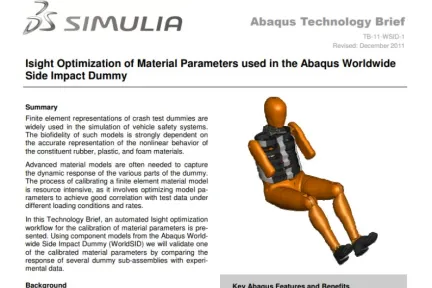
Isight Optimization of Material Parameters used in the Abaqus Worldwide Side Impact Dummy

Finite element representations of crash test dummies are widely used in the simulation of vehicle safety systems. The biofidelity of such models is strongly dependent on the accurate representation of the nonlinear behavior of the constituent rubber, plastic, and foam materials. In this Technology Brief, an automated Isight optimization workflow for the calibration of material parameters is presented. Using component models from the Abaqus Worldwide Side Impact Dummy (WorldSID) we will validate one of the calibrated material parameters by comparing the response of several dummy sub-assemblies with experimental data.

Solution Briefs

Isight Optimization of Material Parameters used in the Abaqus Worldwide Side Impact Dummy
X-FEM for Abaqus Toolkit for Automated Crack Onset and Growth Simulation: New Development, Validation, and Demonstration

A software tool for automated crack onset and growth simulation based on the eXtended Finite Element Method (X-FEM) is developed. This XFA tool for the first time is able to simulate arbitrary crack growth or composite delamination without remeshing. The automated tool is integrated with Abaqus/Standard and Abaqus/CAE via the customization interfaces. It seamlessly works with the Commercial, Off-The-Shelf (COTS) Abaqus suite. The usability of the toolkit is illustrated through a series of industrial problems.

Customer Papers

X-FEM for Abaqus Toolkit for Automated Crack Onset and Growth Simulation: New Development, Validation, and Demonstration
Finite element modelling techniques and testing methods of submerged pipes

The purpose of the present work is to discuss some FEM procedures and experimental methods that are currently used in the pipeline industry and open the way to the possibility of developing new experimental apparatuses which can provide much more economical alternatives to traditional design codes and tests.

Customer Papers

Finite element modelling techniques and testing methods of submerged pipes
260 Ergebnisse

Kundengeschichten

145 Ergebnisse
2 Ergebnisse

SIMULIA Selbstlernprogramm

Wir bieten Hunderte von Selbstlernmodulen an, damit jeder nach seinen eigenen Vorstellungen lernen kann

Blogs

Lesen Sie die neuesten Nachrichten und Innovationen unserer Experten auf dem SIMULIA Blog.

696 Ergebnisse

Vernetzen Sie sich mit SIMULIA

Erfahren Sie, was SIMULIA für Sie tun kann

Lassen Sie sich von unseren SIMULIA Experten zeigen, wie unsere Lösungen eine nahtlose Zusammenarbeit und nachhaltige Innovation in Unternehmen jeder Größe ermöglichen.

Erste Schritte

Wir bieten Kurse und Schulungen für Studierende, Hochschulen, Fachleute und Unternehmen an. Finden Sie die passende SIMULIA Schulung. 

Hilfe anfordern

Hier finden Sie Informationen zu Software- und Hardware-Zertifizierungen, Software-Downloads, Anwenderdokumentation, Support-Kontakten und Serviceangeboten