1506 Ergebnisse
Development of Benchmark Examples for QuasiStatic Delamination Propagation and Fatigue Growth Predictions

The development of benchmark examples for quasi-static delamination propagation and cyclic delamination onset and growth prediction is presented and demonstrated for Abaqus/Standard. The example is based on a finite element model of a Double-Cantilever Beam specimen. The example is independent of the analysis software used and allows the assessment of the automated delamination propagation, onset and growth prediction capabilities in commercial finite element codes based on the virtual crack closure technique (VCCT).

Customer Papers
Development of Benchmark Examples for QuasiStatic Delamination Propagation and Fatigue Growth Predictions
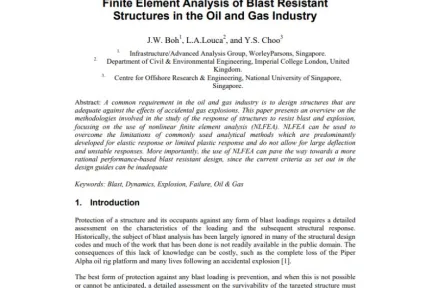
Finite Element Analysis of Blast Resistant Structures in the Oil and Gas Industry

A common requirement in the oil and gas industry is to design structures that are adequate against the effects of accidental gas explosions. This paper presents an overview on the methodologies involved in the study of the response of structures to resist blast and explosion, focusing on the use of nonlinear finite element analysis (NLFEA). NLFEA can be used to overcome the limitations of commonly used analytical methods which are predominantly developed for elastic response or limited plastic response and do not allow for large deflection and unstable responses.

Customer Papers

Finite Element Analysis of Blast Resistant Structures in the Oil and Gas Industry
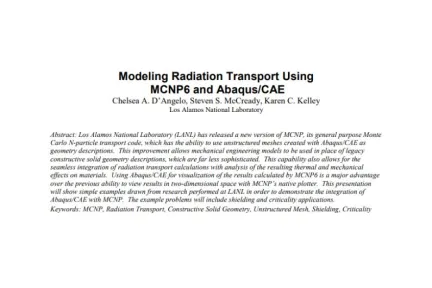
Modeling Radiation Transport Using MCNP6 and AbaqusCAE

Los Alamos National Laboratory (LANL) has released a new version of MCNP, its general purpose Monte Carlo N-particle transport code, which has the ability to use unstructured meshes created with Abaqus/CAE as geometry descriptions. This improvement allows mechanical engineering models to be used in place of legacy constructive solid geometry descriptions, which are far less sophisticated. This capability also allows for the seamless integration of radiation transport calculations with analysis of the resulting thermal and mechanical effects on materials. Using Abaqus/CAE for visualization of the results calculated by MCNP6 is a major advantage over the previous ability to view results in two-dimensional space with MCNP’s native plotter.

Customer Papers

Modeling Radiation Transport Using MCNP6 and AbaqusCAE
ABAQUS High Performance Computing Environment at Nokia

The new commodity high performance computing (HPC) hardware together with the recent ABAQUS performance enhancements, have made it possible to build high performing ABAQUS computing environment cost effectively. Since ABAQUS supports the distributed memory parallel (DMP) hardware, the usage of the cluster type of hardware has become very interesting. This paper presents the current state of ABAQUS computing environment set-up at the company.

Customer Papers

ABAQUS High Performance Computing Environment at Nokia
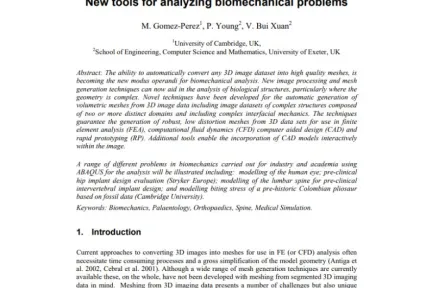
New tools for analyzing biomechanical problems

The ability to automatically convert any 3D image dataset into high quality meshes, is becoming the new modus operandi for biomechanical analysis. New image processing and mesh generation techniques can now aid in the analysis of biological structures, particularly where the geometry is complex. Novel techniques have been developed for the automatic generation of volumetric meshes from 3D image data including image datasets of complex structures composed of two or more distinct domains and including complex interfacial mechanics. The techniques guarantee the generation of robust, low distortion meshes from 3D data sets for use in finite element analysis (FEA), computational fluid dynamics (CFD) computer aided design (CAD) and rapid prototyping (RP).

Customer Papers

New tools for analyzing biomechanical problems
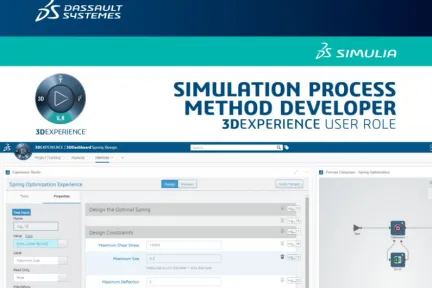
SIMULATION PROCESS METHOD DEVELOPER 3DEXPERIENCE USER ROLE

Simulation Process Method Developer helps experts deliver beautiful, customized experiences to their users without programming. With a drag-and-drop interface builder that is natively integrated with Simulation Process and Optimization and a web-based deployment framework, experts can democratize expertise faster, at lower cost and at greater scale.

Brochures

SIMULATION PROCESS METHOD DEVELOPER 3DEXPERIENCE USER ROLE
Development of 3D finite element model of umbilical systems for offshore application

Umbilical systems provide power and control (electricity, hydraulic power, chemical injection) to subsea oil and gas equipment. Electrical cables and hydraulic tubes are arranged in helical bundles and placed in successive layers depending on the design. Installations into increasingly deeper water place greater demands upon the structural components in terms of strength. 3D finite element analysis is an applicable technique in which to assess the strain and stress distribution and the interactions between components in such complex structures. The true geometry is respected and most of the simplifications of usual approaches can be relieved.

Customer Papers

Development of 3D finite element model of umbilical systems for offshore application
Analysis of Casing String Installation in Directional and Horizontal Oil Wells

The combined load condition that develops in a casing string during its installation in a directional or horizontal oil well needs to be considered in the structural integrity analysis routinely undertaken as part of the well completion design process. This paper presents a non-linear finite element analysis methodology, completed using ABAQUS 6.6, which simulates the installation of casing in directional/horizontal wells. The paper describes the development of the finite element model and demonstrates its use as an effective and reliable method for assessing casing structural integrity in the design of such well completions.

Customer Papers

Analysis of Casing String Installation in Directional and Horizontal Oil Wells
Deep and High Stress Mining – Deformation and Seismicity

Recent advances in mine scale simulation allow direct calibration of modelled displacements using measurements of surface subsidence, tunnel wall closure, shaft deformation and observed damage. The ability to correctly simulate these phenomena on a mine scale, in a single model constitutes a significant step change. Legacy geotechnical modelling packages have been unable to simulate the whole of mine deformation.

Customer Papers

Deep and High Stress Mining – Deformation and Seismicity
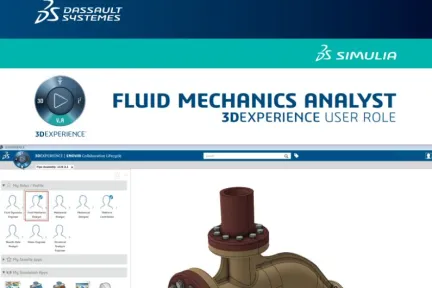
FLUID MECHANICS ANALYST 3DEXPERIENCE USER ROLE

Fluid Mechanics Analyst permits a seamless switch between applications, allowing users to be product-focused: applying the right tool at the right time in their workflow processes. This allows a much greater degree of flexibility and collaboration in the design and simulation process, where geometry changes are automatically updated and made immediately available on the same platform for the analyst to obtain updated results.

Brochures

FLUID MECHANICS ANALYST 3DEXPERIENCE USER ROLE
FEM Prediction of Dynamic Scratch Resistance of Polymer Coatings

Polymer coatings are used in pharmaceutical industry because of their wide functionality. To improve storage stability and performance of pharmaceutical products, the scratch resistance of the coatings must be improved (Gu, 2004). The scratch resistance of a common coating (150 μm HPMC) was predicted by ABAQUSTM simulation. Two models were used.

Customer Papers

FEM Prediction of Dynamic Scratch Resistance of Polymer Coatings
Transient Dynamic Analysis of a Head Surrogate Model

In this paper, an ABAQUS two dimensional transient modal dynamic finite element analysis was performed of a simplified brain model surrounded by cerebral spinal fluid and encased in PMMA. Viscoelastic material parameters of the brain tissue simulant were obtained from open literature. Low speed loading conditions were applied at different locations of this simple brain model structure. The von Mises stress and pressure contours at different times and displacement history plots are presented. The transient dynamic analyses provide insight into key areas of interest and information on the optimal placement of sensors in a more complex brain surrogate model.

Customer Papers

Transient Dynamic Analysis of a Head Surrogate Model
260 Ergebnisse

Kundengeschichten

145 Ergebnisse
2 Ergebnisse

SIMULIA Selbstlernprogramm

Wir bieten Hunderte von Selbstlernmodulen an, damit jeder nach seinen eigenen Vorstellungen lernen kann

Blogs

Lesen Sie die neuesten Nachrichten und Innovationen unserer Experten auf dem SIMULIA Blog.

696 Ergebnisse

Vernetzen Sie sich mit SIMULIA

Erfahren Sie, was SIMULIA für Sie tun kann

Lassen Sie sich von unseren SIMULIA Experten zeigen, wie unsere Lösungen eine nahtlose Zusammenarbeit und nachhaltige Innovation in Unternehmen jeder Größe ermöglichen.

Erste Schritte

Wir bieten Kurse und Schulungen für Studierende, Hochschulen, Fachleute und Unternehmen an. Finden Sie die passende SIMULIA Schulung. 

Hilfe anfordern

Hier finden Sie Informationen zu Software- und Hardware-Zertifizierungen, Software-Downloads, Anwenderdokumentation, Support-Kontakten und Serviceangeboten