1506 Ergebnisse
Linear Elastic Fracture Mechanics Analysis of Flaws within Residual Stress Fields

A procedure for calculating Linear Elastic Fracture Mechanics (LEFM) Stress Intensity Factors associated with postulated flaws located within regions of residual stress that result from large strain forming processes is presented. The procedure is validated by analyzing a structural system with residual stresses representative of a plane strain 3-point bending configuration, for which a known solution exists. The procedure is also applicable to the analysis of flaws in residual stress fields that result from in-service loads leading to large plastic strains, as illustrated by the determination of stress intensity factors associated with a postulated flaw in a deployed coronary stent. The procedure utilizes the ABAQUS import capability where the residual stresses are imported along with the updated model geometry.

Customer Papers
Linear Elastic Fracture Mechanics Analysis of Flaws within Residual Stress Fields
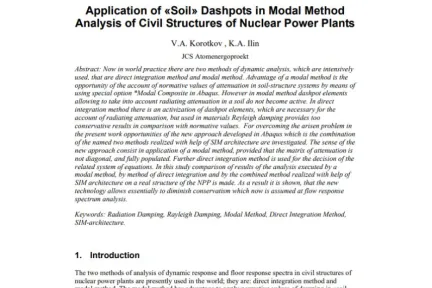
Application of «Soil» Dashpots in Modal Method Analysis of Civil Structures of Nuclear Power Plants

Now in world practice there are two methods of dynamic analysis, which are intensively used, that are direct integration method and modal method. Advantage of a modal method is the opportunity of the account of normative values of attenuation in soil-structure systems by means of using special option *Modal Composite in Abaqus. In direct integration method there is an activization of dashpot elements, which are necessary for the account of radiating attenuation, but used in materials Reyleigh damping provides too conservative results in comparison with normative values. For overcoming the arisen problem in the present work opportunities of the new approach developed in Abaqus which is the combination of the named two methods realized with help of SIM architecture are investigated.

Customer Papers

Application of «Soil» Dashpots in Modal Method Analysis of Civil Structures of Nuclear Power Plants
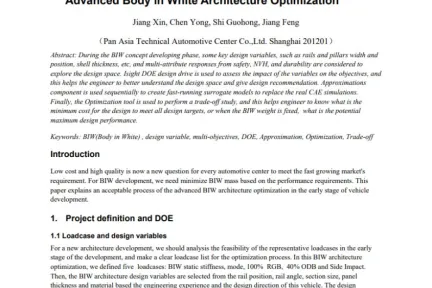
Advanced Body in White Architecture Optimization

During the BIW concept developing phase, some key design variables, such as rails and pillars width and position, shell thickness, etc, and multi-attribute responses from safety, NVH, and durability are considered to explore the design space. Isight DOE design drive is used to assess the impact of the variables on the objectives, and this helps the engineer to better understand the design space and give design recommendation. Approximations component is used sequentially to create fast-running surrogate models to replace the real CAE simulations. Finally, the Optimization tool is used to perform a trade-off study, and this helps engineer to know what is the minimum cost for the design to meet all design targets, or when the BIW weight is fixed, what is the potential maximum design performance.

Customer Papers

Advanced Body in White Architecture Optimization
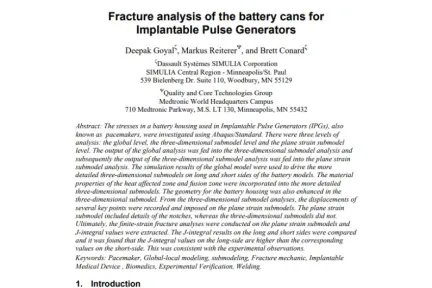
Fracture analysis of the battery cans for Implantable Pulse Generators

The stresses in a battery housing used in Implantable Pulse Generators (IPGs), also known as pacemakers, were investigated using Abaqus/Standard. There were three levels of analysis: the global level, the three-dimensional submodel level and the plane strain submodel level. The output of the global analysis was fed into the three-dimensional submodel analysis and subsequently the output of the three-dimensional submodel analysis was fed into the plane strain submodel analysis. The simulation results of the global model were used to drive the more detailed three-dimensional submodels on long and short sides of the battery models.

Customer Papers

Fracture analysis of the battery cans for Implantable Pulse Generators
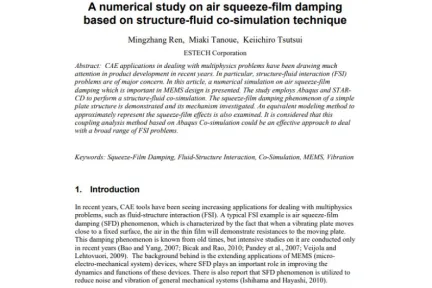
A numerical study on air squeeze-film damping based on structure-fluid co-simulation technique

CAE applications in dealing with multiphysics problems have been drawing much attention in product development in recent years. In particular, structure-fluid interaction (FSI) problems are of major concern. In this article, a numerical simulation on air squeeze-film damping which is important in MEMS design is presented. The study employs Abaqus and STARCD to perform a structure-fluid co-simulation. The squeeze-film damping phenomenon of a simple plate structure is demonstrated and its mechanism investigated. An equivalent modeling method to approximately represent the squeeze-film effects is also examined. It is considered that this coupling analysis method based on Abaqus Co-simulation could be an effective approach to deal with a broad range of FSI problems.

Customer Papers

A numerical study on air squeeze-film damping based on structure-fluid co-simulation technique
Automated Multi-Disciplinary Optimization Process Development and Application on Vehicle Program

This paper presents a highly automated process for Multi-Disciplinary Optimization (MDO) of a vehicle program to achieve weight reduction while balancing the performance for Crash, Body NVH, Full vehicle NVH and Durability attributes. The Full vehicle automated MDO process development resulted in tools and techniques that provided a significant time reduction compared to the conventional process resulting in a 8 week execution time.

Customer Papers

Automated Multi-Disciplinary Optimization Process Development and Application on Vehicle Program
Evaluation of Stress and Strain Induced by the Rock Compaction on a Hydrocarbon Well Completion Using Contact Interfaces with Abaqus

The development plan of a hydrocarbon field includes the design of all the production/injection wells forecasted for the scenario considered. The pressure depletion occurring during the hydrocarbon reservoir exploitation induces rock compaction in the near wellbore area, which may result in mechanical actions transmitted to the well completions, that alter the stress regime in some of their sections. This phenomenon can possibly bring to the failure of the casing and of the cement, eventually leading to the well shutdown and to significant economic loss. By making reference to a case of industrial interest, the paper describes a procedure to evaluate stresses and strains in the completion structure induced by the rock deformation by using Abaqus.

Customer Papers

Evaluation of Stress and Strain Induced by the Rock Compaction on a Hydrocarbon Well Completion Using Contact Interfaces with Abaqus
GNC and Aerothermal Characterization of a Re-entry Vehicle

The computation of the aero-thermal loads on a re-entry vehicle, taking into account all the physical phenomena depending on different flight conditions, is one of the key tasks in the design of such type of vehicles, mainly for those activities dealing with the Thermal Protection and Control System design. The paper presents a methodology implemented in TAS-I that, starting from any reference trajectory, is able to compute the aerothermal loads on the whole surface of a reentry vehicle and for any time step of the trajectory, taking into account all the inaccuracies affecting the trajectory itself (i.e. entry conditions, atmosphere model, Aerodynamic Database, etc.). The whole process used to elaborate those data, coupling GNC and Aerothermodynamics analyses, has been implemented in Isight environment.

Customer Papers

GNC and Aerothermal Characterization of a Re-entry Vehicle
Shape Memory Material Manufacturing Design Optimization and Stress Analysis

A recent breakthrough in the development of shape memory materials has demonstrated promising applications for completion products in the oil and gas industry. In one of the targeted applications, shape modification is a major step toward commercialization of this technology. Efficiently and effectively reshaping the material is a key element for final production. The goal of our technical team is to design and optimize the reshaping equipment so as to enable production quantities of tools while maintaining material properties. This paper will cover the concepts, challenges, and finite element modeling of reshaping shape memory materials.

Customer Papers

Shape Memory Material Manufacturing Design Optimization and Stress Analysis
Smoothed finite element method for the resultant eight-node solid shell element analysis

A local finite element strain smoothing process also known as smoothed finite element method (SFEM) is proposed for the resultant eight-node solid shell element applied in non linear analysis. Only displacement degrees of freedom are used to define the element kinematics. The strain smoothing process of membrane and bending terms is presented in a local Cartesian basis and results in modified strain operators which contain the product of element shape functions and normal vectors to the edges of the resultant quadrilateral element in the shell mid-surface. Cartesian derivatives of shape functions are thus no more required and the integration is performed on the resultant element along the edges of the subdividing cells located in the midsurface of the initial eight-node hexahedral element.

Customer Papers

Smoothed finite element method for the resultant eight-node solid shell element analysis
Automated generation of Isight-Models through a neutral workflow description

At the Cranfield University, a tool named AirCADia has been developed. It enables the dynamic assembly of hierarchical computational processes from sub processes and/or from atomic models. The analyst selects the input variables and specifies the output variables for a particular design study. AirCADia then assembles the necessary simulation sequence automatically, based on the models available in it’s library. In addition, AirCADia enables the dynamic application of relevant numerical treatments, such as multi-objective and robust optimization.

Customer Papers

Automated generation of Isight-Models through a neutral workflow description
Investigation of Interaction between Guidewire and Native Vessel Using Finite Element Analysis

Endovascular aneurysm repair involves insertion of an introductory component called guidewire through native vessels to help with the guidance of the delivery catheter. Guidewire tends to alter the vessel geometry due to its higher stiffness compared to the vessel wall. Very limited data is available to understand such interactions. Investigation of interaction between guidewire and native vessels could provide useful insight into vessel stresses and guidewire deformation in-vivo. This could further help in understanding the initial conditions for delivery catheter and device performance testing to improve deliverability in tortuous anatomy. So, in this study, we evaluated the vessel deformation during guidewire insertion using 3-D finite element analysis with undeformed vessel geometry developed from patient specific Computed-Tomography (CT) scans.

Customer Papers

Investigation of Interaction between Guidewire and Native Vessel Using Finite Element Analysis
260 Ergebnisse

Kundengeschichten

145 Ergebnisse
2 Ergebnisse

SIMULIA Selbstlernprogramm

Wir bieten Hunderte von Selbstlernmodulen an, damit jeder nach seinen eigenen Vorstellungen lernen kann

Blogs

Lesen Sie die neuesten Nachrichten und Innovationen unserer Experten auf dem SIMULIA Blog.

696 Ergebnisse

Vernetzen Sie sich mit SIMULIA

Erfahren Sie, was SIMULIA für Sie tun kann

Lassen Sie sich von unseren SIMULIA Experten zeigen, wie unsere Lösungen eine nahtlose Zusammenarbeit und nachhaltige Innovation in Unternehmen jeder Größe ermöglichen.

Erste Schritte

Wir bieten Kurse und Schulungen für Studierende, Hochschulen, Fachleute und Unternehmen an. Finden Sie die passende SIMULIA Schulung. 

Hilfe anfordern

Hier finden Sie Informationen zu Software- und Hardware-Zertifizierungen, Software-Downloads, Anwenderdokumentation, Support-Kontakten und Serviceangeboten