有 1511 个结果
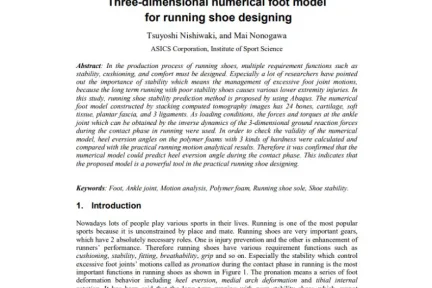
Three-dimensional numerical foot model for running shoe designing

In the production process of running shoes, multiple requirement functions such as stability, cushioning, and comfort must be designed. Especially a lot of researchers have pointed out the importance of stability which means the management of excessive foot joint motions, because the long term running with poor stability shoes causes various lower extremity injuries. In this study, running shoe stability prediction method is proposed by using Abaqus. The numerical foot model constructed by stacking computed tomography images has 24 bones, cartilage, soft tissue, plantar fascia, and 3 ligaments. As loading conditions, the forces and torques at the ankle joint which can be obtained by the inverse dynamics of the 3-dimensional ground reaction forces during the contact phase in running were used.

Customer Papers
Three-dimensional numerical foot model for running shoe designing
Evaluation of Baseball Bats on Impact with a Baseball during a Bunt Hit

This report describes the stresses on a baseball bat during a bunt and analyzes the differences of the ball exit velocity (BEV) when hit at different points on the bat. During a bunt hit, the bat stays stationary on approach of the ball. The bat was made of a white ash wood with 33in of length and the ball used was the model ROLB2 from Rawlings. Eight different spots were analyzed, all of then between 5 to 7 inches from the top of the bat. The pitcher ball velocity was assumed at 90 miles per hour. Abaqus/Explicit was use to run the simulation over time. Results showed that 7 inches from the tip of the barrel is the sweet spot i.e. the best spot to hit the ball, where the highest BEV was reached and the bat had the lowest stresses.

Customer Papers

Evaluation of Baseball Bats on Impact with a Baseball during a Bunt Hit
Analytical Frame Design for Commercial ZTR Mowers

Computed simulation can be a powerful tool when utilized to predict the behavior and life of a structure. Difficulties in properly utilizing finite element software arise when determining how to implement the loads and boundary conditions into a model so that it correlates with the real world.

Customer Papers

Analytical Frame Design for Commercial ZTR Mowers
ASME Cyclic Creep Evaluation of Critical Piping Component using CREEP Subroutine and ORNL Test Data

A critical piping component, constructed of Alloy 800-HT, is evaluated for cyclic creep concerns. The inelastic strain analysis portion of the analysis is conducted assuming the material as perfectly plastic. This method of perfect plasticity was preferred due to the lack of kinematic hardening data for Alloy 800-HT, especially at temperatures above the 800°F limitation of the ASME Section VIII Div. 2 Code. A CREEP subroutine was created using Oak Ridge National Laboratory test data and curve fitting equations.

Customer Papers

ASME Cyclic Creep Evaluation of Critical Piping Component using CREEP Subroutine and ORNL Test Data
Weight Optimization of a Landing Gear Steering Collar using Tosca in Abaqus

The adoption of topology optimization as a tool in the design cycle of a landing gear was tested using Tosca in Abaqus. The optimization process was carried out in collaboration with one of the leading landing gear manufacturers. The manufacturer is already a user of CATIA and Abaqus and was interested to see the capabilities of Tosca. To test Tosca’s capabilities, a landing gear steering collar which was already in production and had previously gone through several phases of design iterations was used as the sample component. The steering collar weighed 35.155 lb before the optimization and there was little room for further material reduction largely due to multiple contact regions and multiple loading conditions.

Customer Papers

Weight Optimization of a Landing Gear Steering Collar using Tosca in Abaqus
Strip Flatness Prediction in a 4 High Tandem Mill Using a Dynamic Model.

Some defects on the strip flatness could appear during the cold rolling, such as waves at center of edges. There are factors that influence the strip shape during the process including variables such as rolling speed, strip width, materials properties, forces at the entrances and exit of the rolling mill, elastic deflection, work rolls crown. In this work how the strip, the crown and the rolls behave during a cold rolling process in a 4 high tandem mill composed by four stands, and how their behavior create the strip shape are being studied. For developing the model a study of the mesh density, element type in the selected mesh, boundary conditions, type of part (deformable, analytical rigid), were taken into account.

Customer Papers

Strip Flatness Prediction in a 4 High Tandem Mill Using a Dynamic Model.
Optimised design of foundations for wind towers

Environmental, political, and other considerations are leading to the installation of growing numbers of wind turbines for electricity generation. The present paper concentrates on onshore installations, in which the turbine is placed at the end of a tower founded on the ground. A serious problem with the foundation or its connection with the tower entails a global failure. A worrying percentage of the towers built before 2010 is ill designed, often with obvious manifestations of the design problem. On the other hand the new designs attempt to optimise material quantities and costs while providing an adequate behaviour under the demands imposed.

Customer Papers
Optimised design of foundations for wind towers
Evaluation of Tennis Racket Swing during Impact with a Tennis Ball

This report analyzes the differences in the ball exit velocity (BEV) when a ball arriving at a given velocity is hit at different points on the string bed of a racket and describes the reaction force on the handle of the racket, though the use of Dynamic Finite Element Simulations. The objective is to prove that the Finite Element Method can be used to determine optimal hitting points for rackets during a tennis match. Optimal hitting points are considered to be the ones producing the fastest BEV and lowest reaction force on the user’s hand. Eleven different spots were analyzed. The incoming ball velocity was assumed to be 40m/s and the racket rotational swing speed was assumed to be 0.05 rad/ms. The results show that it is feasible to simulate the impact of a ball with a racket and determine stresses on the racket as well as the BEV and reaction force on the user’s hand using Dynamic Finite Elements and Abaqus/Explicit.

Customer Papers

Evaluation of Tennis Racket Swing during Impact with a Tennis Ball
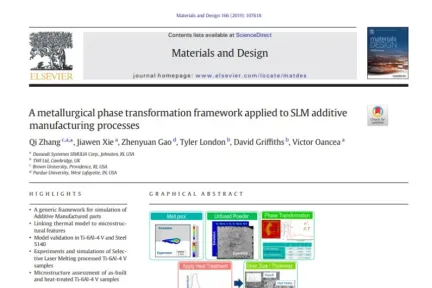
A metallurgical phase transformation framework applied to SLM additive manufacturing processes

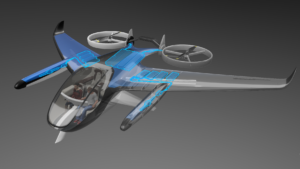
While significant progress has been made in the last few years, the reliability of Additively Manufactured (AM) parts is often less than desirable as they suffer from manufacturing defects and hence subpar strength and fatigue life. To address this challenge, numerical methods are sought to provide insight into the process and help accelerate progress in raising the quality of AM parts. In metal AM applications, assessing the amount of unfused powder, melt pool volumes, and metallurgical phase transformations is often of interest. In this work, we introduce a generic framework for assessing metallurgical phase transformations, building on a previously-developed general simulation framework for predicting temperature evolution, distortions, and residual stresses.

Customer Papers
A metallurgical phase transformation framework applied to SLM additive manufacturing processes
Dassault Systèmes SIMULIA Analyst Event 2018: New Highlights in Simulating Product, Nature and Life

CIMdata recently attended the Dassault Systèmes SIMULIA brand 2018 analyst event at its campus in Johnston, RI. As SIMULIA executives pointed out, with this dedicated event focusing on simulation, Dassault Systèmes continues to demonstrate its commitment towards simulation as a foundational element in achieving its overall vision to “imagine sustainable innovation capable of harmonizing product, nature and life.” By focusing on providing a broad range of industry solutions based on the 3DEXPERIENCE platform, Dassault Systèmes is utilizing the power of its brands more effectively. SIMULIA’s journey to improve and expand its simulation capabilities has been supported through organic research and development and continues with their 2017 acquisition of Exa Corporation to further improve the coverage in bringing multiscale together with multiphysics and science as show in Figure 1.

White Papers

Dassault Systèmes SIMULIA Analyst Event 2018: New Highlights in Simulating Product, Nature and Life
有 250 个结果

客户成功故事

有 151 个结果
有 4 个结果

SIMULIA 自学

我们提供数百个自学模块,以便您能够在方便的时间不断学习

博客

欢迎阅读 SIMULIA 博客,了解最新报道以及我们专家的最新创新。

有 701 个结果

了解 SIMULIA 可以为您带来哪些价值

与 SIMULIA 专家交流,了解我们的解决方案如何在各种规模的企业中实现无缝协作和可持续创新。

开始使用

现为学生、学术机构、专业人士和企业提供各类课程与培训。查找适合您的 SIMULIA 培训。 

获取帮助

查找有关软硬件认证、软件下载、用户文档、支持联系人和服务项目的信息