There are 1483 results
An Evaluation of Associative Interface for SolidWorks and ABAQUSCAE

In the modern design and manufacturing world, shorter development cycle times are being demanded. In addition, engineers are being asked to perform more analyses and studies to improve their products. To meet the challenge, engineers will seek more ways to increase robustness and productivity. With the continued integration of computational tools, such as the associative import between SolidWorks and Abaqus/CAE, it is possible to analyze and reiterate designs, materials, and structures in a more productive and efficient fashion.

Customer Papers
An Evaluation of Associative Interface for SolidWorks and ABAQUSCAE
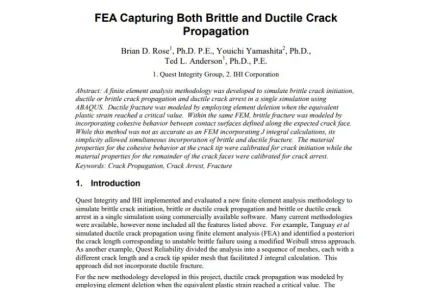
FEA Capturing Both Brittle and Ductile Crack Propagation

A finite element analysis methodology was developed to simulate brittle crack initiation, ductile or brittle crack propagation and ductile crack arrest in a single simulation using ABAQUS. Ductile fracture was modeled by employing element deletion when the equivalent plastic strain reached a critical value. Within the same FEM, brittle fracture was modeled by incorporating cohesive behavior between contact surfaces defined along the expected crack face. While this method was not as accurate as an FEM incorporating J integral calculations, its simplicity allowed simultaneous incorporation of brittle and ductile fracture.

Customer Papers

FEA Capturing Both Brittle and Ductile Crack Propagation
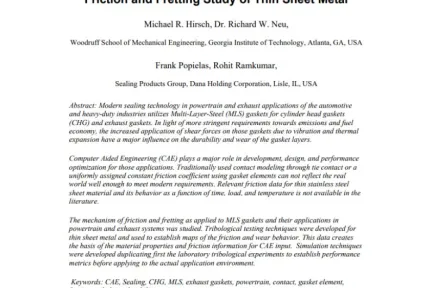
Friction and Fretting Study of Thin Sheet Metal

Modern sealing technology in powertrain and exhaust applications of the automotive and heavy-duty industries utilizes Multi-Layer-Steel (MLS) gaskets for cylinder head gaskets (CHG) and exhaust gaskets. In light of more stringent requirements towards emissions and fuel economy, the increased application of shear forces on those gaskets due to vibration and thermal expansion have a major influence on the durability and wear of the gasket layers.

Customer Papers

Friction and Fretting Study of Thin Sheet Metal
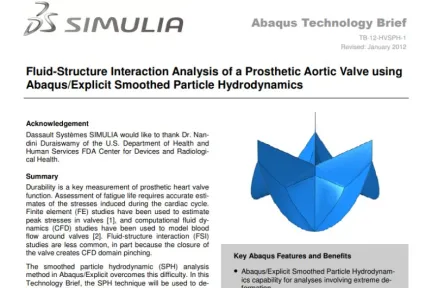
Fluid-Structure Interaction Analysis of a Prosthetic Aortic Valve using Abaqus/Explicit Smoothed Particle Hydrodynamics

Durability is a key measurement of prosthetic heart valve function. Assessment of fatigue life requires accurate estimates of the stresses induced during the cardiac cycle. Finite element (FE) studies have been used to estimate peak stresses in valves, and computational fluid dynamics (CFD) studies have been used to model blood flow around valves. Fluid-structure interaction (FSI) studies are less common, in part because the closure of the valve creates CFD domain pinching. The smoothed particle hydrodynamic (SPH) analysis method in Abaqus/Explicit overcomes this difficulty. In this Technology Brief, the SPH technique will be used to determine the FSI response of a generic prosthetic heart valve.

Solution Briefs

Fluid-Structure Interaction Analysis of a Prosthetic Aortic Valve using Abaqus/Explicit Smoothed Particle Hydrodynamics
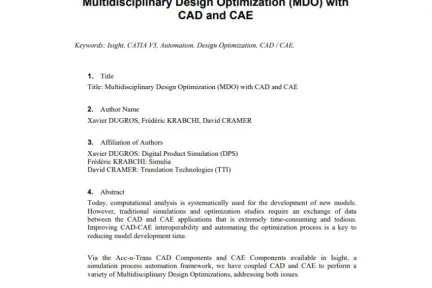
Multidisciplinary Design Optimization with CAD and CAE

Today, computational analysis is systematically used for the development of new models. However, traditional simulations and optimization studies require an exchange of data between the CAD and CAE applications that is extremely time-consuming and tedious. Improving CAD-CAE interoperability and automating the optimization process is a key to reducing model development time.

Customer Papers

Multidisciplinary Design Optimization with CAD and CAE
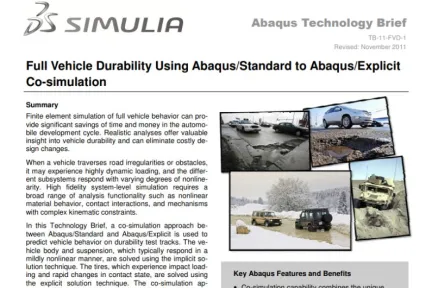
Full Vehicle Durability Using AbaqusStandard to AbaqusExplicit Co-simulation

In this Technology Brief, a co-simulation approach between Abaqus/Standard and Abaqus/Explicit is used to predict vehicle behavior on durability test tracks. The vehicle body and suspension, which typically respond in a mildly nonlinear manner, are solved using the implicit solution technique. The tires, which experience impact loading and rapid changes in contact state, are solved using the explicit solution technique. The co-simulation approach allows for an efficient analysis by capitalizing on the strengths of both solution techniques simultaneously.

Solution Briefs

Full Vehicle Durability Using AbaqusStandard to AbaqusExplicit Co-simulation
Dynamic Load Analysis and Optimization of a Fracture-Split Connecting Rod

This paper summarizes the methodology to design fracture-split (FS) connecting rod using CAE tools, ensuring product quality with reliability and rapid response in terms of study and implementation. FS connecting rod is first manufactured as single piece, then precisely cracked-off, aided by laser score-line, to produce jagged surfaces which provides perfect alignment, higher strength and keeps production costs low.

Customer Papers

Dynamic Load Analysis and Optimization of a Fracture-Split Connecting Rod
Friction stir plug weld crack meshing for NASA

Friction stir welding is used to fabricate the NASA Ares I rocket upper stage fuel tank. The friction stir plug weld fills the hole left when the stir weld tool is removed. NASA engineers want to examine fracture conditions in the plug weld due to possible imperfections to assure safety and reliability. An automated and parametric crack mesh generator is needed to quickly and easily examine numerous cases. The plug weld crack meshing approach and its reliance on Abaqus for analysis is discussed, and crack mesh basics are reviewed. The choice of crack shape and 39 additional geometric and mesh control parameters, such as the plug diameter, transverse weld sizes, and plug bevel angle affect how the crack mesh is created.

Customer Papers

Friction stir plug weld crack meshing for NASA
Machining Part Program Optimization through an Advanced Multidisciplinary Procedure

In the production of aerospace engine components, metal cutting processes are characterized by a strong demand for increased productivity that does not compromise the high quality of the product. In aerospace machining applications on hard-cut materials like: nickel based alloys, titanium alloys, etc, it is fundamental to keep under control the local cutting zone phenomena in order to assure the final product quality. The machining process design development can be summarized by the following steps: definition and verification of the Part Program (PP) through dedicated CAD–CAM software applications, post processing of the produced PP, CNC machine simulation and physical tryout.

Customer Papers

Machining Part Program Optimization through an Advanced Multidisciplinary Procedure
Predicting Snap-through of a Thin-walled Panel due to Thermal and Acoustic Loads

Under contract from Wright-Patterson AFB (WPAFB), ATA Engineering, Inc., (ATA) has performed a study of “snap-through buckling” of a panel on a hypersonic vehicle under the influence of fluctuating pressures. Snap-through occurs when the elastic stiffness of the structure is cancelled by the effects of compressive stress within the structure. If this effect causes the structure to suddenly displace a large amount in a direction normal to the load direction then it is classical bifurcation buckling. If there is a sudden large movement in the direction of the loading it is snap-through buckling.

Customer Papers

Predicting Snap-through of a Thin-walled Panel due to Thermal and Acoustic Loads
Simplification and automated modification of existing Isight-processes

Currently, the typical Isight user is a specialist in process integration, optimization and creation of complex processes. He can create complex processes with different external programmes quickly and has a good knowledge of data structure, interfaces and useful control scripts. If some problems appear, the expert user with his experience can react and solve the problem very quickly. By contrast, non-expert users need much more time to build or customise the same complex processes and to solve occurring problems. Therefore, there is a clear barrier for non-expert users to work on complex processes with Isight.

Customer Papers

Simplification and automated modification of existing Isight-processes
Modeling and Analysis Techniques for Suspension Rubber Bushings

Suspension rubber bushingsin full vehicle models are usually represented with nonlinear spring elements. However, when bushings are preloaded or deformed in diagonal direction, the spring element models tend to express inaccurate movement. In this paper, suspension rubber bushings are modeled with solid finite elements. We established a technique enabling to evaluate the nonlinear large deformation behavior ofrubber bushings. This modeling technique is also able to improve simulation accuracy compared to the conventional modeling technique.

Customer Papers

Modeling and Analysis Techniques for Suspension Rubber Bushings
There are 245 results

Customer stories

There are 130 results

From the communities

There are 6 results

SIMULIA Self Learning

We provide hundreds of self-learning modules so you can continue to learn at your convenience

Blogs

Read the SIMULIA blog on the latest news and innovations from our experts.

There is no result

Learn What SIMULIA Can Do for You

Speak with a SIMULIA expert to learn how our solutions enable seamless collaboration and sustainable innovation at organizations of every size.

Get Started

Courses and classes are available for students, academia, professionals and companies. Find the right SIMULIA training for you. 

Get Help

Find information on software & hardware certification, software downloads, user documentation, support contact and services offering