There are 1483 results
On the application of ABAQUS for the evaluation of the structural integrity of railway vehicles

Stadler Rail, an emerging European railway manufacturer, has been using ABAQUS for the structural evaluation of car body shells and bogie frames since 2003. The finite element models derived for quasi-static analyses of the primary load carrying structures can be directly used for explicit analyses of the crashworthiness behavior. Standards like EN15227 or the FRA waiver regulations in the RSAC ETF I report of FRA prescribe special collision scenarios for which the survival zone of the passengers and the engineer have to be proven. Comparisons between explicit analysis results and dynamic testing have shown that the crash behavior of the structures has been successfully captured.

Customer Papers
On the application of ABAQUS for the evaluation of the structural integrity of railway vehicles
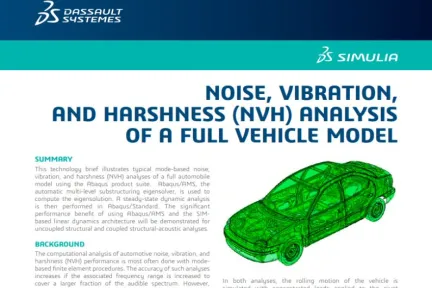
NOISE, VIBRATION, AND HARSHNESS ANALYSIS OF A FULL VEHICLE MODEL

This technology brief illustrates typical mode-based noise, vibration, and harshness (NVH) analyses of a full automobile model using the Abaqus product suite. Abaqus/AMS, the automatic multi-level substructuring eigensolver, is used to compute the eigensolution. A steady-state dynamic analysis is then performed in Abaqus/Standard. The significant performance benefit of using Abaqus/AMS and the SIMbased linear dynamics architecture will be demonstrated for uncoupled structural and coupled structural-acoustic analyses.

Solution Briefs

NOISE, VIBRATION, AND HARSHNESS ANALYSIS OF A FULL VEHICLE MODEL
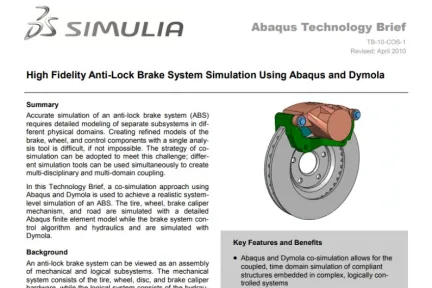
High Fidelity Anti-Lock Brake System Simulation Using Abaqus and Dymola

In this Technology Brief, a co-simulation approach using Abaqus and Dymola is used to achieve a realistic systemlevel simulation of an ABS. The tire, wheel, brake caliper mechanism, and road are simulated with a detailed Abaqus finite element model while the brake system control algorithm and hydraulics and are simulated with Dymola.

Solution Briefs

High Fidelity Anti-Lock Brake System Simulation Using Abaqus and Dymola
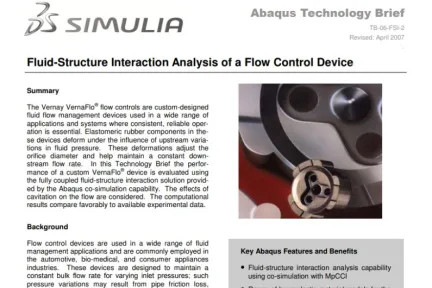
Fluid-Structure Interaction Analysis of a Flow Control Device

The Vernay VernaFlo flow controls are custom-designed fluid flow management devices used in a wide range of applications and systems where consistent, reliable operation is essential. Elastomeric rubber components in these devices deform under the influence of upstream variations in fluid pressure. These deformations adjust the orifice diameter and help maintain a constant downstream flow rate. In this Technology Brief the performance of a custom VernaFlo device is evaluated using the fully coupled fluid-structure interaction solution provided by the Abaqus co-simulation capability. The effects of cavitation on the flow are considered. The computational results compare favorably to available experimental data.

Solution Briefs

Fluid-Structure Interaction Analysis of a Flow Control Device
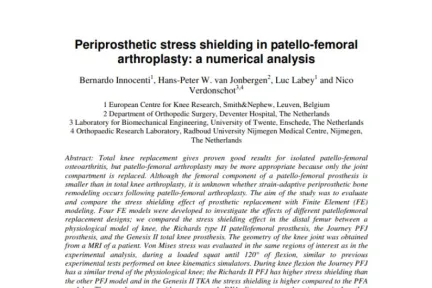
Periprosthetic stress shielding in patello-femoral arthroplasty: a numerical analysis

Total knee replacement gives proven good results for isolated patello-femoral osteoarthritis, but patello-femoral arthroplasty may be more appropriate because only the joint compartment is replaced. Although the femoral component of a patello-femoral prosthesis is smaller than in total knee arthroplasty, it is unknown whether strain-adaptive periprosthetic bone remodeling occurs following patello-femoral arthroplasty. The aim of the study was to evaluate and compare the stress shielding effect of prosthetic replacement with Finite Element modeling.

Customer Papers

Periprosthetic stress shielding in patello-femoral arthroplasty: a numerical analysis
Automotive Brake Squeal Analysis Using a Complex Modes Approach

A methodology to study friction-induced squeal in a complete automotive disc brake assembly is presented. The analysis process uses a nonlinear static simulation sequence followed by a complex eigenvalue extraction to determine the dynamic instabilities that are manifested as unwanted noise. The effects of assembly loads; nonuniform contact pressure between the brake linings and disc; velocity-, temperature-, and pressure-dependent friction coefficients; friction-induced damping; and lining wear can be included. The methodology is demonstrated with a representative disc brake assembly. Good correlation between the analysis results and available experimental data is achieved.

Solution Briefs

Automotive Brake Squeal Analysis Using a Complex Modes Approach
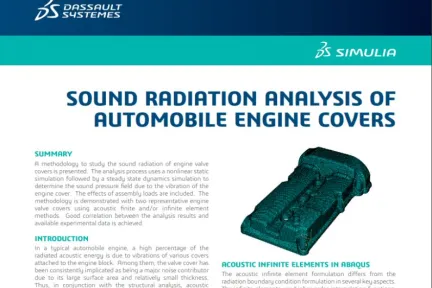
Sound Radiation Analysis of Automobile Engine Covers

A methodology to study the sound radiation of engine valve covers is presented. The analysis process uses a nonlinear static simulation followed by a steady state dynamics simulation to determine the sound pressure field due to the vibration of the engine cover. The effects of assembly loads are included. The methodology is demonstrated with two representative engine valve covers using acoustic finite and/or infinite element methods. Good correlation between the analysis results and available experimental data is achieved.

Solution Briefs

Sound Radiation Analysis of Automobile Engine Covers
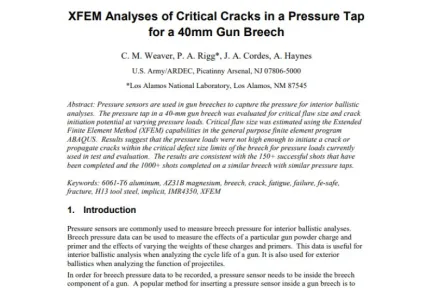
XFEM Analyses of Critical Cracks in a Pressure Tap for a 40mm Gun Breech

Critical flaw size was estimated using the Extended Finite Element Method (XFEM) capabilities in the general purpose finite element program ABAQUS. Results suggest that the pressure loads were not high enough to initiate a crack or propagate cracks within the critical defect size limits of the breech for pressure loads currently used in test and evaluation. The results are consistent with the 150+ successful shots that have been completed and the 1000+ shots completed on a similar breech with similar pressure taps.

Customer Papers

XFEM Analyses of Critical Cracks in a Pressure Tap for a 40mm Gun Breech
Simulation of Electroencephalography Using Abaqus

In this Technology Brief we present some results from simulations performed on a model of a human head [4]. The distributions of electrical potentials and currents within the model are calculated for known source locations in the brain. The electrical conductivity in the model is considered to be inhomogeneous as well as anisotropic.

Solution Briefs

Simulation of Electroencephalography Using Abaqus
Simulation of the Quasi-static Crushing of a Fabric Composite Plate

In this Technology Brief, we describe a methodology for modeling the crushing behavior of composite structures using Abaqus/Explicit. Very good quantitative and qualitative agreement between the numerical results and experimental data is shown, demonstrating the utility of Abaqus/ Explicit for assessing the crashworthiness of composite structures and reducing the amount of costly experimental testing.

Solution Briefs

Simulation of the Quasi-static Crushing of a Fabric Composite Plate
There are 245 results

Customer stories

There are 130 results

From the communities

There are 6 results

SIMULIA Self Learning

We provide hundreds of self-learning modules so you can continue to learn at your convenience

Blogs

Read the SIMULIA blog on the latest news and innovations from our experts.

There is no result

Learn What SIMULIA Can Do for You

Speak with a SIMULIA expert to learn how our solutions enable seamless collaboration and sustainable innovation at organizations of every size.

Get Started

Courses and classes are available for students, academia, professionals and companies. Find the right SIMULIA training for you. 

Get Help

Find information on software & hardware certification, software downloads, user documentation, support contact and services offering