1506 Ergebnisse
Creep Analysis of Lead-Free Solders Undergoing Thermal Loading

Lead and its compounds have been widely used for many years in the electronics industry. However, the global demand to reduce the use of hazardous materials has compelled electronics manufacturers to consider lead-free materials in future products. This transition has heightened the necessity for new finite element material models that can be used to evaluate the reliability of lead-free solders. Along with extensive nonlinear analysis capabilities, Abaqus/Standard includes a variety of creep models, including those applicable to lead-free solders. It is thus an ideal design tool for the electronics industry.

Solution Briefs
Creep Analysis of Lead-Free Solders Undergoing Thermal Loading
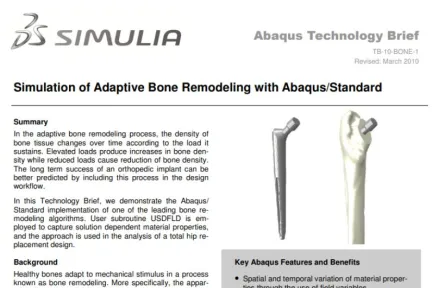
Simulation of Adaptive Bone Remodeling with Abaqus/Standard

In this Technology Brief, we demonstrate the Abaqus/ Standard implementation of one of the leading bone remodeling algorithms. User subroutine USDFLD is employed to capture solution dependent material properties, and the approach is used in the analysis of a total hip replacement design.

Solution Briefs

Simulation of Adaptive Bone Remodeling with Abaqus/Standard
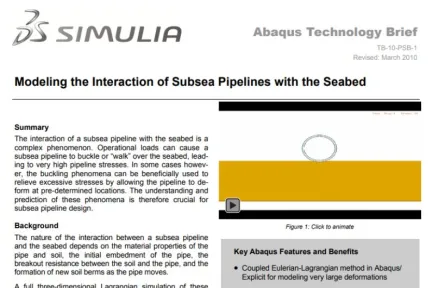
Modeling the Interaction of Subsea Pipelines with the Seabed

The interaction of a subsea pipeline with the seabed is a complex phenomenon. Operational loads can cause a subsea pipeline to buckle or “walk” over the seabed, leading to very high pipeline stresses. In some cases however, the buckling phenomena can be beneficially used to relieve excessive stresses by allowing the pipeline to deform at pre-determined locations. The understanding and prediction of these phenomena is therefore crucial for subsea pipeline design.

Solution Briefs

Modeling the Interaction of Subsea Pipelines with the Seabed
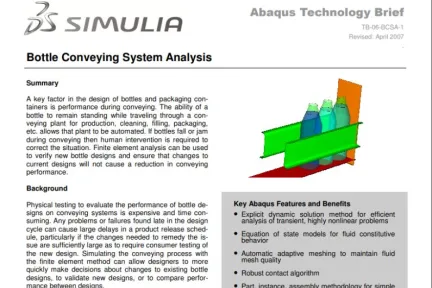
Bottle Conveying System Analysis

A key factor in the design of bottles and packaging containers is performance during conveying. The ability of a bottle to remain standing while traveling through a conveying plant for production, cleaning, filling, packaging, etc. allows that plant to be automated. If bottles fall or jam during conveying then human intervention is required to correct the situation. Finite element analysis can be used to verify new bottle designs and ensure that changes to current designs will not cause a reduction in conveying performance.

Solution Briefs

Bottle Conveying System Analysis
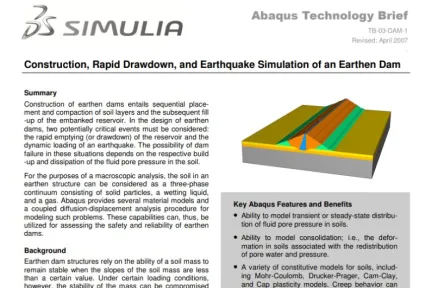
Construction, Rapid Drawdown, and Earthquake Simulation of an Earthen Dam

Construction of earthen dams entails sequential placement and compaction of soil layers and the subsequent fill -up of the embanked reservoir. In the design of earthen dams, two potentially critical events must be considered: the rapid emptying (or drawdown) of the reservoir and the dynamic loading of an earthquake. The possibility of dam failure in these situations depends on the respective build -up and dissipation of the fluid pore pressure in the soil.

Solution Briefs

Construction, Rapid Drawdown, and Earthquake Simulation of an Earthen Dam
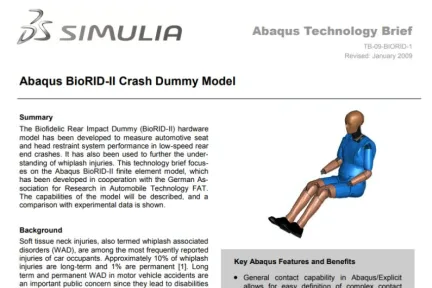
Abaqus BioRID-II Crash Dummy Model

The Biofidelic Rear Impact Dummy (BioRID-II) hardware model has been developed to measure automotive seat and head restraint system performance in low-speed rear end crashes. It has also been used to further the understanding of whiplash injuries. This technology brief focuses on the Abaqus BioRID-II finite element model, which has been developed in cooperation with the German Association for Research in Automobile Technology FAT. The capabilities of the model will be described, and a comparison with experimental data is shown.

Solution Briefs

Abaqus BioRID-II Crash Dummy Model
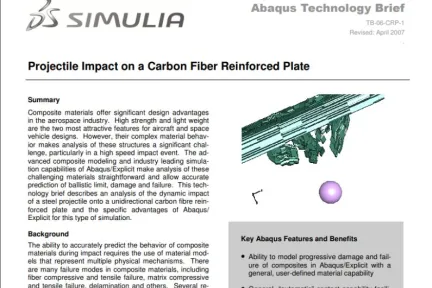
Projectile Impact on a Carbon Fiber Reinforced Plate

Composite materials offer significant design advantages in the aerospace industry. High strength and light weight are the two most attractive features for aircraft and space vehicle designs. However, their complex material behavior makes analysis of these structures a significant challenge, particularly in a high speed impact event. The advanced composite modeling and industry leading simulation capabilities of Abaqus/Explicit make analysis of these challenging materials straightforward and allow accurate prediction of ballistic limit, damage and failure. This technology brief describes an analysis of the dynamic impact of a steel projectile onto a unidirectional carbon fibre reinforced plate and the specific advantages of Abaqus/ Explicit for this type of simulation.

Solution Briefs

Projectile Impact on a Carbon Fiber Reinforced Plate
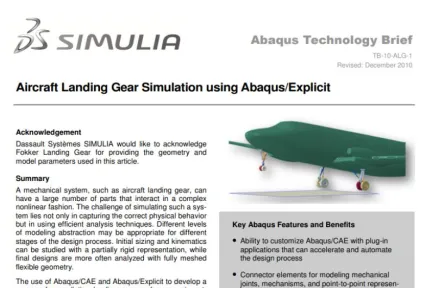
Aircraft Landing Gear Simulation using AbaqusExplicit

The use of Abaqus/CAE and Abaqus/Explicit to develop a process for predicting landing gear performance is outlined in this Technology Brief. By combining the automation and customization capabilities of Abaqus/CAE, the robustness of Abaqus/Explicit, and Unified Finite Element Analysis (UFEA) concepts, we show how the Abaqus product suite can be used to efficiently analyze mechanical systems.

Solution Briefs

Aircraft Landing Gear Simulation using AbaqusExplicit
Composite materials offer significant design advantages in the aerospace industry. High strength and light weight are the two most attractive features for aircraft and space vehicle designs. However, their complex material behavior makes analysis of these

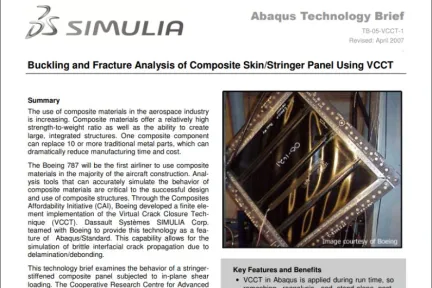
The use of composite materials in the aerospace industry is increasing. Composite materials offer a relatively high strength-to-weight ratio as well as the ability to create large, integrated structures. One composite component can replace 10 or more traditional metal parts, which can dramatically reduce manufacturing time and cost.

Solution Briefs

Composite materials offer significant design advantages in the aerospace industry. High strength and light weight are the two most attractive features for aircraft and space vehicle designs. However, their complex material behavior makes analysis of these
Multi-Physics Analysis of a Refractory Metal ACOperated High Temperature Heater with Abaqus

Electrically operated high temperature furnaces and reactors are used in many industrial manufacturing processes such as sintering or single crystal growth in order to allow for the required process conditions. In view of their outstanding characteristics refractory metals are ideally suited as materials for the resistive heating elements. Nevertheless, significant and lifetime-limiting irreversible deformations of these elements can be frequently observed which are assumed to be caused by a combination of temperature expansion, electromagnetic forces, and high temperature creep effects. In order to study this undesired behavior, a multi-physics model of a particular three-phase AC heating element of a sintering furnace is formulated and implemented within Abaqus.

Customer Papers

Multi-Physics Analysis of a Refractory Metal ACOperated High Temperature Heater with Abaqus
SIMULIA | DesignSight Structure Plus

Enables up-front realistic simulation of product assemblies under structural loading conditions extending DesignSight Structure to enable additional physics and productivity tools.

Datasheets

SIMULIA | DesignSight Structure Plus
260 Ergebnisse

Kundengeschichten

145 Ergebnisse
2 Ergebnisse

SIMULIA Selbstlernprogramm

Wir bieten Hunderte von Selbstlernmodulen an, damit jeder nach seinen eigenen Vorstellungen lernen kann

Blogs

Lesen Sie die neuesten Nachrichten und Innovationen unserer Experten auf dem SIMULIA Blog.

696 Ergebnisse

Vernetzen Sie sich mit SIMULIA

Erfahren Sie, was SIMULIA für Sie tun kann

Lassen Sie sich von unseren SIMULIA Experten zeigen, wie unsere Lösungen eine nahtlose Zusammenarbeit und nachhaltige Innovation in Unternehmen jeder Größe ermöglichen.

Erste Schritte

Wir bieten Kurse und Schulungen für Studierende, Hochschulen, Fachleute und Unternehmen an. Finden Sie die passende SIMULIA Schulung. 

Hilfe anfordern

Hier finden Sie Informationen zu Software- und Hardware-Zertifizierungen, Software-Downloads, Anwenderdokumentation, Support-Kontakten und Serviceangeboten