有 1511 个结果
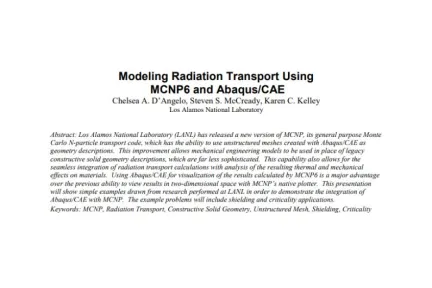
Modeling Radiation Transport Using MCNP6 and AbaqusCAE

Los Alamos National Laboratory (LANL) has released a new version of MCNP, its general purpose Monte Carlo N-particle transport code, which has the ability to use unstructured meshes created with Abaqus/CAE as geometry descriptions. This improvement allows mechanical engineering models to be used in place of legacy constructive solid geometry descriptions, which are far less sophisticated. This capability also allows for the seamless integration of radiation transport calculations with analysis of the resulting thermal and mechanical effects on materials. Using Abaqus/CAE for visualization of the results calculated by MCNP6 is a major advantage over the previous ability to view results in two-dimensional space with MCNP’s native plotter.

Customer Papers
Modeling Radiation Transport Using MCNP6 and AbaqusCAE
ABAQUS High Performance Computing Environment at Nokia

The new commodity high performance computing (HPC) hardware together with the recent ABAQUS performance enhancements, have made it possible to build high performing ABAQUS computing environment cost effectively. Since ABAQUS supports the distributed memory parallel (DMP) hardware, the usage of the cluster type of hardware has become very interesting. This paper presents the current state of ABAQUS computing environment set-up at the company.

Customer Papers

ABAQUS High Performance Computing Environment at Nokia
New tools for analyzing biomechanical problems

The ability to automatically convert any 3D image dataset into high quality meshes, is becoming the new modus operandi for biomechanical analysis. New image processing and mesh generation techniques can now aid in the analysis of biological structures, particularly where the geometry is complex. Novel techniques have been developed for the automatic generation of volumetric meshes from 3D image data including image datasets of complex structures composed of two or more distinct domains and including complex interfacial mechanics. The techniques guarantee the generation of robust, low distortion meshes from 3D data sets for use in finite element analysis (FEA), computational fluid dynamics (CFD) computer aided design (CAD) and rapid prototyping (RP).

Customer Papers

New tools for analyzing biomechanical problems
SIMULATION PROCESS METHOD DEVELOPER 3DEXPERIENCE USER ROLE

Simulation Process Method Developer helps experts deliver beautiful, customized experiences to their users without programming. With a drag-and-drop interface builder that is natively integrated with Simulation Process and Optimization and a web-based deployment framework, experts can democratize expertise faster, at lower cost and at greater scale.

Brochures

SIMULATION PROCESS METHOD DEVELOPER 3DEXPERIENCE USER ROLE
Development of 3D finite element model of umbilical systems for offshore application

Umbilical systems provide power and control (electricity, hydraulic power, chemical injection) to subsea oil and gas equipment. Electrical cables and hydraulic tubes are arranged in helical bundles and placed in successive layers depending on the design. Installations into increasingly deeper water place greater demands upon the structural components in terms of strength. 3D finite element analysis is an applicable technique in which to assess the strain and stress distribution and the interactions between components in such complex structures. The true geometry is respected and most of the simplifications of usual approaches can be relieved.

Customer Papers

Development of 3D finite element model of umbilical systems for offshore application
Analysis of Casing String Installation in Directional and Horizontal Oil Wells

The combined load condition that develops in a casing string during its installation in a directional or horizontal oil well needs to be considered in the structural integrity analysis routinely undertaken as part of the well completion design process. This paper presents a non-linear finite element analysis methodology, completed using ABAQUS 6.6, which simulates the installation of casing in directional/horizontal wells. The paper describes the development of the finite element model and demonstrates its use as an effective and reliable method for assessing casing structural integrity in the design of such well completions.

Customer Papers

Analysis of Casing String Installation in Directional and Horizontal Oil Wells
Deep and High Stress Mining – Deformation and Seismicity

Recent advances in mine scale simulation allow direct calibration of modelled displacements using measurements of surface subsidence, tunnel wall closure, shaft deformation and observed damage. The ability to correctly simulate these phenomena on a mine scale, in a single model constitutes a significant step change. Legacy geotechnical modelling packages have been unable to simulate the whole of mine deformation.

Customer Papers

Deep and High Stress Mining – Deformation and Seismicity
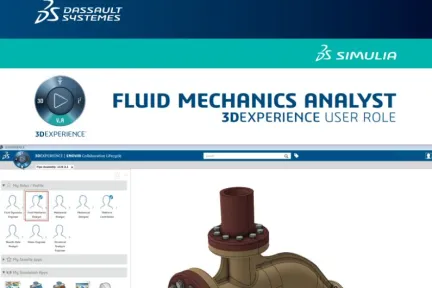
FLUID MECHANICS ANALYST 3DEXPERIENCE USER ROLE

Fluid Mechanics Analyst permits a seamless switch between applications, allowing users to be product-focused: applying the right tool at the right time in their workflow processes. This allows a much greater degree of flexibility and collaboration in the design and simulation process, where geometry changes are automatically updated and made immediately available on the same platform for the analyst to obtain updated results.

Brochures

FLUID MECHANICS ANALYST 3DEXPERIENCE USER ROLE
FEM Prediction of Dynamic Scratch Resistance of Polymer Coatings

Polymer coatings are used in pharmaceutical industry because of their wide functionality. To improve storage stability and performance of pharmaceutical products, the scratch resistance of the coatings must be improved (Gu, 2004). The scratch resistance of a common coating (150 μm HPMC) was predicted by ABAQUSTM simulation. Two models were used.

Customer Papers

FEM Prediction of Dynamic Scratch Resistance of Polymer Coatings
Transient Dynamic Analysis of a Head Surrogate Model

In this paper, an ABAQUS two dimensional transient modal dynamic finite element analysis was performed of a simplified brain model surrounded by cerebral spinal fluid and encased in PMMA. Viscoelastic material parameters of the brain tissue simulant were obtained from open literature. Low speed loading conditions were applied at different locations of this simple brain model structure. The von Mises stress and pressure contours at different times and displacement history plots are presented. The transient dynamic analyses provide insight into key areas of interest and information on the optimal placement of sensors in a more complex brain surrogate model.

Customer Papers

Transient Dynamic Analysis of a Head Surrogate Model
Development of 3D finite element model of umbilical systems for offshore application

Umbilical systems provide power and control (electricity, hydraulic power, chemical injection) to subsea oil and gas equipment. Electrical cables and hydraulic tubes are arranged in helical bundles and placed in successive layers depending on the design. Installations into increasingly deeper water place greater demands upon the structural components in terms of strength. 3D finite element analysis is an applicable technique in which to assess the strain and stress distribution and the interactions between components in such complex structures. The true geometry is respected and most of the simplifications of usual approaches can be relieved.

Customer Papers

Development of 3D finite element model of umbilical systems for offshore application
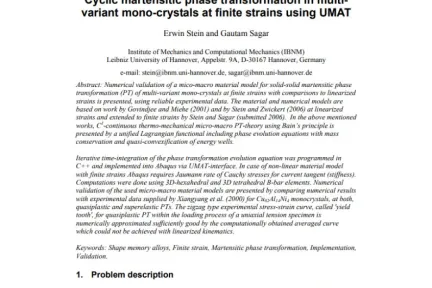
Cyclic martensitic phase transformation in multivariant mono-crystals at finite strains using UMAT

Numerical validation of a mico-macro material model for solid-solid martensitic phase transformation (PT) of multi-variant mono-crystals at finite strains with comparisons to linearized strains is presented, using reliable experimental data. The material and numerical models are based on work by Govindjee and Miehe (2001) and by Stein and Zwickert (2006) at linearized strains and extended to finite strains by Stein and Sagar (submitted 2006). In the above mentioned works, C1 -continuous thermo-mechanical micro-macro PT-theory using Bain’s principle is presented by a unified Lagrangian functional including phase evolution equations with mass conservation and quasi-convexification of energy wells.

Customer Papers

Cyclic martensitic phase transformation in multivariant mono-crystals at finite strains using UMAT
有 250 个结果

客户成功故事

有 151 个结果
有 4 个结果

SIMULIA 自学

我们提供数百个自学模块,以便您能够在方便的时间不断学习

博客

欢迎阅读 SIMULIA 博客,了解最新报道以及我们专家的最新创新。

有 701 个结果

了解 SIMULIA 可以为您带来哪些价值

与 SIMULIA 专家交流,了解我们的解决方案如何在各种规模的企业中实现无缝协作和可持续创新。

开始使用

现为学生、学术机构、专业人士和企业提供各类课程与培训。查找适合您的 SIMULIA 培训。 

获取帮助

查找有关软硬件认证、软件下载、用户文档、支持联系人和服务项目的信息