有 1511 个结果
Integrated Tool for Strain Extraction in Virtual Testing

This paper presents an automated approach to extract strains of aircraft structural models from widely used CAD and FE environments. The developed approach has been implemented as an integrated tool in widely used CATIA V5 and Abaqus environments. The integrated tool eliminates tedious procedures involved in manual extraction of strains using FEA models at appropriate strain gage locations. This integrated tool is a quick, inexpensive and effective technique for predicting structural strains. This work uses Abaqus-Python, CATIA-VB and Visual Basic environment to develop integrated tool for identifying location, direction and strains in the strain gages present in an aircraft structure.

Customer Papers
Integrated Tool for Strain Extraction in Virtual Testing
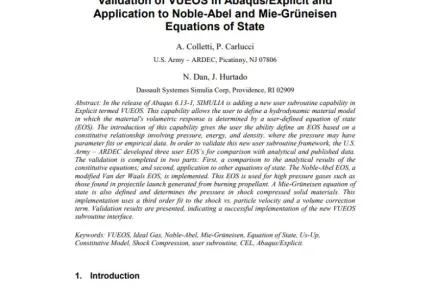
Validation of VUEOS in Abaqus/Explicit and Application to Noble-Abel and Mie-Grüneisen Equations of State

In the release of Abaqus 6.13-1, SIMULIA is adding a new user subroutine capability in Explicit termed VUEOS. This capability allows the user to define a hydrodynamic material model in which the material's volumetric response is determined by a user-defined equation of state (EOS). The introduction of this capability gives the user the ability define an EOS based on a constitutive relationship involving pressure, energy, and density, where the pressure may have parameter fits or empirical data. In order to validate this new user subroutine framework, the U.S. Army – ARDEC developed three user EOS’s for comparison with analytical and published data.

Customer Papers

Validation of VUEOS in Abaqus/Explicit and Application to Noble-Abel and Mie-Grüneisen Equations of State
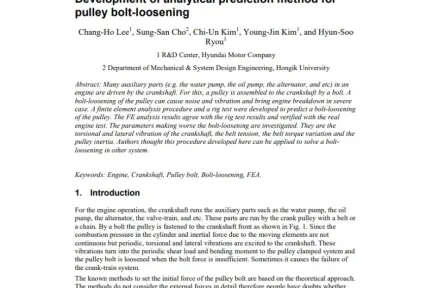
Development of analytical prediction method for pulley bolt-loosening

Many auxiliary parts (e.g. the water pump, the oil pump, the alternator, and etc) in an engine are driven by the crankshaft. For this, a pulley is assembled to the crankshaft by a bolt. A bolt-loosening of the pulley can cause noise and vibration and bring engine breakdown in severe case. A finite element analysis procedure and a rig test were developed to predict a bolt-loosening of the pulley. The FE analysis results agree with the rig test results and verified with the real engine test. The parameters making worse the bolt-loosening are investigated. They are the torsional and lateral vibration of the crankshaft, the belt tension, the belt torque variation and the pulley inertia. Authors thought this procedure developed here can be applied to solve a boltloosening in other system.

Customer Papers

Development of analytical prediction method for pulley bolt-loosening
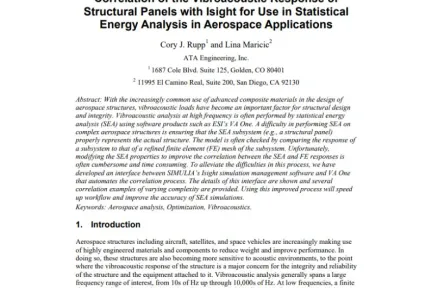
Correlation of the Vibroacoustic Response of Structural Panels with Isight for Use in Statistical Energy Analysis in Aerospace Applications

With the increasingly common use of advanced composite materials in the design of aerospace structures, vibroacoustic loads have become an important factor for structural design and integrity. Vibroacoustic analysis at high frequency is often performed by statistical energy analysis (SEA) using software products such as ESI’s VA One. A difficulty in performing SEA on complex aerospace structures is ensuring that the SEA subsystem (e.g., a structural panel) properly represents the actual structure. The model is often checked by comparing the response of a subsystem to that of a refined finite element (FE) mesh of the subsystem.

Customer Papers

Correlation of the Vibroacoustic Response of Structural Panels with Isight for Use in Statistical Energy Analysis in Aerospace Applications
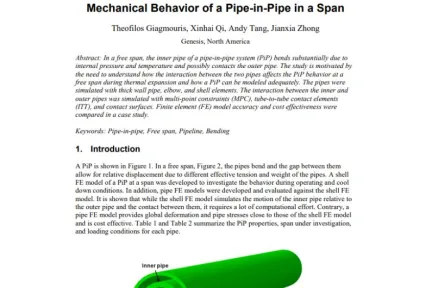
Mechanical Behavior of a Pipe-in-Pipe in a Span

In a free span, the inner pipe of a pipe-in-pipe system (PiP) bends substantially due to internal pressure and temperature and possibly contacts the outer pipe. The study is motivated by the need to understand how the interaction between the two pipes affects the PiP behavior at a free span during thermal expansion and how a PiP can be modeled adequately. The pipes were simulated with thick wall pipe, elbow, and shell elements. The interaction between the inner and outer pipes was simulated with multi-point constraints (MPC), tube-to-tube contact elements (ITT), and contact surfaces. Finite element (FE) model accuracy and cost effectiveness were compared in a case study.

Customer Papers

Mechanical Behavior of a Pipe-in-Pipe in a Span
A Methodology for Sensor Positioning Based on Eigenmode data

The importance of sensor location is crucial for a correct assessment of the dynamic response of structures and, if early structural damage detection is a concern, for increasing the POD-Probability of Detection of Structural Health Monitoring (SHM) vibration-based methods. Also, the high cost of sensoring equipment (accelerometers, strain-gauges, fibre-optic sensors, etc...) implies the use of a minimum number of sensors that must be judiciously positioned in order to extract adequate and relevant information from the monitored structure. Critical Materials S.A. is developing algorithms for sensor positioning procedures, as an auxiliary tool for the deployment of vibration-based SHM techniques, based on Eigenmode and Eigenfrequency data retrieved from natural frequency extraction analysis procedures.

Customer Papers

A Methodology for Sensor Positioning Based on Eigenmode data
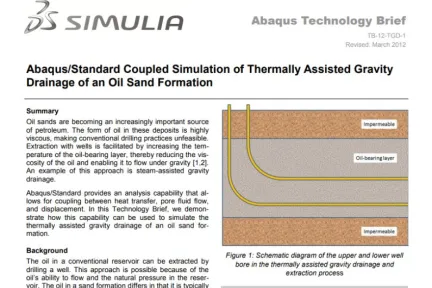
Abaqus/Standard Coupled Simulation of Thermally Assisted Gravity Drainage of an Oil Sand Formation

Oil sands are becoming an increasingly important source of petroleum. The form of oil in these deposits is highly viscous, making conventional drilling practices unfeasible. Extraction with wells is facilitated by increasing the temperature of the oil-bearing layer, thereby reducing the viscosity of the oil and enabling it to flow under gravity [1,2]. An example of this approach is steam-assisted gravity drainage. Abaqus/Standard provides an analysis capability that allows for coupling between heat transfer, pore fluid flow, and displacement. In this Technology Brief, we demonstrate how this capability can be used to simulate the thermally assisted gravity drainage of an oil sand formation.

Tech Notes

Abaqus/Standard Coupled Simulation of Thermally Assisted Gravity Drainage of an Oil Sand Formation
Combining Detailed Experiments, PolyUMod, Kornucopia, and Abaqus to Create Accurate FE Scratch Simulations

Creating a viable simulation approach capable of representing key fundamental aspects of scratch of polymers is an extremely challenging task. The simulation must include complicated material response, such as nonlinear viscoelastic/viscoplastic behavior of the polymeric material at large strains. In addition, the model must include a sufficiently detailed representation of the scratching event using frictional contact between the indenter and the sample, and the model must take into account the indenter loading history. This paper discusses how Abaqus/Explicit models using the PolyUMod advanced Parallel Network Material models were used in conjunction with detail experiments processed by Kornucopia to create scratch simulations that correlated well to several physical scratch tests.

Customer Papers

Combining Detailed Experiments, PolyUMod, Kornucopia, and Abaqus to Create Accurate FE Scratch Simulations
Numerical simulations of quasi-static and rockfall impact tests of ultra-high strength steel wire-ring nets using Abaqus/Explicit

Flexible, light-weight wire ring-net barriers are used to stop falling rocks serving as protection for villages and roadways in mountainous regions. The steel wire-ring nets are difficult to model because of their complex geometry. The rings consist of a single steel wire strand wrapped together multiple times, and are connected to one another in a chainmail fashion to form the net. Their geometry and behavior represent a challenge to finite element modeling. This paper presents quasi-static and impact explicit FE simulation results of wire-ring net tests using an approach which relies on the general contact algorithm available in the FE code Abaqus. This approach allows a better description of the physics involved in impact problems related to rock falls.

Customer Papers

Numerical simulations of quasi-static and rockfall impact tests of ultra-high strength steel wire-ring nets using Abaqus/Explicit
Design and Finite Element evaluation using Abaqus of a tri-axle suspension frame for a passenger bus.

The usage of modern suspension systems in passenger buses increases the performance of the vehicle, to include a new kind of suspension in a passenger bus requires a careful examination of the packaging needs, load transfer and structure characteristics which leads to a safe design to be manufactured. The main objective of this paper is to provide a design proposal for a passenger bus frame to incorporate a commercial tri-axle pneumatic suspension, a system level CAE evaluation is presented to validate and optimize the proposed design.

Customer Papers

Design and Finite Element evaluation using Abaqus of a tri-axle suspension frame for a passenger bus.
The latest Application of Abaqus for the Expansion of Simulation Ability in TMC Chassis CAE

TMC Chassis CAE has used Abaqus successfully for many years. This paper presents three recent examples of Abaqus analyses performed by TMC Chassis CAE. 1. Shape Optimization of Suspension Arm comprehending material and geometric nonlinearities. 2. A new method to identify material coefficients of static and dynamic characteristics of rubber using Abaqus. (Reproduce stress relaxing behavior, strain rate dependency, frequency dependency and amplitude dependency using one set of material coefficients) 3. FE Analysis Method to simulate the Static Stiffness Characteristic of Air Suspension Stiffness.

Customer Papers

The latest Application of Abaqus for the Expansion of Simulation Ability in TMC Chassis CAE
有 250 个结果

客户成功故事

有 151 个结果
有 4 个结果

SIMULIA 自学

我们提供数百个自学模块,以便您能够在方便的时间不断学习

博客

欢迎阅读 SIMULIA 博客,了解最新报道以及我们专家的最新创新。

有 701 个结果

了解 SIMULIA 可以为您带来哪些价值

与 SIMULIA 专家交流,了解我们的解决方案如何在各种规模的企业中实现无缝协作和可持续创新。

开始使用

现为学生、学术机构、专业人士和企业提供各类课程与培训。查找适合您的 SIMULIA 培训。 

获取帮助

查找有关软硬件认证、软件下载、用户文档、支持联系人和服务项目的信息