有 1506 个结果
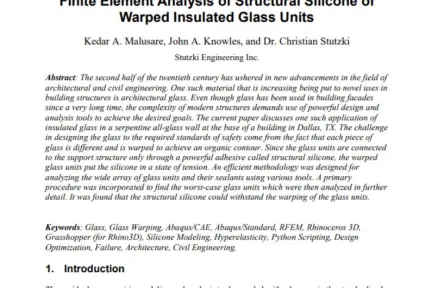
Finite Element Analysis of Structural Silicone of Warped Insulated Glass Units

The second half of the twentieth century has ushered in new advancements in the field of architectural and civil engineering. One such material that is increasing being put to novel uses in building structures is architectural glass. Even though glass has been used in building facades since a very long time, the complexity of modern structures demands use of powerful design and analysis tools to achieve the desired goals. The current paper discusses one such application of insulated glass in a serpentine all-glass wall at the base of a building in Dallas, TX. The challenge in designing the glass to the required standards of safety come from the fact that each piece of glass is different and is warped to achieve an organic contour.

Customer Papers
Finite Element Analysis of Structural Silicone of Warped Insulated Glass Units
Finite Element Analysis of the Asiana Airlines Flight 214 Crash

This report synthesizes the results of a Finite Element Analysis (FEA) modeling the Asiana Airlines Flight 214 crash, at San Francisco International Airport (SFO). The goal was to reproduce the movement of the aircraft and to validate how truthfully the method of FEA could represent the real crash dynamically. At first, only rigid elements were used to represent the model with the purpose of using the maximum number of rigid elements in order to save processing time. Secondly, a combination of rigid and deformable elements were used, in order to find the weak spots during impact. Thirdly, cohesive elements were introduced at the weak spots, located at the turbine, tail and wheels, in order to model part separation during impact.

Customer Papers

Finite Element Analysis of the Asiana Airlines Flight 214 Crash
Implementation CAD and EF Composite Parts for Aerospace Industry

The objective of this study was to investigate the use of composite as an alternative in the aircraft wing and thus help to reduce the weight of the plane. In general, the composite material is used in the aviation industry to reduce the overall weight as much as possible in order to improve aircraft maneuver performance, decrease aircraft manufacturing and operational costs while keeping the stress levels under a certain value (static or fatigue allowable). The wing structure is design in CATIA V5, and the skin of wing is applied with CATIA composite design. Then the model is exported to Abaqus to calculate, simulate and optimize.

Customer Papers

Implementation CAD and EF Composite Parts for Aerospace Industry
Isight Automatic Process in the Virtual Drop Test Simulation for Innovative Packaging Design

This paper will illustrate a SIMULIA SEE process involving Abaqus/Explicit in order to perform an automatic complex sequence of virtual drop test on the packaging of gas hobs. The virtual drop process is intended to be used by the designers without specific knowledge of the explicit dynamic simulations and it involves automatic mesh of the packaging CAD geometries. The Isight virtual drop process enables the design of innovative packaging, it supports the introduction of new materials in the packaging technologies reducing the time to market within the usual try&fix of the physical testing. The process has been designed flexible enough to address the meaningful library of the gas hob product line shapes and material. Some numerical versus physical test validation will be shown.

Customer Papers

Isight Automatic Process in the Virtual Drop Test Simulation for Innovative Packaging Design
Solution from Lattice Sizing Optimization to Additive Manufacturing

Lattice structures bear many desirable characteristics from design standpoints, such as stable designs with large network of structural members, desirable weight characteristics, custom mechanical behavior and porous nature that could facilitate bone and tissue growth on medical implants. To efficiently optimize the structure of lattices, we can use Tosca structure to vary the lattices thickness to reach certain design objectives. However, the radii in Tosca are associated with beams which are not optimal to have a smooth stress transition on connected nodes.

Customer Papers

Solution from Lattice Sizing Optimization to Additive Manufacturing
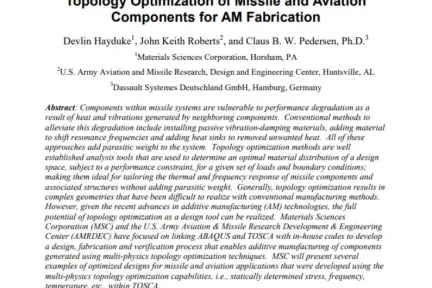
Topology Optimization of Missile and Aviation Components for AM Fabrication

Components within missile systems are vulnerable to performance degradation as a result of heat and vibrations generated by neighboring components. Conventional methods to alleviate this degradation include installing passive vibration-damping materials, adding material to shift resonance frequencies and adding heat sinks to removed unwanted heat. All of these approaches add parasitic weight to the system. Topology optimization methods are well established analysis tools that are used to determine an optimal material distribution of a design space, subject to a performance constraint, for a given set of loads and boundary conditions; making them ideal for tailoring the thermal and frequency response of missile components and associated structures without adding parasitic weight.

Customer Papers

Topology Optimization of Missile and Aviation Components for AM Fabrication
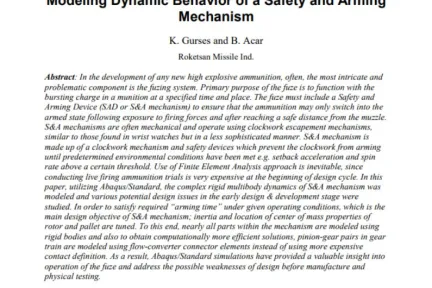
Modeling Dynamic Behavior of a Safety and Arming Mechanism

In the development of any new high explosive ammunition, often, the most intricate and problematic component is the fuzing system. Primary purpose of the fuze is to function with the bursting charge in a munition at a specified time and place. The fuze must include a Safety and Arming Device (SAD or S&A mechanism) to ensure that the ammunition may only switch into the armed state following exposure to firing forces and after reaching a safe distance from the muzzle. S&A mechanisms are often mechanical and operate using clockwork escapement mechanisms, similar to those found in wrist watches but in a less sophisticated manner.

Customer Papers

Modeling Dynamic Behavior of a Safety and Arming Mechanism
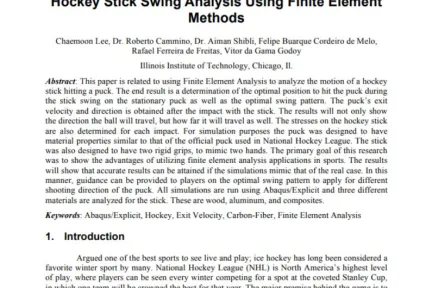
Hockey Stick Swing Analysis Using Finite Element Methods

This paper is related to using Finite Element Analysis to analyze the motion of a hockey stick hitting a puck. The end result is a determination of the optimal position to hit the puck during the stick swing on the stationary puck as well as the optimal swing pattern. The puck’s exit velocity and direction is obtained after the impact with the stick. The results will not only show the direction the ball will travel, but how far it will travel as well. The stresses on the hockey stick are also determined for each impact. For simulation purposes the puck was designed to have material properties similar to that of the official puck used in National Hockey League. The stick was also designed to have two rigid grips, to mimic two hands.

Customer Papers
Hockey Stick Swing Analysis Using Finite Element Methods
有 246 个结果

客户成功故事

有 150 个结果
有 6 个结果

SIMULIA 自学

我们提供数百个自学模块,以便您能够在方便的时间不断学习

博客

欢迎阅读 SIMULIA 博客,了解最新报道以及我们专家的最新创新。

有 694 个结果

了解 SIMULIA 可以为您做些什么

与 SIMULIA 专家交谈,了解我们的解决方案如何在各种规模的企业中实现无缝协作和可持续创新。

启动开发

课程面向学生、学术界、专业人士和企业开放。查找适合您的 SIMULIA 培训。

获得帮助

查找有关软硬件认证、软件下载、用户文档、支持联系人和服务项目的信息