有 1506 个结果
Validation of XFEM-based Simulation Capabilities for Fluid-driven Fractures in Permeable Media

The eXtended Finite Elements Method (XFEM) refers to a simulation technique where a fracture is modeled via splitting of special enriched finite elements during the course of a simulation. XFEM, unlike Cohesive Zone Method (CZM), allows simulating nucleation and growth of a fracture along an arbitrary, solution-dependent path without re-meshing the material in the bulk. In this work, we have used 2D XFEM coupled with pore-pressure degrees of freedom to simulate a variety of boundary value problems related to fluid-driven (hydraulic) fractures in a permeable medium. Specifically, through these simulations, we investigate the influence of critical geomechanical and operational parameters on hydraulic fracturing.

Customer Papers
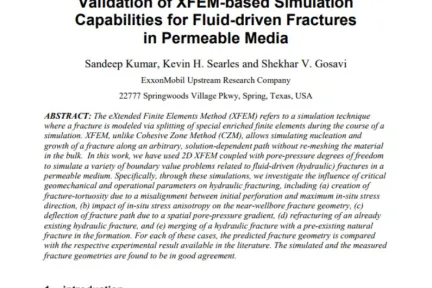
Validation of XFEM-based Simulation Capabilities for Fluid-driven Fractures in Permeable Media
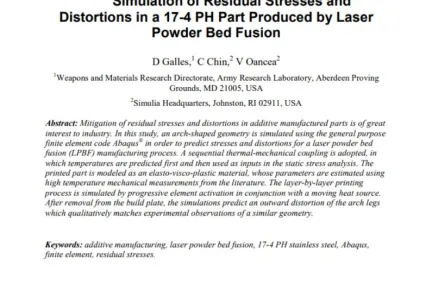
Simulation of Residual Stresses and Distortions in a 17-4 PH Part Produced by Laser Powder Bed Fusion

Mitigation of residual stresses and distortions in additive manufactured parts is of great interest to industry. In this study, an arch-shaped geometry is simulated using the general purpose finite element code Abaqus in order to predict stresses and distortions for a laser powder bed fusion (LPBF) manufacturing process. A sequential thermal-mechanical coupling is adopted, in which temperatures are predicted first and then used as inputs in the static stress analysis. The printed part is modeled as an elasto-visco-plastic material, whose parameters are estimated using high temperature mechanical measurements from the literature. The layer-by-layer printing process is simulated by progressive element activation in conjunction with a moving heat source. After removal from the build plate, the simulations predict an outward distortion of the arch legs which qualitatively matches experimental observations of a similar geometry.

Customer Papers
Simulation of Residual Stresses and Distortions in a 17-4 PH Part Produced by Laser Powder Bed Fusion
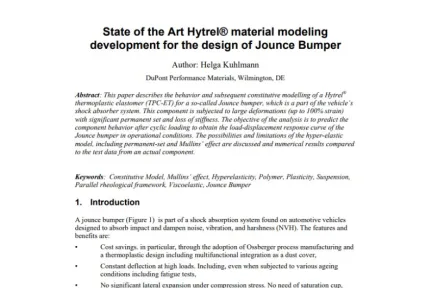
State of the Art Hytrel material modeling development for the design of Jounce Bumper

This paper describes the behavior and subsequent constitutive modelling of a Hytrel thermoplastic elastomer (TPC-ET) for a so-called Jounce bumper, which is a part of the vehicle’s shock absorber system. This component is subjected to large deformations (up to 100% strain) with significant permanent set and loss of stiffness. The objective of the analysis is to predict the component behavior after cyclic loading to obtain the load-displacement response curve of the Jounce bumper in operational conditions. The possibilities and limitations of the hyper-elastic model, including permanent-set and Mullins’ effect are discussed and numerical results compared to the test data from an actual component.

Customer Papers

State of the Art Hytrel material modeling development for the design of Jounce Bumper
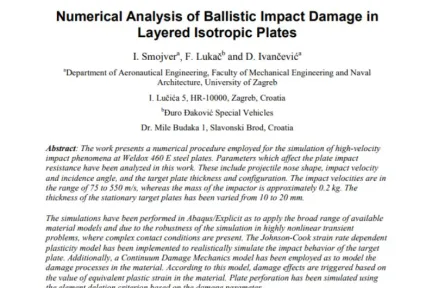
Numerical Analysis of Ballistic Impact Damage in Layered Isotropic Plates

The work presents a numerical procedure employed for the simulation of high-velocity impact phenomena at Weldox 460 E steel plates. Parameters which affect the plate impact resistance have been analyzed in this work. These include projectile nose shape, impact velocity and incidence angle, and the target plate thickness and configuration. The impact velocities are in the range of 75 to 550 m/s, whereas the mass of the impactor is approximately 0.2 kg. The thickness of the stationary target plates has been varied from 10 to 20 mm.

Customer Papers

Numerical Analysis of Ballistic Impact Damage in Layered Isotropic Plates
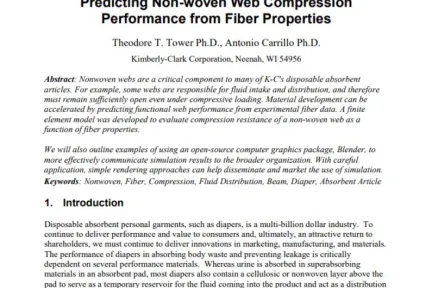
Predicting Non-woven Web Compression Performance from Fiber Properties

Nonwoven webs are a critical component to many of K-C's disposable absorbent articles. For example, some webs are responsible for fluid intake and distribution, and therefore must remain sufficiently open even under compressive loading. Material development can be accelerated by predicting functional web performance from experimental fiber data. A finite element model was developed to evaluate compression resistance of a non-woven web as a function of fiber properties. We will also outline examples of using an open-source computer graphics package, Blender, to more effectively communicate simulation results to the broader organization. With careful application, simple rendering approaches can help disseminate and market the use of simulation.

Customer Papers

Predicting Non-woven Web Compression Performance from Fiber Properties
The Role of Finite Element Analysis in the Development of a 60mm Sensor Mortar Projectile

Reconnaissance projectiles are being developed by the U.S. military with increasing frequency to facilitate a variety of emerging needs. One of those needs includes long range deployment of these projectiles, while maintaining the survivability of electronic sensors and other components. To help fill this need, a completely new remotely deployable 60mm sensor mortar projectile was designed and developed by ARDEC. Through the use of finite element analysis (FEA), the design cycle was drastically reduced to the point where first article prototypes successfully survived live fire testing at Yuma Proving Ground. This paper will give an overview of the design, and the key role that FEA played in developing a successful design at a reduced development cost and short project schedule.

Customer Papers

The Role of Finite Element Analysis in the Development of a 60mm Sensor Mortar Projectile
A Revolutionary Framework to Enable High-Fidelity Multiscale Modeling

The present work provides a new way to carry out multiscale modeling. This method is based on the Mechanics of Structure Genome, a recently developed theory, which can predict effective properties from a Structure Genome, defined as the smallest mathematical building block of the structure, and local strains and stresses from global response at the structure level. A custom toolset is developed to connect the multiscale modeling code to Abaqus/CAE, utilizing its pre- and post-processing capabilities of creating model, meshing and visualization. Three examples, including beam, plate and 3D solid structures, are presented.

Customer Papers

A Revolutionary Framework to Enable High-Fidelity Multiscale Modeling
FEA Modeling for Thermal Well Casing Connection Evaluation Programs

This paper starts with a review of the evaluation program requirements for thermal well casing connections, and presents Finite Element Analysis (FEA) modeling considerations in support of ISO/PAS 12835:2013 thermal connection qualification programs. The paper covers a few key topics for such FEA modeling, including the structural and material modeling, determination of biased test population, impact of material properties, impact of make-up torque, and the determination of a stiff-length factor for the testing program. The paper also presents the use of FEA modeling to guide the design evaluation and optimization of thermal well casing connections based on an assessment of predicted demand (loading) and capacity (response) relative to performance criteria for sealability.

Customer Papers

FEA Modeling for Thermal Well Casing Connection Evaluation Programs
Bird Strike and Novel Design of Fan Blades

The intent of this project was to find an appropriate bird substitute model and evaluate how engine blade properties can be tweaked to better handle bird strikes. Several bird geometries and material models were evaluated using the Lagrangian and smoothed particle hydrodynamic (SPH) modeling approaches. The SPH method was found to be more efficient for modeling a bird. All simulations were performed using Abaqus 2016. The material model for the calibrated bird model was best represented using a tabulated equation of state with 10% porous gelatin. The results for the hemispherical-ended cylinder with a length-to-diameter ratio of 1.6 correlated well with experimental results.

Customer Papers

Bird Strike and Novel Design of Fan Blades
Simulation of Semi-Crystalline Composites in the Extrusion Deposition Additive Manufacturing Process

A UMATHT user subroutine was developed in Abaqus to combine a non-isothermal dual crystallization kinetics model with a statistical melting model in order to describe the simultaneous solidification/re-melting behavior of 3D printed parts during the Extrusion Deposition (ED) process. This subroutine is described in detail. Results indicate that crystallization behavior is significant and strongly dependent on the utilized polymer. As an outlook, the interaction with a second UMAT user subroutine that will be employed to predict residual stresses and deformations is explained.

Customer Papers

Simulation of Semi-Crystalline Composites in the Extrusion Deposition Additive Manufacturing Process
Solution from Lattice Sizing Optimization to Additive Manufacturing

Lattice structures bear many desirable characteristics from design standpoints, such as stable designs with large network of structural members, desirable weight characteristics, custom mechanical behavior and porous nature that could facilitate bone and tissue growth on medical implants. To efficiently optimize the structure of lattices, we can use Tosca structure to vary the lattices thickness to reach certain design objectives. However, the radii in Tosca are associated with beams which are not optimal to have a smooth stress transition on connected nodes.

Customer Papers

Solution from Lattice Sizing Optimization to Additive Manufacturing
Tackling the Challenges of Deployable Thin-Film Space Structures with Abaqus

In order to support challenging requirements for space science missions, NASA and its industry partners are turning to deployable thin-film structures. A good example is the sunshield for the James Webb Space Telescope (JWST). The sunshield provides the necessary screening from external light and heat sources required to ensure proper functioning of the telescope. It is comprised of multiple layers of very thin (0.001-0.002 inch) Kapton film and has a deployed planform area roughly equivalent to a tennis court. In order to fit within the launch vehicle payload envelope of course this large-area structure must be stowed in a folded configuration then deployed to full plan-form once on orbit.

Customer Papers

Tackling the Challenges of Deployable Thin-Film Space Structures with Abaqus
有 246 个结果

客户成功故事

有 150 个结果
有 6 个结果

SIMULIA 自学

我们提供数百个自学模块,以便您能够在方便的时间不断学习

博客

欢迎阅读 SIMULIA 博客,了解最新报道以及我们专家的最新创新。

有 694 个结果
People, profit and planet

definition of sustainability: meet present needs without compromising future needs -UN World Commission...

Article

People, profit and planet

了解 SIMULIA 可以为您做些什么

与 SIMULIA 专家交谈,了解我们的解决方案如何在各种规模的企业中实现无缝协作和可持续创新。

启动开发

课程面向学生、学术界、专业人士和企业开放。查找适合您的 SIMULIA 培训。

获得帮助

查找有关软硬件认证、软件下载、用户文档、支持联系人和服务项目的信息