有 1506 个结果
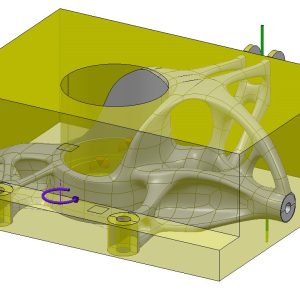
Process Modeling and Validation for Metal Big Area Additive Manufacturing

Metal Big Area Additive Manufacturing (mBAAM) is a new additive manufacturing (AM) technology based on the metal arc welding. A continuously fed metal wire is melted by an electric arc that forms between the wire and the substrate, and deposited in the form of a bead of molten metal along the predetermined path. Objects are manufactured one layer at a time starting from the base plate. The final properties of the manufactured object are dependent on its geometry and the metal deposition path, in addition to depending on the basic welding process parameters.

Customer Papers
Process Modeling and Validation for Metal Big Area Additive Manufacturing
A Study of Durability Improvement of Balance Shaft Module

The balance shaft clamping bolts in the recent engines tend to have the loosening problem by increased engine power. In this paper, a CAE procedure is introduced to predict loosening angle of bolts, wear, durability of the drive shaft. The procedure is performed through two analysis steps. In the first step, the multi-body dynamic simulation is used to obtain more accurate loading boundary conditions applied to the finite element model for the following step. Next, the finite element analysis is performed to predict the durability of the drive shaft through the calculation of the safety factor. Through this CAE procedure, design guidelines leading up to good BSM reliability has been obtained as a result of this activity.

Customer Papers

A Study of Durability Improvement of Balance Shaft Module
Influence of Surrounding Powder Bed and Build Platform on Thermal Cooling Characteristics in 3D Printed Parts via Selective Laser Melting

Selective laser melting (SLM) leads to high cooling rates and correspondingly high residual stresses, which can distort the printed part on the printing platform and even lead to part cracking and consequent print failure. The temperature profile and cooling rates during the SLM process are influenced by the surrounding powder bed and building platform, which can act as a significant heat sink depending on part design and platform arrangement. The new functionality of the Abaqus additive manufacturing simulation framework allows for separate modelling of solid (laser exposed) material, powder bed (not exposed) and platform (not exposed), as well as evolving heat transfer surfaces for the AM part. In this paper we highlight the influence of the surrounding powder bed and platform on the thermal characteristics of the printed part.

Customer Papers

Influence of Surrounding Powder Bed and Build Platform on Thermal Cooling Characteristics in 3D Printed Parts via Selective Laser Melting
BIOMECHANICS OF CRANIOFACIAL FRACTURES: A SIMULATION STUDY

In this study a 3D finite element model of the skull is created using CT scan data. All complexities of the skull geometry are simulated using ABAQUS. This numerical model is then subjected to frontal, lateral. vertical, occlusal and angulated impact conditions. Impact analysis is done and weak areas susceptible to fracture and hence failure are identified. Further fracture fixations of various designs and materials used in craniofacial fracture fixations are placed in different fracture situations in the virtual model and subjected to different impact conditions. This will enable the study of fracture and stability of the fracture of the skull under cranio facial fracture conditions.

Customer Papers
BIOMECHANICS OF CRANIOFACIAL FRACTURES: A SIMULATION STUDY
Development of the Subroutine Library 'UMMDp' for Anisotropic Yield Functions

The working group of JANCAE was launched from the idea of providing a multidisciplinary forum for steel researchers, design engineers, and software engineers through the medium of advanced finite element codes. The subroutine library is called the Unified Material Model Driver for Plasticity (UMMDp). This paper introduces the development of UMMDp and discusses a simulation of a drawing and redrawing process using some yield functions for its applications with Abaqus.

Customer Papers

Development of the Subroutine Library 'UMMDp' for Anisotropic Yield Functions
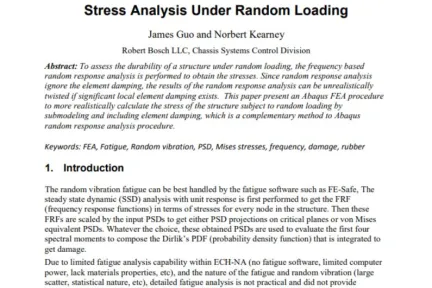
Stress Analysis Under Random Loading

To assess the durability of a structure under random loading, the frequency based random response analysis is performed to obtain the stresses. Since random response analysis ignore the element damping, the results of the random response analysis can be unrealistically twisted if significant local element damping exists. This paper present an Abaqus FEA procedure to more realistically calculate the stress of the structure subject to random loading by submodeling and including element damping, which is a complementary method to Abaqus random response analysis procedure.

Customer Papers
Stress Analysis Under Random Loading
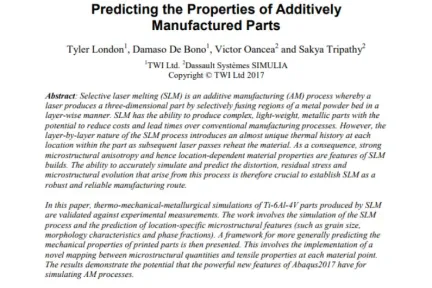
Predicting the Properties of Additively Manufactured Parts

In this paper, thermo-mechanical-metallurgical simulations of Ti-6Al-4V parts produced by SLM are validated against experimental measurements. The work involves the simulation of the SLM process and the prediction of location-specific microstructural features (such as grain size, morphology characteristics and phase fractions). A framework for more generally predicting the mechanical properties of printed parts is then presented. This involves the implementation of a novel mapping between microstructural quantities and tensile properties at each material point. The results demonstrate the potential that the powerful new features of Abaqus2017 have for simulating AM processes.

Customer Papers

Predicting the Properties of Additively Manufactured Parts
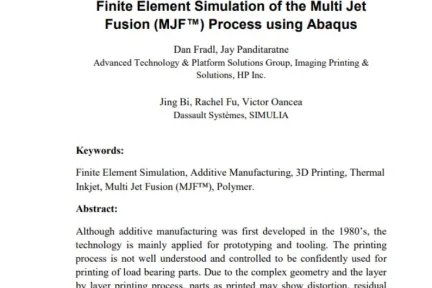
Finite Element Simulation of the Multi Jet Fusion Process using Abaqus

Although additive manufacturing was first developed in the 1980’s, the technology is mainly applied for prototyping and tooling. The printing process is not well understood and controlled to be confidently used for printing of load bearing parts. Due to the complex geometry and the layer by layer printing process, parts as printed may show distortion, residual stress, delamination and failure that render the part unusable at the moment that it comes out of the machine. Finite element simulations of additive manufacturing can be very effective in understanding the cause of these defects and predicting the in-service performance of the printed parts. However, most finite element codes are not designed for simulating additive manufacturing processes.

Customer Papers

Finite Element Simulation of the Multi Jet Fusion Process using Abaqus
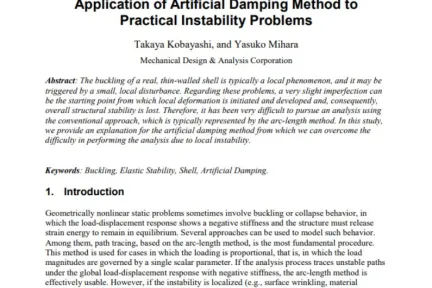
Application of Artificial Damping Method to Practical Instability Problems

The buckling of a real, thin-walled shell is typically a local phenomenon, and it may be triggered by a small, local disturbance. Regarding these problems, a very slight imperfection can be the starting point from which local deformation is initiated and developed and, consequently, overall structural stability is lost. Therefore, it has been very difficult to pursue an analysis using the conventional approach, which is typically represented by the arc-length method. In this study, we provide an explanation for the artificial damping method from which we can overcome the difficulty in performing the analysis due to local instability.

Customer Papers

Application of Artificial Damping Method to Practical Instability Problems
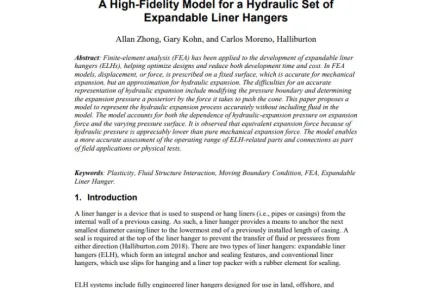
A High-Fidelity Model for a Hydraulic Set of Expandable Liner Hangers

Finite-element analysis (FEA) has been applied to the development of expandable liner hangers (ELHs), helping optimize designs and reduce both development time and cost. In FEA models, displacement, or force, is prescribed on a fixed surface, which is accurate for mechanical expansion, but an approximation for hydraulic expansion. The difficulties for an accurate representation of hydraulic expansion include modifying the pressure boundary and determining the expansion pressure a posteriori by the force it takes to push the cone. This paper proposes a model to represent the hydraulic expansion process accurately without including fluid in the model. The model accounts for both the dependence of hydraulic-expansion pressure on expansion force and the varying pressure surface.

Customer Papers

A High-Fidelity Model for a Hydraulic Set of Expandable Liner Hangers
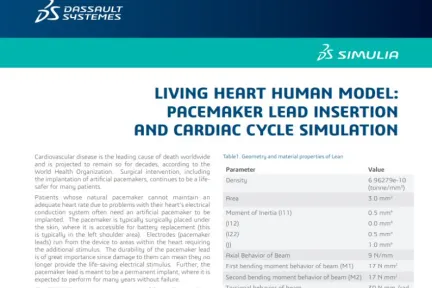
LIVING HEART HUMAN MODEL: PACEMAKER LEAD INSERTION AND CARDIAC CYCLE SIMULATION

The SIMULIA Living Heart Human Model provides a unique testing environment where a pacemaker lead can be virtually inserted and mechanically deformed during the cardiac cycle. Once the mechanical deformation results are obtained, the long-term durability of the implant can be assessed. The virtual nature of the test provides a physiologically accurate methodology to test new and existing devices without exposing patients to un-necessary risk.

Solution Briefs

LIVING HEART HUMAN MODEL: PACEMAKER LEAD INSERTION AND CARDIAC CYCLE SIMULATION
有 246 个结果

客户成功故事

有 150 个结果
有 6 个结果

SIMULIA 自学

我们提供数百个自学模块,以便您能够在方便的时间不断学习

博客

欢迎阅读 SIMULIA 博客,了解最新报道以及我们专家的最新创新。

有 694 个结果

了解 SIMULIA 可以为您做些什么

与 SIMULIA 专家交谈,了解我们的解决方案如何在各种规模的企业中实现无缝协作和可持续创新。

启动开发

课程面向学生、学术界、专业人士和企业开放。查找适合您的 SIMULIA 培训。

获得帮助

查找有关软硬件认证、软件下载、用户文档、支持联系人和服务项目的信息