有 1506 个结果
Leak-before-break Leakage and Heat Transfer Simulation Of Aircraft Bleed Air System Ducts

For the safe design of aircraft bleed air system ducts and assessment of ducts with minor cracks found in the quality inspection, it is required to understand and predict the crack behavior and leak-before-break air leakage. A leak before break is desired so a leak can be detected and a repair made before a structural failure. Measuring the leaked air temperature is a widely used technique to detect the leakage flow. The ground maintenance team uses thermal imagining and temperature probe, while the on-board system uses temperature sensor wires to detect the hot air leakage. In this study, the Extended Finite Element Method (XFEM) is used to evaluate if an initial crack will grow into unstable failure.

Customer Papers
Leak-before-break Leakage and Heat Transfer Simulation Of Aircraft Bleed Air System Ducts
Design of a Prototype of an Olive Oil Extraction Machine for Home Use

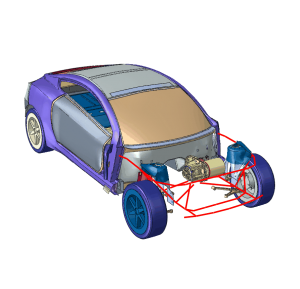
The mechanical methods used to extract virgin oils from olives are of two types: the discontinuous system and the continuous system. In any case, the system defined as "continuous" is composed of several steps, not all of which are completely continuous, due to the presence of the batching device. The aim of this work was to design a prototype of a home olive oil extraction machine with a heating device to be placed immediately before the filtration step to facilitate solid / liquid separation. This strategy represents the first step towards the transformation of the step of mixing a discontinuous operation into a continuous real process. The design, analysis and simulation were done using Catia and Abaqus.

Customer Papers
Design of a Prototype of an Olive Oil Extraction Machine for Home Use
Experimental and Numerical Study for Analyzing the Incompatibility between Materials used in the Restoration of Heritage Building in Morocco

This research work study the modeling the mortar-block assembly for analyzing the potential occurrence of mechanical problems at interfaces as the consequence of an eventual incompatibility. The study considers a heritage building located in Morocco. In this recent study the authors test the effect of non linear behavior of materials and interface. The goal of the modeling works is to compare the repartition of internal solicitations between the original situation and the restored one in order to quantify the risk, for materials that should be conserved, associated with the “stress shielding” phenomenon and to justify the particular attention to be paid for the choice of a specific mortar for interventions to be carried out on the concerned building. One concrete numerical example using Abaqus code will be treated and showed on this paper.

Customer Papers

Experimental and Numerical Study for Analyzing the Incompatibility between Materials used in the Restoration of Heritage Building in Morocco
Failure is Good: Perforation Patterns and Stretchy Paper Towels

Engineering analyses are often targeted to help design parts and systems that provide a margin of safety against failure. More sophisticated models that include plasticity, damage, and failure help the analyst assess the part or system’s ability to continue to serve its intended function safely in a partially-damaged state. However, at Kimberly-Clark we like failure—specifically when consumers are tearing a paper towel off the roll (known as “dispensing” in the parlance of consumer packaged goods). By utilizing Abaqus, the essential roles the mechanical behavior (including failure) of the towel and the perforation pattern have in dispensing has become clearer.

Customer Papers

Failure is Good: Perforation Patterns and Stretchy Paper Towels
Using Abaqus to Model Permanent Set in Rubber: Assessment and Sensitivity Study

Permanent set in applications using rubber is a common problem. Modeling of this phenomenon is available in the literature; however, the permanent set material models are not widely used because of their limitations and lack of validation. Recently, one permanent set model was implemented using Abaqus. To validate this model in actual applications, it was assessed through a series of button compression set tests at three temperatures. The sensitivity of the permanent set model to multiple hyperelastic models was studied. Some minor issues were observed in the application of the model with regard to field temperature, and a workaround solution was identified. The model was otherwise verified and validated through compression set test results.

Customer Papers

Using Abaqus to Model Permanent Set in Rubber: Assessment and Sensitivity Study
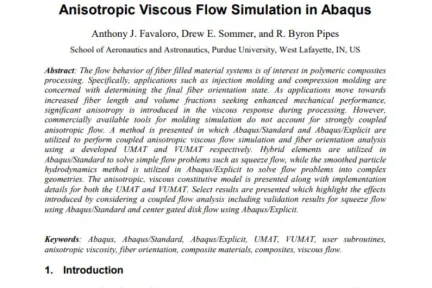
Anisotropic Viscous Flow Simulation in Abaqus

The flow behavior of fiber filled material systems is of interest in polymeric composites processing. Specifically, applications such as injection molding and compression molding are concerned with determining the final fiber orientation state. As applications move towards increased fiber length and volume fractions seeking enhanced mechanical performance, significant anisotropy is introduced in the viscous response during processing. However, commercially available tools for molding simulation do not account for strongly coupled anisotropic flow. A method is presented in which Abaqus/Standard and Abaqus/Explicit are utilized to perform coupled anisotropic viscous flow simulation and fiber orientation analysis using a developed UMAT and VUMAT respectively.

Customer Papers

Anisotropic Viscous Flow Simulation in Abaqus
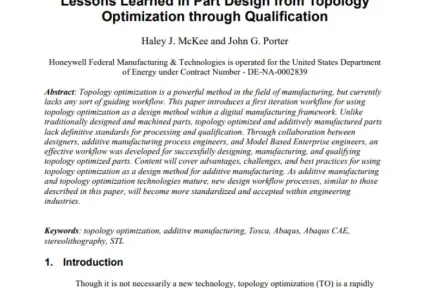
Lessons Learned in Part Design from Topology Optimization through Qualification

Topology optimization is a powerful method in the field of manufacturing, but currently lacks any sort of guiding workflow. This paper introduces a first iteration workflow for using topology optimization as a design method within a digital manufacturing framework. Unlike traditionally designed and machined parts, topology optimized and additively manufactured parts lack definitive standards for processing and qualification. Content will cover advantages, challenges, and best practices for using topology optimization as a design method for additive manufacturing. As additive manufacturing and topology optimization technologies mature, new design workflow processes, similar to those described in this paper, will become more standardized and accepted within engineering industries.

Customer Papers

Lessons Learned in Part Design from Topology Optimization through Qualification
Improved Thermal Stress Prediction in Quenched Cylindrical Bodies through a Dynamic Convection Coefficient Library

The transient temperature distribution of a quenched solid is driven by the convection coefficient at the wetted interface and the temperature difference between the component and quenching fluid. During finite element analysis, accurate applications of the convection coefficient is especially difficult due to the temporal evolution of the coefficient during the quenching process. For example, excursions through multiple regimes such as nucleate boiling followed by turbulent and/or laminar thermal boundary layers are common. During simulation efforts, a constant-valued coefficient is often used in lieu of the dynamic coefficient that accurately represents the convective boundary.

Customer Papers

Improved Thermal Stress Prediction in Quenched Cylindrical Bodies through a Dynamic Convection Coefficient Library
Improving Consumer Experience with Squeezable Containers

Packaging trends indicate that the consumer is demanding not only a visually appealing package but also one that has a functional benefit after purchase. Challenges to that outcome include adequate top load and dent resistance at the lightest possible weight. Products like ketchup, mayonnaise, salad dressing, dish and hand soap are a few types that need to meet these performance characteristics. This study examined existing commercial packages and analyzed the design features that can be modified to improve container squeezability. These geometric features involve structural components like ribs in the panel area and also the vertical and horizontal profile of the container design.

Customer Papers

Improving Consumer Experience with Squeezable Containers
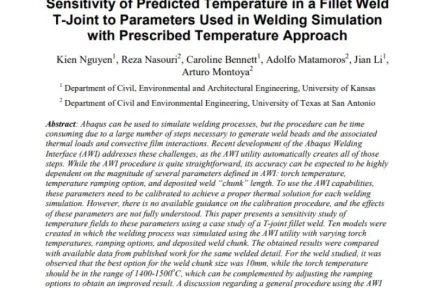
Sensitivity of Predicted Temperature in a Fillet Weld T-Joint to Parameters Used in Welding Simulation with Prescribed Temperature Approach

Abaqus can be used to simulate welding processes, but the procedure can be time consuming due to a large number of steps necessary to generate weld beads and the associated thermal loads and convective film interactions. Recent development of the Abaqus Welding Interface (AWI) addresses these challenges, as the AWI utility automatically creates all of those steps. While the AWI procedure is quite straightforward, its accuracy can be expected to be highly dependent on the magnitude of several parameters defined in AWI: torch temperature, temperature ramping option, and deposited weld “chunk” length. This paper presents a sensitivity study of temperature fields to these parameters using a case study of a T-joint fillet weld.

Customer Papers

Sensitivity of Predicted Temperature in a Fillet Weld T-Joint to Parameters Used in Welding Simulation with Prescribed Temperature Approach
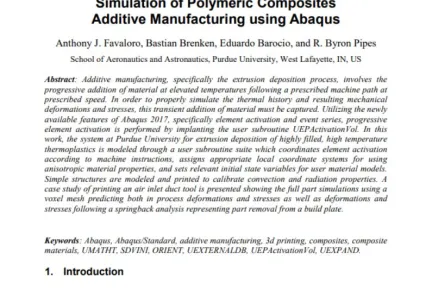
Simulation of Polymeric Composites Additive Manufacturing using Abaqus

Additive manufacturing, specifically the extrusion deposition process, involves the progressive addition of material at elevated temperatures following a prescribed machine path at prescribed speed. Utilizing the newly available features of Abaqus 2017, specifically element activation and event series, progressive element activation is performed by implanting the user subroutine UEPActivationVol. In this work, the system at Purdue University for extrusion deposition of highly filled, high temperature thermoplastics is modeled through a user subroutine suite which coordinates element activation according to machine instructions, assigns appropriate local coordinate systems for using anisotropic material properties, and sets relevant initial state variables for user material models.

Customer Papers

Simulation of Polymeric Composites Additive Manufacturing using Abaqus
A Computational Framework for the Analysis of an Aero-Thermochemical-Elastic Eroding Nozzle

A multiphysics simulation capability has been developed that incorporates mutual interactions between aerodynamics, structural response from aerothermal loading, ablation/pyrolysis, heating, and surface-to-surface radiation to perform high-fidelity, fully coupled aerothermoelastic ablation simulations, which to date had been unattainable. The multiphysics framework couples CHAR (a 3D implicit charring ablator solver), Loci/CHEM (a computational fluid dynamics solver for high-speed chemically reacting flows), and Abaqus/Standard to create a fully coupled aerothermoelastic charring ablative solver.

Customer Papers

A Computational Framework for the Analysis of an Aero-Thermochemical-Elastic Eroding Nozzle
有 246 个结果

客户成功故事

有 150 个结果
有 6 个结果

SIMULIA 自学

我们提供数百个自学模块,以便您能够在方便的时间不断学习

博客

欢迎阅读 SIMULIA 博客,了解最新报道以及我们专家的最新创新。

有 694 个结果

了解 SIMULIA 可以为您做些什么

与 SIMULIA 专家交谈,了解我们的解决方案如何在各种规模的企业中实现无缝协作和可持续创新。

启动开发

课程面向学生、学术界、专业人士和企业开放。查找适合您的 SIMULIA 培训。

获得帮助

查找有关软硬件认证、软件下载、用户文档、支持联系人和服务项目的信息