1503 résultats
Numerical simulations of quasi-static and rockfall impact tests of ultra-high strength steel wire-ring nets using Abaqus/Explicit

Flexible, light-weight wire ring-net barriers are used to stop falling rocks serving as protection for villages and roadways in mountainous regions. The steel wire-ring nets are difficult to model because of their complex geometry. The rings consist of a single steel wire strand wrapped together multiple times, and are connected to one another in a chainmail fashion to form the net. Their geometry and behavior represent a challenge to finite element modeling. This paper presents quasi-static and impact explicit FE simulation results of wire-ring net tests using an approach which relies on the general contact algorithm available in the FE code Abaqus. This approach allows a better description of the physics involved in impact problems related to rock falls.

Customer Papers
Numerical simulations of quasi-static and rockfall impact tests of ultra-high strength steel wire-ring nets using Abaqus/Explicit
Design and Finite Element evaluation using Abaqus of a tri-axle suspension frame for a passenger bus.

The usage of modern suspension systems in passenger buses increases the performance of the vehicle, to include a new kind of suspension in a passenger bus requires a careful examination of the packaging needs, load transfer and structure characteristics which leads to a safe design to be manufactured. The main objective of this paper is to provide a design proposal for a passenger bus frame to incorporate a commercial tri-axle pneumatic suspension, a system level CAE evaluation is presented to validate and optimize the proposed design.

Customer Papers

Design and Finite Element evaluation using Abaqus of a tri-axle suspension frame for a passenger bus.
The latest Application of Abaqus for the Expansion of Simulation Ability in TMC Chassis CAE

TMC Chassis CAE has used Abaqus successfully for many years. This paper presents three recent examples of Abaqus analyses performed by TMC Chassis CAE. 1. Shape Optimization of Suspension Arm comprehending material and geometric nonlinearities. 2. A new method to identify material coefficients of static and dynamic characteristics of rubber using Abaqus. (Reproduce stress relaxing behavior, strain rate dependency, frequency dependency and amplitude dependency using one set of material coefficients) 3. FE Analysis Method to simulate the Static Stiffness Characteristic of Air Suspension Stiffness.

Customer Papers

The latest Application of Abaqus for the Expansion of Simulation Ability in TMC Chassis CAE
A study of Vehicle – Road Interaction Using Abaqus CoSimulation Approach

Early prediction of road loads is vital in vehicle development program to allow maximum flexibility for optimum design of structure. In this paper, Abaqus co-simulation based approach is explored and successfully applied to study vehicle-road interaction. The co-simulation approach provides user with tremendous flexibility in modeling vehicle system. The power of explicit and implicit codes can be unleashed to extract maximum benefits out of them. This combination allows user to simulate complex elements of system without putting over burden on system requirements. The ease with which highly nonlinear elements like tires and bump stoppers can be represented, free use of substructures, selective subcycling are the vital features of this study.

Customer Papers

A study of Vehicle – Road Interaction Using Abaqus CoSimulation Approach
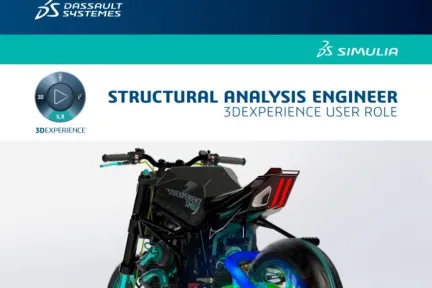
STRUCTURAL ANALYSIS ENGINEER 3DEXPERIENCE USER ROLE

Structural Analysis Engineer provides a broad environment to conduct structural static, frequency, buckling, modal dynamic response, and structural thermal simulation of parts and assemblies within the 3DEXPERIENCE platform. It boosts innovation in product engineering and fosters collaboration in an intuitive environment using state-of-the art Abaqus simulation technology.

Brochures

STRUCTURAL ANALYSIS ENGINEER 3DEXPERIENCE USER ROLE
PowerDELTA 3DS Branded

PowerDELTA by SIMULIA provides an end-to-end solution from geometry preparation through simulation and optimization in PowerFLOW , eliminating manual third-party tools. With the industry’s fastest time to the highest quality simulation meshes, it accelerates collaboration between design and engineering teams, improving products and processes for leading manufacturers.

Brochures

PowerDELTA 3DS Branded
Implementing a gradient dependent plasticity model in ABAQUS

A strain gradient dependent plasticity model is implemented using the user element subroutine interface in ABAQUS. Based on the implementation, a simple shear case is studied as well as a more complex crack tip problem. Large influence of the incorporated material length scale is observed in the two cases.

Customer Papers

Implementing a gradient dependent plasticity model in ABAQUS
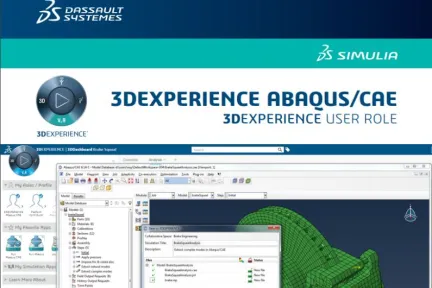
3DEXPERIENCE ABAQUSCAE - 3DEXPERIENCE USER ROLE

3DEXPERIENCE Abaqus/CAE allows the existing Abaqus/CAE user to build, capture, and run simulation processes and methods that use Abaqus/CAE. Abaqus/CAE may be opened directly from 3DEXPERIENCE, models may be imported and defined, then run, executed, and postprocessed all from the platform. This allows simulation methods to be captured, shared, exposed, and leveraged by other users and stored for future re-use.

Brochures

3DEXPERIENCE ABAQUSCAE - 3DEXPERIENCE USER ROLE
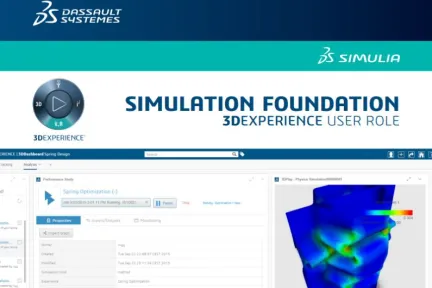
SIMULATION FOUNDATION 3DEXPERIENCE USER ROLE

Engineers often lack the detailed information of how their trade-off decisions affect the performance and robustness of their products. While research has shown that best-in class companies leverage simulation techniques with measureable business benefits, there are many challenges and few have been able to implement the vision of simulation driven design. One such challenge is that simulation has often been restricted to experts, too complex and time consuming for engineers and designers to leverage.

Brochures

SIMULATION FOUNDATION 3DEXPERIENCE USER ROLE
On the Measurement and Modeling of Polymeric Materials that Exhibit Unstable Localized Necking

Some polymeric materials are known to exhibit localized necking instabilities during uniaxial tension testing. Once the neck begins, it first localizes and then propagates over the length of the sample. After it has fully propagated, the material will often endure significant amounts of additional deformation before complete failure. The localized necking creates a problem in that traditional methods of measuring strain & stress from the sample become invalid. Even the newest imaging correlation methods are unable to properly measure the sample's strain and stress. This paper presents a pragmatic approach to salvage such data and discusses its use within finite element models.

Customer Papers

On the Measurement and Modeling of Polymeric Materials that Exhibit Unstable Localized Necking
257 résultats

Témoignages clients

150 résultats
4 résultats

Auto-apprentissage SIMULIA

Nous proposons plusieurs centaines de modules d'auto-apprentissage pour que vous puissiez continuer à apprendre à votre rythme.

Blogs

Lisez le blog SIMULIA pour connaître les dernières actualités et innovations de nos experts.

703 résultats

Découvrir comment SIMULIA peut vous aider

Contactez un expert SIMULIA pour découvrir comment nos solutions permettent une collaboration transparente et une innovation durable dans des entreprises de toutes tailles.

Commencer

Des formations et des cours sont disponibles pour les étudiants, le monde académique, les professionnels et les sociétés. Trouvez la formation SIMULIA qui vous convient. 

Obtenir de l'aide

Obtenez des informations sur la certification des logiciels et du matériel, les téléchargements de logiciels, la documentation utilisateur, les coordonnées du support et l'offre de services.