
Manatee for Electrical, Mechanical and Acoustics Engineers
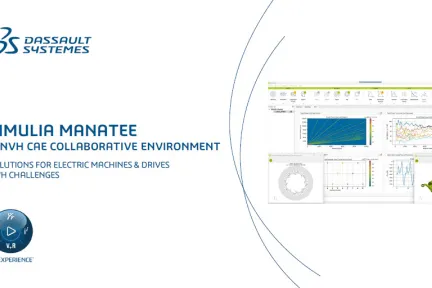
Manatee can help electrical, mechanical and acoustics (NVH) engineers tackle key e-NVH challenges in electrical system design.
Brochures
Trouvez tout ce dont vous avez besoin sur SIMULIA
Manatee can help electrical, mechanical and acoustics (NVH) engineers tackle key e-NVH challenges in electrical system design.
Brochures
Communiqué de Presse
26 avril 2024
Press Release
26 avril 2024

Communiqué de Presse
21 mars 2024
CST STUDIO SUITEELECTROMAGNETIC FIELD SIMULATION SOFTWARE
Brochures
Engineering products are becoming more sophisticated and complex, yet development timescales invariably shorten. In today’s global marketplace, competition is becoming more intense. More than ever before, successful products need to be highly optimized for their target markets. This might demand optimization in different forms such as lower raw material costs, better performance, smaller size or greater efficiency.
Brochures
Press Release
14 mars 2024
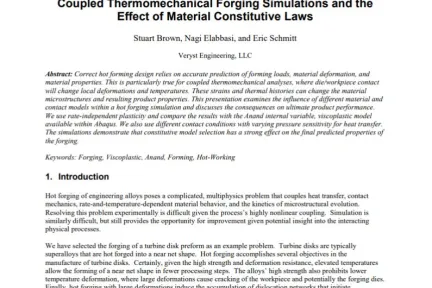
Correct hot forming design relies on accurate prediction of forming loads, material deformation, and material properties. This is particularly true for coupled thermomechanical analyses, where die/workpiece contact will change local deformations and temperatures. These strains and thermal histories can change the material microstructures and resulting product properties. This presentation examines the influence of different material and contact models within a hot forging simulation and discusses the consequences on ultimate product performance. We use rate-independent plasticity and compare the results with the Anand internal variable, viscoplastic model available within Abaqus. We also use different contact conditions with varying pressure sensitivity for heat transfer. The simulations demonstrate that constitutive model selection has a strong effect on the final predicted properties of the forging.
Customer Papers
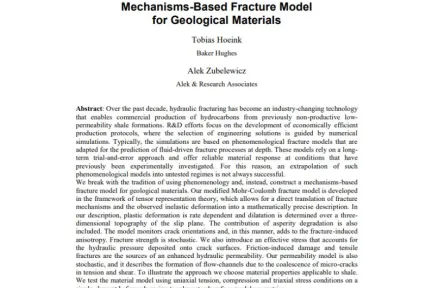
Over the past decade, hydraulic fracturing has become an industry-changing technology that enables commercial production of hydrocarbons from previously non-productive lowpermeability shale formations. R&D efforts focus on the development of economically efficient production protocols, where the selection of engineering solutions is guided by numerical simulations. Typically, the simulations are based on phenomenological fracture models that are adapted for the prediction of fluid-driven fracture processes at depth. These models rely on a longterm trial-and-error approach and offer reliable material response at conditions that have previously been experimentally investigated. For this reason, an extrapolation of such phenomenological models into untested regimes is not always successful.
Customer Papers
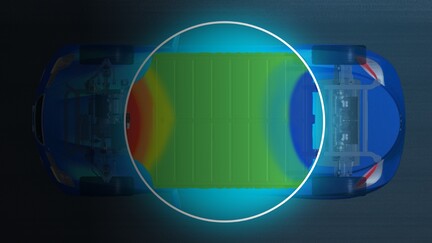
Watch the replay to learn how to find the best trade-offs for range, safety, and durability, while balancing cost and performance, with battery module and pack engineering.
E-seminar
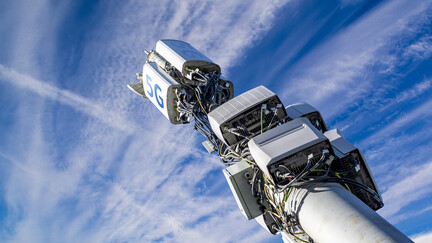
In this e-seminar we will explore state-of-the-art simulation approaches for antenna array design, with a particular focus on 5G small-cell base station antennas.
E-seminar
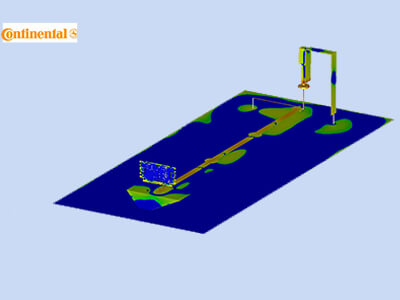
In the first episode of the Champion e-seminar series, Lin Biao WANG from Continental Automotive Singapore will present how he uses CST Studio Suite to model and analyze ESD field coupling from the harness to the DUT. Through the visualization of 2D field plots and 3D field animations, the root cause of the problem was identified.
E-seminar
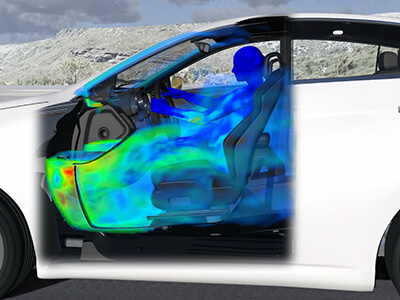
As consumers are looking for refreshing and comfortable experiences, cabin design is taking center stage as a dominant selling factor for the automotive, aerospace and industrial equipment industries.
E-seminar
Join this event replay to get key insights on how to enable remote-office collaborative engineering, accelerate affordable virtual simulation & testing and ramp up production safely with higher agility.
E-seminar

Learn how to Improve battery performance and streamline R&D by unifying multi-scale and multi-physics modelling and simulation
E-seminar

Discover how EMC simulation improves cable shielding in HV motors cables.
E-seminar
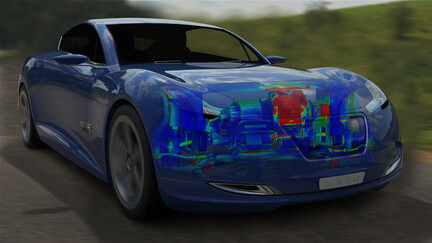
Watch the replay to find out how you can leverage PowerDELTA 2020.
E-seminar
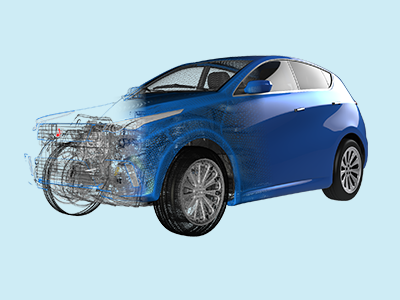
The e-seminar will describe the process of setting up and analyzing a DesignGUIDE design study, as well as cover a series of examples across different industries and disciplines.
E-seminar
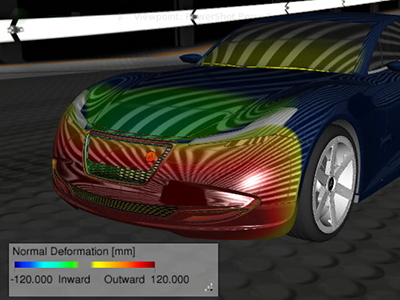
The workshop will focus on recent simulation trends to handle the full complexity of complete antenna systems, incorporated in Dassault Systèmes electromagnetic simulation suite design process.
E-seminar

The new Flow Driven Generative Design leverages proven technologies already used in multiple industries.
E-seminar

The e-seminar will give a brief introduction to the vehicle dynamics topic.
E-seminar
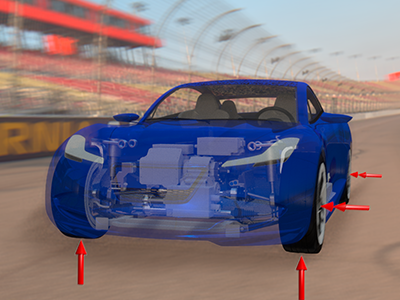
Nous proposons plusieurs centaines de modules d'auto-apprentissage pour que vous puissiez continuer à apprendre à votre rythme.
Lisez le blog SIMULIA pour connaître les dernières actualités et innovations de nos experts.
The 2021 SIMULIA Champions come from multiple industries across the globe. We recently spoke with Andrea Giampieri from Tetra Pak in Italy to find out more about his engineering career and his passion for simulation.
Article
The Simulation Process Engineer role leverages simulation methods and provides access to key simulation tools.
Article
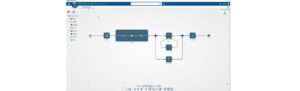
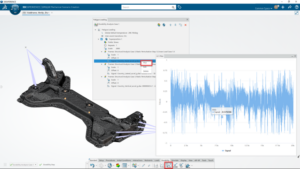
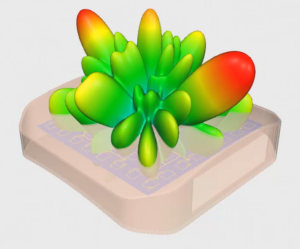
This blog post will demonstrate collaborative antenna design using the example of a 5G small cell antenna array.
Article
SIMULIA Champions come from around the world, and from a variety of industries. Here, we speak with David Scholtz of Wood Group in Australia to find out what led him into engineering and how his business is using simulation.
Article

Overview Engineers have to develop innovative products in the shortest development time...
Article
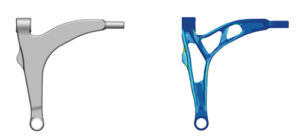
This post was originally published in July 2020 and has had several...
Article
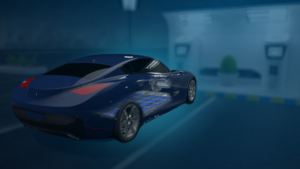
The design of vehicles is a challenging, time-consuming, and expensive process. Increased...
Article
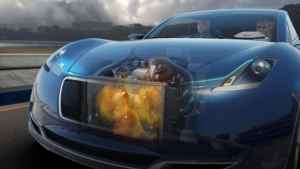
Simulia, marque phare de Dassault Systèmes donne aux acteurs de tout type les moyens de simuler pour accélerer l’innovation
Article

This post is a continuation in a series about simulation on the 3DEXPERIENCE...
Article
Want to learn more about conceptual structural optimization for urban air mobility?...
Article

Want to learn how to simulate X-ray tubes in SIMULIA Opera? Don’t...
Article

Contactez un expert SIMULIA pour découvrir comment nos solutions permettent une collaboration transparente et une innovation durable dans des entreprises de toutes tailles.
Des formations et des cours sont disponibles pour les étudiants, le monde académique, les professionnels et les sociétés. Trouvez la formation SIMULIA qui vous convient.
Obtenez des informations sur la certification des logiciels et du matériel, les téléchargements de logiciels, la documentation utilisateur, les coordonnées du support et l'offre de services.