1503 résultats
Flow-Induced Vibration Modeling

The current work pertains to a re-closeable annular flow valve oil completion tool (XAFV) with high gas flow passing through the valve, causing pressure oscillation due to flow separation and high turbulence energy. The objective is to assess the vibration level to protect the tool from damage. The first step was to perform CFD simulation by using Fluent on The valve port region. The power spectral density (PSD) of pressure fluctuations at the high turbulence region was obtained. The next step of the work was to extract natural frequencies of the tool by using Abaqus. The last step was to utilize random vibration analysis (RVA) to obtain the PSD and root mean square of stresses to assess the random vibration effect by using CFD predicted PSD of excitation pressure.

Customer Papers

Flow-Induced Vibration Modeling
Cylinder Head Valve Guide Wear Analysis of Internal Combustion Engine

An analytical process was developed to study the root cause of the exhaust valve guide wear in the gasoline engine from a high mileage accumulation vehicle test. A thermo-structural model was created to determine maximum cam bore misalignment based on engine thermal structural analysis. Then a valve train dynamic model was developed as a submodel based on cylinder head thermal deformation, the cam axis was adjusted based on the maximum cam bore misalignment in this dynamic model and valve tip side load from cam and rocker arm was calculated. Normal and reversed spin of cam was performed to study its effect on rocker motion between left and right bank cylinder heads. Valve and guide contact was monitored during the dynamic analysis and the resulting valve and guide deformation from this dynamic analysis was input to a tribology model to calculate the guide wear rate. Abaqus/Standard was used in thermo-structural analysis, and Abaqus/Explicit was used for valve train dynamic analysis. Based on this study, the root cause of the guide wear was verified.

Customer Papers
Cylinder Head Valve Guide Wear Analysis of Internal Combustion Engine
Simplifying Composites Process Modelling in Abaqus with COMPRO

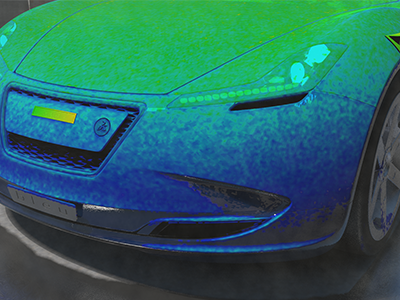
Simulation of the manufacture of composite materials, commonly known as composites process modelling, has been gaining acceptance in industry since the mid-1990s. Starting from the early simple 1D and 2D representations of composite parts, process modelling of complex, fully configured 3D composite parts is now performed on a regular basis. Until recently, creating and running such simulations has required a high level of expertise not only in the manufacture of composite materials, but also in 3D finite element analysis.

Customer Papers
Simplifying Composites Process Modelling in Abaqus with COMPRO
Quality Control of PipeLay and Riser Dynamic Analysis

The increasing frequency in the use of Engineering Criticality Assessments (ECA) to determine weld quality in the installation of offshore pipelines and risers has put an increased focus on the importance of accurate predictions in dynamic stresses during installation and service. Over-predictions impose constrains to the installation campaign with high cost and safety implications. The response predictions of a pipe profile suspended from a vessel in random sea state with environmental loading and interaction with the seabed is a complex nonlinear problem. From a dynamic structural in place perspective the pipe catenary presents a near continuous spectrum of frequencies and modes of vibration. This has important dynamic numerical and structural relevance, implying excellent resonance transmissibility for any input forcing oscillation frequency.

Customer Papers
Quality Control of PipeLay and Riser Dynamic Analysis
Bond Model Development for Pretensioned Concrete Crossties with User Materials in Abaqus

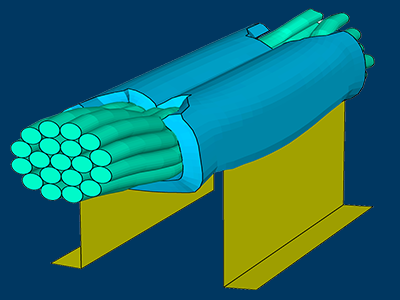
Pretensioned concrete crossties are increasingly employed in railroad heavy haul and high speed lines. The bond between steel reinforcements and concrete affects several important performance measures of concrete ties, and bond modeling is a critical component in the analysis of concrete tie behavior using the finite element (FE) method. This paper summarizes the bond models developed at the Volpe Center for pretensioned concrete crossties and their implementation as user materials for cohesive elements in Abaqus. The bond models are macroscale or phenomenological and developed within the elasto-plastic framework. The steel reinforcement-concrete interface is homogenized and represented with a thin layer of cohesive elements sandwiched between steel and concrete elements.

Customer Papers

Bond Model Development for Pretensioned Concrete Crossties with User Materials in Abaqus
Finite Element Analysis for Understanding Oil and Gas Well Deformation Mechanisms

This paper presents several FEA models used to analyze different modes of casing deformation including casing collapse, buckling and shear. Analysis examples are presented to demonstrate the use of the FEA models together with available caliper survey data in investigating the loading conditions and mechanisms responsible for causing such casing deformations in a number of actual wells.

Customer Papers
Finite Element Analysis for Understanding Oil and Gas Well Deformation Mechanisms
RESERVOIR GEOMECHANICS

Energy consumption in the world is increasing. The growth in consumption is expected to be strongly driven by China, India and other non-OECD countries. Most of this consumption will be related to oil and gas, mainly for transportation and electricity. Oil and gas also are primary raw materials for a wide range of products including plastics and chemicals, and their usage is also increasing fast. This increase in the demand for oil and gas needs to be satisfied reliably and sustainably. How can we ensure that this happens?

White Papers

RESERVOIR GEOMECHANICS
Mechanics of hydraulic fracturing in ultra-low permeability formations: role of cavitation and sorption

Hydraulic fracturing (HF) comprises nucleation and growth of fractures in rock formations via flow-induced pressurization. HF is routinely used as a means of stimulating low permeability rock formations to enhance the recovery of oil and gas. The physical processes in the fracture process zone (FPZ) during HF are usually very complex because of the coupling between fracturing-fluid flow, rock deformation and diffusion of host fluid. Identifying all the critical pieces of physics is the key to developing a reliable full-physics modeling and simulation capability. Such a capability will not only enhance our understanding of HF but will also aid greatly towards the development of an effective stimulation strategy.

Customer Papers

Mechanics of hydraulic fracturing in ultra-low permeability formations: role of cavitation and sorption
Coupling Reservoir Simulation and Geomechanical Modeling to Improve the Analysis of Hydrocarbon Reservoir Behavior

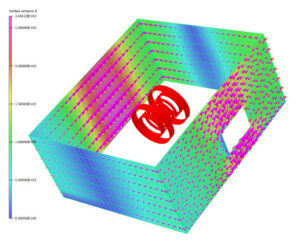
In oil and gas field development, reservoir simulation is applied to accurately predict and analyze fluid flow during production. The results of reservoir simulation can be used as input for 4D geomechanical modelling to obtain the earth’s mechanical response such as reservoir compaction. However, in such a one-way coupling scheme, the geomechanical response of a system has no influence on the reservoir simulation, whereas in reality mechanical and flow behaviors influence each other.

Customer Papers
Coupling Reservoir Simulation and Geomechanical Modeling to Improve the Analysis of Hydrocarbon Reservoir Behavior
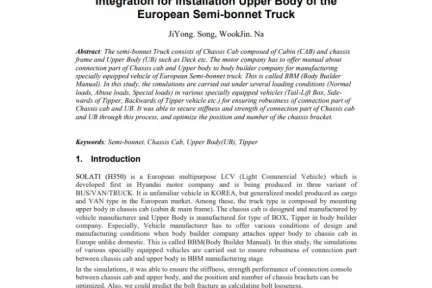
Integration for installation Upper Body of the European Semi-bonnet Truck

The semi-bonnet Truck consists of Chassis Cab composed of Cabin (CAB) and chassis frame and Upper Body (UB) such as Deck etc. The motor company has to offer manual about connection part of Chassis cab and Upper body to body builder company for manufacturing specially equipped vehicle of European Semi-bonnet truck. This is called BBM (Body Builder Manual). In this study, the simulations are carried out under several loading conditions (Normal loads, Abuse loads, Special loads) in various specially equipped vehicles (Tail-Lift Box, Sidewards of Tipper, Backwards of Tipper vehicle etc.) for ensuring robustness of connection part of Chassis cab and UB. It was able to secure stiffness and strength of connection part of Chassis cab and UB through this process, and optimize the position and number of the chassis bracket.

Customer Papers

Integration for installation Upper Body of the European Semi-bonnet Truck
257 résultats
Multiphysics PCB Simulation | Dassault Systèmes

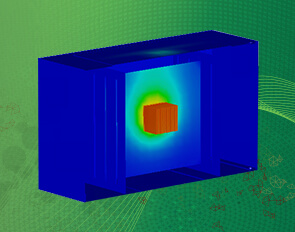
Learn how a holistic simulation approach can allow Print Circuit Board (PCB) designers to identify potential issues early, conduct virtual testing and ensure the PCB’s functionality.

E-seminar

Multiphysics PCB Simulation | Dassault Systèmes
On demand

Témoignages clients

150 résultats
4 résultats

Auto-apprentissage SIMULIA

Nous proposons plusieurs centaines de modules d'auto-apprentissage pour que vous puissiez continuer à apprendre à votre rythme.

Blogs

Lisez le blog SIMULIA pour connaître les dernières actualités et innovations de nos experts.

703 résultats

Découvrir comment SIMULIA peut vous aider

Contactez un expert SIMULIA pour découvrir comment nos solutions permettent une collaboration transparente et une innovation durable dans des entreprises de toutes tailles.

Commencer

Des formations et des cours sont disponibles pour les étudiants, le monde académique, les professionnels et les sociétés. Trouvez la formation SIMULIA qui vous convient. 

Obtenir de l'aide

Obtenez des informations sur la certification des logiciels et du matériel, les téléchargements de logiciels, la documentation utilisateur, les coordonnées du support et l'offre de services.