1503 résultats
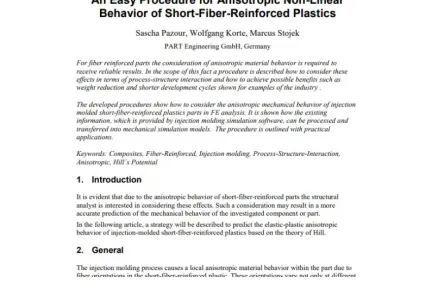
An Easy Procedure for Anisotropic Non-Linear Behavior of Short-Fiber-Reinforced Plastics

The developed procedures show how to consider the anisotropic mechanical behavior of injection molded short-fiber-reinforced plastics parts in FE analysis. It is shown how the existing information, which is provided by injection molding simulation software, can be processed and transferred into mechanical simulation models. The procedure is outlined with practical applications.

Customer Papers
An Easy Procedure for Anisotropic Non-Linear Behavior of Short-Fiber-Reinforced Plastics
Failure Analysis of CFRP Tubes with Integrated Rubber Layers Subjected to Transverse LowVelocity Impact Loading

Among the numerous advantages of CFRP laminated structures there are some drawbacks, such as the high sensitivity in terms of impact loading. Particularly low-velocity impacts result in non-visible and barely-visible impact damage respectively. The threedimensional state of stress in the impact zone leads to matrix cracking and delamination inside the composite laminate and possibly to fibre failure for higher impact energies. It can be very difficult to detect such damage by visual inspection, and additionally, in most cases a significant reduction of strength and stiffness can be expected. To improve the damage tolerance a rubber layer, named KRAIBON , is integrated in the composite layup of cylindrical carbon/epoxy tubular specimens.

Customer Papers
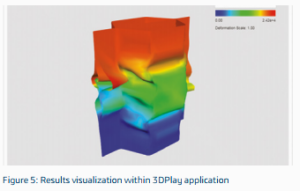
Failure Analysis of CFRP Tubes with Integrated Rubber Layers Subjected to Transverse LowVelocity Impact Loading
A Simulation Tool for Fatigue Analysis and Lifecycle Prediction

This paper presents an interactive web-based simulation tool for a modern fatigue analysis and lifecycle prediction methodology of smooth and notched components. Users around the globe with diverse degree of fatigue familiarity may access it via Internet by means of multiple platforms such as desk- and lap-top computers, tablets and/or smart-phones. In particular, the users with a limited fatigue analysis background would benefit from “onthe-fly” fatigue learning experience. This is accomplished by means of proper guidance through a step-by-step process and providing specific details and explanations without the need of a tutorial handbook.

Customer Papers

A Simulation Tool for Fatigue Analysis and Lifecycle Prediction
Finite Element Simulation of Thermal Barrier Coatings in Rocket Engines

Rocket engines need to withstand extreme gas temperatures. To achieve this, the engine is lined with copper and cooled with liquid hydrogen. Nevertheless, creep processes can lead to damage and failure of the component. To avoid this, rocket engines can be protected with thermal barrier coatings. Standard coating systems as used in gas turbines are problematic because of larger thermal stresses between the copper substrate and the coating due to a large thermal mismatch. In this work, we use finite element simulations to study the stress evolution in a coating material tailored for application in a rocket engine. The influence of the thermal conductivity on the resulting stress state is discussed and general conclusions for the design of thermal barrier coatings in rocket engines are drawn.

Customer Papers

Finite Element Simulation of Thermal Barrier Coatings in Rocket Engines
Shrinkage Modeling of Thermoplastic Wing Rib

During manufacture of parts made of thermoplastic composites in the process of thermoforming liquid of resin transfers to solid-state with occurrence of residual stresses in part which may lead to distortion of the shape of the product. Transition from liquid to solid is called the crystallization process, the reverse process – melting. In order to predict products distortion mathematical modeling techniques are developed. Methods are allowed to evaluate the degree of warpage of the selected design solutions and on the basis of these data to change the process parameters or product design.

Customer Papers

Shrinkage Modeling of Thermoplastic Wing Rib
Piping Flexibility Analysis and the Development of PCS – Pipe Calculation System for Abaqus

The current framework for piping stress analysis is based on a simplified calculation method directly derived from experimental research performed over 60 years ago in the 1940s and 1950s. This framework was originally intended for hand calculations and, apart from minor changes and amendments, has been successfully employed by piping engineers since its development. As computational power increases and finite element analysis (FEA) becomes accessible for piping engineers, it has become clear that this framework is not well suited for complex FEA evaluation of piping. Advanced FEA procedures enable engineers to perform in depth evaluation of piping systems that are extremely difficult or even impossible to evaluate through traditional methods.

Customer Papers

Piping Flexibility Analysis and the Development of PCS – Pipe Calculation System for Abaqus
Multiscale Modeling of High Velocity Impact Damage on Composite Structures

A multiscale damage prediction procedure has been developed which employs Abaqus/Explicit to solve the problem at the structural level of composite structures. The multiscale framework has been established applying the user material subroutine VUMAT which is coupled with the micromechanical model. The procedure is based on a computationally enhanced version of the High Fidelity Generalized Method of Cells (HFGMC) micromechanical model. The twoscale approach enables calculation of the stress field within the unit cell, based on the constitutive behavior of each subcell and the unit cell morphology. As the stress distribution is determined for the representative unit cells, calculations of failure criteria and damage effects in the composite are performed at the micro-level.

Customer Papers
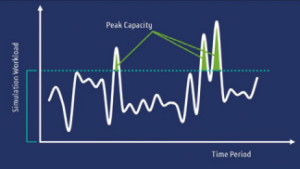
Multiscale Modeling of High Velocity Impact Damage on Composite Structures
Using the existing capability in Abaqus to model the draping & consolidation of composite preforms.

The work is concerned with the development of such a predictive model using a rebar-approach in Abaqus. In this approach, the fibres are held in a “shell” by some other means – perhaps stitched loosely or held by uncured prepreg resin. Any forming deformation rearranges the fibres and needs to do this against the frictional or other restraint offered internally by the “shell”. The anisotropic properties of the preform are naturally represented by the model. The model is used to solve some verification problems from the literature, as well as performing draping/forming analysis in a particular mould using a calibrated preform kinematic/mechanical model.

Customer Papers
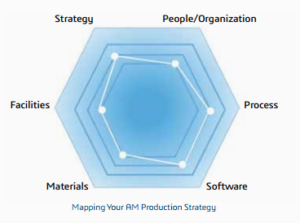
Using the existing capability in Abaqus to model the draping & consolidation of composite preforms.
Use of Abaqus/CAE and True-LoadTM to Determine External and Internal Loading of a Full Suspension Mountain Bicycle

Trek Bicycle Corporation has long been at the leading edge in the bicycle industry. Treks bicycles are subjected to the most rigorous testing in the industry and their frames are covered by a lifetime warranty. To maintain the highest level of safety and quality, real world loads need to be properly understood. Trek Factory Racing professional athletes are pushing that understanding; most recently attempting a front flip across a 72 foot canyon. The loads generated for such an event are certainly beyond current understanding and testing protocols.

Customer Papers

Use of Abaqus/CAE and True-LoadTM to Determine External and Internal Loading of a Full Suspension Mountain Bicycle
A Virtual Simulation Platform for the Design, Testing, and Verification of Unmanned Aerial Vehicle Designs

The Aerospace Systems Design Laboratory (ASDL) at the Georgia Institute of Technology has an advanced virtual prototyping facility for small-scale UAVs and autonomous systems to conduct conceptual and preliminary design trade studies. The authors are using requirements inspired by a US Army UAV research project to develop a design process that will employ the Winning Program Experience (packaged DS software on the V6 platform). In order to analyze large UAV concept spaces, ASDL has developed a process called the Interactive Reconfigurable Matrix of Alternatives (IRMA). The study will discuss how virtual test benches will be created for UAV systems, including simulation objects for SLM/Isight.

Customer Papers

A Virtual Simulation Platform for the Design, Testing, and Verification of Unmanned Aerial Vehicle Designs
Hydraulic Fracturing Simulation for Fracture Networks

The term ‘Unconventional Reservoirs’ is used in the oil and gas industry for hydrocarbon reservoirs that have very low permeability in the magnitude of microdarcy (μd) and therefore rely on artificially introducing pathways for fluids and gases, commonly by using hydraulic fracturing techniques, to enable economic production. This approach of using fracturing stimulation campaigns is also increasingly used to improve production in mature oil and gas fields. Industry estimates for North America indicate that more than half of all stimulation treatments have no impact on production, despite this technique having been in use in numerous onshore wells for more than a decade.

Customer Papers

Hydraulic Fracturing Simulation for Fracture Networks
Methodology for the analysis of tolerances in the assembly process of a wing torsion box through FE simulations

This work presents a methodology for the analysis of deviations that might be produced during the assembly process of aircraft components using the finite element method as calculation tool. The methodology allows determining the effect that different deviations in the constituent parts may have on the final tolerances of an assembly considering the influence of the joining techniques and the different operations that are usually carried out during such processes. This permits to evaluate if certain deviations in some parts would maintain the final assembly within the specified tolerances or, conversely, may accumulate/propagate negatively generating a non conformity.

Customer Papers

Methodology for the analysis of tolerances in the assembly process of a wing torsion box through FE simulations
257 résultats

Témoignages clients

150 résultats
4 résultats

Auto-apprentissage SIMULIA

Nous proposons plusieurs centaines de modules d'auto-apprentissage pour que vous puissiez continuer à apprendre à votre rythme.

Blogs

Lisez le blog SIMULIA pour connaître les dernières actualités et innovations de nos experts.

703 résultats
Focus On Simulation

Bringing Innovation and Industry into the Classroom 3DEXPERIENCE for Academia is an...

Article

Focus On Simulation

Découvrir comment SIMULIA peut vous aider

Contactez un expert SIMULIA pour découvrir comment nos solutions permettent une collaboration transparente et une innovation durable dans des entreprises de toutes tailles.

Commencer

Des formations et des cours sont disponibles pour les étudiants, le monde académique, les professionnels et les sociétés. Trouvez la formation SIMULIA qui vous convient. 

Obtenir de l'aide

Obtenez des informations sur la certification des logiciels et du matériel, les téléchargements de logiciels, la documentation utilisateur, les coordonnées du support et l'offre de services.