Hay 1497 resultados
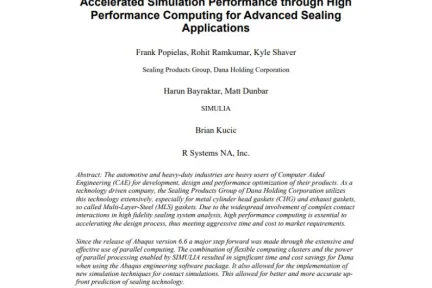
Accelerated Simulation Performance through High Performance Computing for Advanced Sealing Applications

The automotive and heavy-duty industries are heavy users of Computer Aided Engineering (CAE) for development, design and performance optimization of their products. As a technology driven company, the Sealing Products Group of Dana Holding Corporation utilizes this technology extensively, especially for metal cylinder head gaskets (CHG) and exhaust gaskets, so called Multi-Layer-Steel (MLS) gaskets. This paper provides an overview on accelerated simulation performance studies utilizing the latest SIMULIA technology for advanced sealing application from the Sealing Products Group of Dana Holding Corp. Furthermore it provides an outlook of steps to come.

Customer Papers
Accelerated Simulation Performance through High Performance Computing for Advanced Sealing Applications
CAE PROCESS AND AUTOMATION STRATEGY IN BREMBO

Brembo S.p.A produces mainly braking systems and components for automotive market. Actually, Brembo organization and business are quite complex due to the geographic dimension (Brembo is present in several countries worldwide both with manufacturing and engineering sites) , to the market dimension (Brembo produces for passengers cars, commercial vehicle, motorcycles, racing cars, OE, Aftermarket, etc...), and finally to the customers dimension; infact Brembo designs the braking system on specific customer and car.

Customer Papers

CAE PROCESS AND AUTOMATION STRATEGY IN BREMBO
An Abaqus Extension for Welding Simulations

An Abaqus Extension, in the form of an Abaqus/CAE Plug-In, has been developed for modeling welding. The Plug-In enables an easy, efficient, model-tree based approach to setup all aspects of a welding model from within Abaqus/CAE by automating most of the repetitive, timeconsuming tasks associated with building a welding model in a traditional CAE environment. Examples of tasks supported by the Plug-In include weld-bead and pass definitions, automatic definition of steps and boundary conditions for each pass, automatic (but editable) creation of node sets for each pass to enable definition of temperature sensors, and set-up of both the thermal and mechanical analysis models.

Customer Papers

An Abaqus Extension for Welding Simulations
Flood-cooling of Mechanical Components

A methodology is presented for evaluating the safety of an accidental or intentionally applied accelerated cooling process. Accelerated cooling occurs due to increased heat transfer from the wetted surfaces. For steady state processes like pool boiling, the change across the various heat transfer regimes occurs at specific temperatures and due to extensive studies, the minimum and maximum limits of heat flux can be determined with reasonable accuracy. However, flood-cooling is not a steady state process and the boiling curve exhibits some transient distortion. A flood-cooling heat transfer model was developed based on a generalized correlation of single and two-phase forced flow combined with literature data for the modified heat transfer regimes during quenching of hot surfaces.

Customer Papers

Flood-cooling of Mechanical Components
Advanced Decohesion Elements for the Simulation of Composite Delamination

This paper introduces an alternative decohesion element that offers improved convergence characteristics over other formulations. The new element’s implementation as an Abaqus UEL is discussed, along with certain insights the authors have developed that illuminate at least some of the factors complicating convergence of cohesive-element models. Methods for improving convergence of delamination and disbond problems are presented and evaluated with respect to a canonical test case.

Customer Papers

Advanced Decohesion Elements for the Simulation of Composite Delamination
Performance Evaluation of Finite Elements for Analysis of Advanced Hybrid Laminates

Advanced hybrid laminates (AHL) are based on advanced metal alloys and involve the strategic placement of Fiber Metal Laminates (FML) and/or fiber prepreg only where necessary to enhance structural performance. Finite element analysis of these layered structures is quite complex involving simulation of interaction between metallic and composite layers, accurate prediction of in-plane and out-of-plane stresses, contact simulation and progressive failure analysis of metallic and composite layers. The finite element chosen should be able to accurately predict both in plane and out of plane stresses. This paper presents a study of isotropic, orthotropic, composite and hybrid structures under tension, bending, shear and combined loadings using various 2D and 3D finite elements and their accuracy in predicting stresses.

Customer Papers

Performance Evaluation of Finite Elements for Analysis of Advanced Hybrid Laminates
An Evaluation of Associative Interface for SolidWorks and ABAQUSCAE

In the modern design and manufacturing world, shorter development cycle times are being demanded. In addition, engineers are being asked to perform more analyses and studies to improve their products. To meet the challenge, engineers will seek more ways to increase robustness and productivity. With the continued integration of computational tools, such as the associative import between SolidWorks and Abaqus/CAE, it is possible to analyze and reiterate designs, materials, and structures in a more productive and efficient fashion.

Customer Papers

An Evaluation of Associative Interface for SolidWorks and ABAQUSCAE
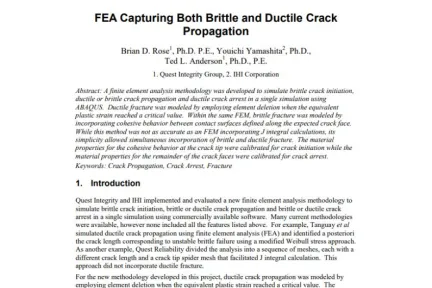
FEA Capturing Both Brittle and Ductile Crack Propagation

A finite element analysis methodology was developed to simulate brittle crack initiation, ductile or brittle crack propagation and ductile crack arrest in a single simulation using ABAQUS. Ductile fracture was modeled by employing element deletion when the equivalent plastic strain reached a critical value. Within the same FEM, brittle fracture was modeled by incorporating cohesive behavior between contact surfaces defined along the expected crack face. While this method was not as accurate as an FEM incorporating J integral calculations, its simplicity allowed simultaneous incorporation of brittle and ductile fracture.

Customer Papers

FEA Capturing Both Brittle and Ductile Crack Propagation
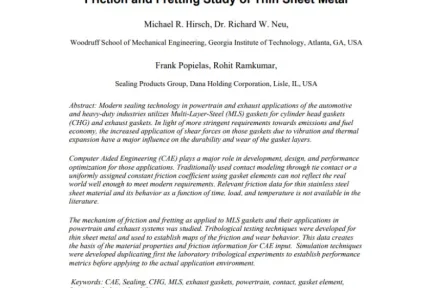
Friction and Fretting Study of Thin Sheet Metal

Modern sealing technology in powertrain and exhaust applications of the automotive and heavy-duty industries utilizes Multi-Layer-Steel (MLS) gaskets for cylinder head gaskets (CHG) and exhaust gaskets. In light of more stringent requirements towards emissions and fuel economy, the increased application of shear forces on those gaskets due to vibration and thermal expansion have a major influence on the durability and wear of the gasket layers.

Customer Papers

Friction and Fretting Study of Thin Sheet Metal
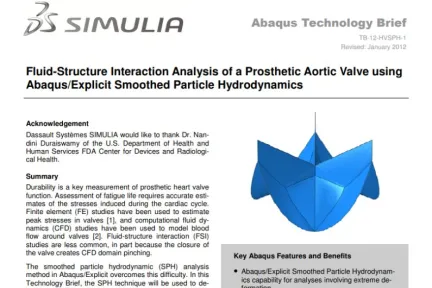
Fluid-Structure Interaction Analysis of a Prosthetic Aortic Valve using Abaqus/Explicit Smoothed Particle Hydrodynamics

Durability is a key measurement of prosthetic heart valve function. Assessment of fatigue life requires accurate estimates of the stresses induced during the cardiac cycle. Finite element (FE) studies have been used to estimate peak stresses in valves, and computational fluid dynamics (CFD) studies have been used to model blood flow around valves. Fluid-structure interaction (FSI) studies are less common, in part because the closure of the valve creates CFD domain pinching. The smoothed particle hydrodynamic (SPH) analysis method in Abaqus/Explicit overcomes this difficulty. In this Technology Brief, the SPH technique will be used to determine the FSI response of a generic prosthetic heart valve.

Solution Briefs

Fluid-Structure Interaction Analysis of a Prosthetic Aortic Valve using Abaqus/Explicit Smoothed Particle Hydrodynamics
Hay 247 resultados

Testimonios de clientes

Hay 132 resultados
Hay 3 resultados

Autoaprendizaje de SIMULIA

Ofrecemos cientos de módulos de autoaprendizaje para que pueda seguir aprendiendo a su ritmo

Blogs

Lea el blog de SIMULIA sobre las últimas noticias e innovaciones de nuestros expertos.

Hay 696 resultados

Descubra lo que SIMULIA puede hacer por usted

Hable con un experto de SIMULIA para descubrir cómo nuestras soluciones permiten colaborar sin problemas e innovar de manera sostenible en organizaciones de todos los tamaños.

Póngase en marcha

Los cursos y las clases están disponibles para estudiantes, instituciones académicas, profesionales y empresas. Encuentre la formación de SIMULIA adecuada para usted. 

Obtener ayuda

Encuentre información sobre certificación de software y hardware, descargas de software, documentación del usuario, contacto con soporte y oferta de servicios