Hay 1497 resultados
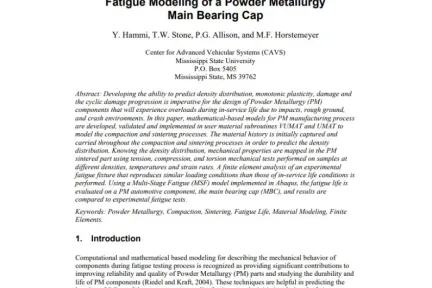
Fatigue Modeling of a Powder Metallurgy Main Bearing Cap

Developing the ability to predict density distribution, monotonic plasticity, damage and the cyclic damage progression is imperative for the design of Powder Metallurgy (PM) components that will experience overloads during in-service life due to impacts, rough ground, and crash environments. In this paper, mathematical-based models for PM manufacturing process are developed, validated and implemented in user material subroutines VUMAT and UMAT to model the compaction and sintering processes.

Customer Papers
Fatigue Modeling of a Powder Metallurgy Main Bearing Cap
Virtual design from nature: Kinematic modeling of the seahorse tail

Seahorses (belonging to the genus Hippocampus) and pipehorses are unique among fishes in being armed with robust body plates instead of scales, and in being able to bend their tail ventrally for use as a prehensile appendage. They lack a powerful caudal fin, making them very slow swimmers, which can hardly escape predatory fish. However, they have survived millions of years of natural selection, yielding a very well camouflaged fish with a highly specialized caudal skeleton.

Customer Papers

Virtual design from nature: Kinematic modeling of the seahorse tail
Tire performance evaluation for severe snow traction

Snow traction is an important tire performance parameter for product applications in markets where snow is present for several months during the year. It is very difficult to perform multiple tests because proving grounds and consistent test conditions are available only for limited periods of time and due to prototyping and test expense. This paper deals with the simulation aspects of the snow traction test using Abaqus.

Customer Papers

Tire performance evaluation for severe snow traction
Automating Architecture Alternative Trades

This paper describes how advancements in simulation and optimization tools have facilitated architecture trade studies during the initial phases of the system design process. Laying out the architecture for a new system is traditionally done by drawing upon input from stakeholders, experts, and previous work to select a structure that is likely to meet system requirements. While this works well when adapting existing designs to new applications, it does not always provide solid selection criteria, especially when creating distinctly new or innovative systems. This can lead to conforming new systems’ architectures to known and trusted design structures, rather than considering novel and potentially superior but untested designs.

Customer Papers

Automating Architecture Alternative Trades
FEM analysis of a gearbox housing, for the calculation of stress and deflection characteristics

In the present study, a real case automotive gearbox housing is modelled, in order to investigate stress and deflection characteristics for a number of load cases. It incorporates the FE modeling of the housing, contacts simulation, assembly and operating conditions loading. Solution results are obtained and evaluated in accordance to the design requirements. Finally, a conclusion whether to further modify the design or proceed with building a prototype for testing is reached. The study was done utilizing ANSA pre-processor and Abaqus/Standard.

Customer Papers

FEM analysis of a gearbox housing, for the calculation of stress and deflection characteristics
Finite Element Modeling of Thermoplastics at Different Temperatures

Thermoplastic materials are inherently nonlinear in their deformation and temperature behavior. These nonlinearities can present significant challenges when performing finite element analyses during product design or failure analysis. In this study we have shown how an advanced user-material model (UMAT) can be calibrated and used to simulate the behavior of polycarbonate (PC) at temperatures from -30°C to +90°C. The calibration was performed using experimental data from both uniaxial tension at different temperatures, and uniaxial creep at different stress levels. The techniques and software tools used for the material model development and calibration procedure will be presented in detail illustrating also how the analysis strategy can be applied to other materials.

Customer Papers

Finite Element Modeling of Thermoplastics at Different Temperatures
Creating Viable FEA Material Representations for Elastomers Using Non-Ideal Test Data

Most automated material fitting procedures in commercial FEA codes assume that “ideal tests” are used to generate measured material data. Unfortunately, there are many scenarios where only “non-ideal” test data are available. This paper presents two case studies that highlight various strategies to transform and/or salvage such distorted test data so that viable FEA material representations can be created. Two examples are presented: (1) The hyperelastic characterization of a nearly incompressible elastomer that is manufactured with a stiff PET film on one side which prohibits the use of planar shear testing and distorts data from puck compression testing and (2) The characterization of nearly incompressible elastomers reinforced by short stiff fibers.

Customer Papers

Creating Viable FEA Material Representations for Elastomers Using Non-Ideal Test Data
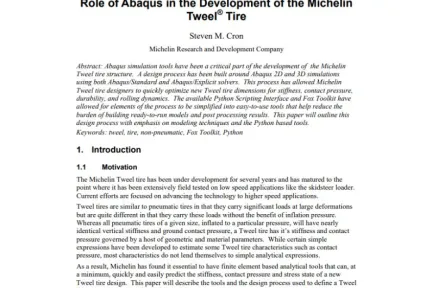
Role of Abaqus in the Development of the Michelin Tweel Tire

Abaqus simulation tools have been a critical part of the development of the Michelin Tweel tire structure. A design process has been built around Abaqus 2D and 3D simulations using both Abaqus/Standard and Abaqus/Explicit solvers. This process has allowed Michelin Tweel tire designers to quickly optimize new Tweel tire dimensions for stiffness, contact pressure, durability, and rolling dynamics. The available Python Scripting Interface and Fox Toolkit have allowed for elements of the process to be simplified into easy-to-use tools that help reduce the burden of building ready-to-run models and post processing results. This paper will outline this design process with emphasis on modeling techniques and the Python based tools.

Customer Papers

Role of Abaqus in the Development of the Michelin Tweel Tire
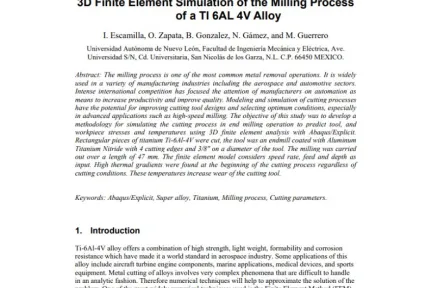
3D Finite Element Simulation of the Milling Process of a TI 6AL 4V Alloy

The milling process is one of the most common metal removal operations. It is widely used in a variety of manufacturing industries including the aerospace and automotive sectors. Intense international competition has focused the attention of manufacturers on automation as means to increase productivity and improve quality. Modeling and simulation of cutting processes have the potential for improving cutting tool designs and selecting optimum conditions, especially in advanced applications such as high-speed milling. The objective of this study was to develop a methodology for simulating the cutting process in end milling operation to predict tool, and workpiece stresses and temperatures using 3D finite element analysis with Abaqus/Explicit.

Customer Papers

3D Finite Element Simulation of the Milling Process of a TI 6AL 4V Alloy
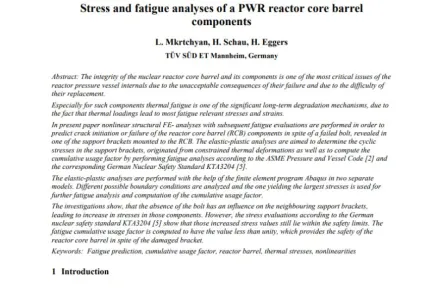
Stress and fatigue analyses of a PWR reactor core barrel components

The integrity of the nuclear reactor core barrel and its components is one of the most critical issues of the reactor pressure vessel internals due to the unacceptable consequences of their failure and due to the difficulty of their replacement. Especially for such components thermal fatigue is one of the significant long-term degradation mechanisms, due to the fact that thermal loadings lead to most fatigue relevant stresses and strains.

Customer Papers

Stress and fatigue analyses of a PWR reactor core barrel components
Hay 247 resultados

Testimonios de clientes

Hay 132 resultados
Hay 3 resultados

Autoaprendizaje de SIMULIA

Ofrecemos cientos de módulos de autoaprendizaje para que pueda seguir aprendiendo a su ritmo

Blogs

Lea el blog de SIMULIA sobre las últimas noticias e innovaciones de nuestros expertos.

Hay 696 resultados

Descubra lo que SIMULIA puede hacer por usted

Hable con un experto de SIMULIA para descubrir cómo nuestras soluciones permiten colaborar sin problemas e innovar de manera sostenible en organizaciones de todos los tamaños.

Póngase en marcha

Los cursos y las clases están disponibles para estudiantes, instituciones académicas, profesionales y empresas. Encuentre la formación de SIMULIA adecuada para usted. 

Obtener ayuda

Encuentre información sobre certificación de software y hardware, descargas de software, documentación del usuario, contacto con soporte y oferta de servicios