有 1511 个结果
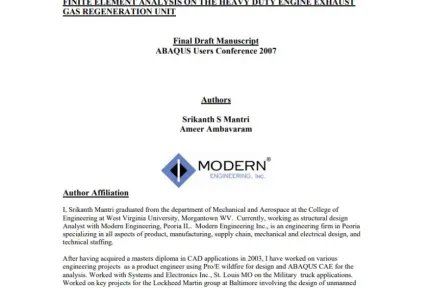
FINITE ELEMENT ANALYSIS ON THE HEAVY DUTY ENGINE EXHAUST GAS REGENERATION UNIT

In order to match the more stringent 2007 Environmental Protection Agency (EPA) emission standards, the need for more robust and refined exhaust gas treatment has been recognized by the heavy duty engine manufacturers. This led to the conception of a breakthrough technology in the engine exhaust gas treatment by one of the World’s leading heavy duty engine manufacturer. The soul of this technology is vested in the Exhaust Gas Regeneration Unit which comprises of various intricate components along with a network of fuel, coolant and air ducts, and distribution head fittings. A prime challenge in the development of a successful design was to come up with a robust routing of these ducts which consisted of various combinations of Hard lines and Flex lines along with compatible end fittings.

Customer Papers
FINITE ELEMENT ANALYSIS ON THE HEAVY DUTY ENGINE EXHAUST GAS REGENERATION UNIT
Using a Drop Tower test to Dynamically Validate an ABAQUS model of an Automotive Seat for Side Impact Crash Simulation

In contrast to frontal crash, the occupant sits directly in the deformation zone of the vehicle structure during a side impact event. The goal in occupant protection is not one of restraining the occupant relative to the interior of the vehicle but one of protecting the occupant from the high energies of the intruding surface. This paper describes a study undertaken to establish a means of dynamically validating a typical finite element seat model used in the virtual development of side impact protection systems at BMW.

Customer Papers

Using a Drop Tower test to Dynamically Validate an ABAQUS model of an Automotive Seat for Side Impact Crash Simulation
Link of injection molding simulation with FEM structure mechanical analysis

One major benefit of using a 3D injection molding simulation is the capability to simulate the fiber orientation and the anisotropic warpage, with the option, to transfer the material properties to structural mechanical analysis. With this option, it is possible to reduce the over dimensioning of fiber reinforced parts and thus resulting in substantial savings of mass, material and costs .This work will demonstrate the benefit of FEM combined with injection molding simulation but also the risks that can occur.

Customer Papers

Link of injection molding simulation with FEM structure mechanical analysis
Elastomer Analysis, a case study in element selection and mesh discretization

While nonlinear FEA of rubber or elastomer components is quite common today, there is still some uncertainty in modelling choices and representations. Material modelling choices, curve fitting from material test data, etc., have been discussed in many papers, but some fundamental issues of element selection and mesh discretization for nearly incompressible and fully incompressible materials are less discussed

Customer Papers

Elastomer Analysis, a case study in element selection and mesh discretization
A Gasket Element Representation of An Intumescent Mat Material

An intumescent mat is a very popular material for mounting a ceramic catalyst inside the steel can of an automotive catalytic converter. The major roles of this mat material in a converter are providing a tight seal between catalyst and can, and holding the catalyst without breakage during assemblage and operation stages. Choosing the right mat material is critical for the performance and durability of the catalytic converter. Numerical simulation of the mat material and catalytic converter system provides a good tool for evaluating the mat material performance, and the accurate material modeling is essential.

Customer Papers

A Gasket Element Representation of An Intumescent Mat Material
Application of Optimization Program IOSO NM and ABAQUS at Civil Structures of NPP

At the stage of NPP civil structure design for determination of stress-strain state (SSS) at static and dynamic loading ABAQUS is widely used. Hereto the floor response spectra are determined for calculation of loadings on the equipment at special dynamic impacts (seismic, air shock wave, aircraft crash). In case if the obtained characteristics of SSS or spectral accelerations exceed maximum permissible values, designers take actions on strengthening the corresponding structural components.

Customer Papers

Application of Optimization Program IOSO NM and ABAQUS at Civil Structures of NPP
Crashworthy design of a heavy 6-axle diesel locomotive

The main focus in this paper is on the simulation with ABAQUS/Explicit of the required crash scenarios with different obstacles. Especially the assembly of the full scale crash model will be discussed in greater detail. It consists of the carbody with all equipment, bogies with wheelsets and the coupling elements. Thereby extensive use was made from different connector elements available in ABAQUS. Also the external crash buffer elements with their energy absorbing characteristics were modelled by means of special connector behavior features. The contact between wheel and rail is also included. Before the actual crash the spring deflection of the primary and secondary suspension due to gravity is considered.

Customer Papers

Crashworthy design of a heavy 6-axle diesel locomotive
Numerical Simulation in the Design Process of Foam Seats for the Automotive Industry

This study is focused on the assessment of the application of numerical simulations done with ABAQUS in the development of car seat cushions made of polyurethane foam. First, mechanical simulations of simple tests were carried out using a hyperelastic constitutive model of ABAQUS in order to adjust its parameters with real test data. Then, a static indentation test, which reproduces the mechanical response of a seat under the load of a dummy occupant, was simulated. The indentation curve was validated with real test results in a first approach. Validation of the contact pressure field is still to be done.

Customer Papers

Numerical Simulation in the Design Process of Foam Seats for the Automotive Industry
Modeling Fluid Structure Interaction for Aerospace Applications

New approach for solving Fluid Structure Interaction in aerospace application is presented in this paper. The proposed approach is based on the two-way coupling between CFD code FlowVision and FEA code ABAQUS. The codes are coupled directly without using any 3rd party software or intermediate structure. A direct link offers a full control over the load transfer and interpolation error free data exchange between the codes. The direct link is implemented using special meshing techniques (submerged meshes in FlowVision). FE mesh is subtracted from the Cartesian CFD mesh; all links between CFD mesh cell and outside faces of the finite elements are preserved.

Customer Papers

Modeling Fluid Structure Interaction for Aerospace Applications
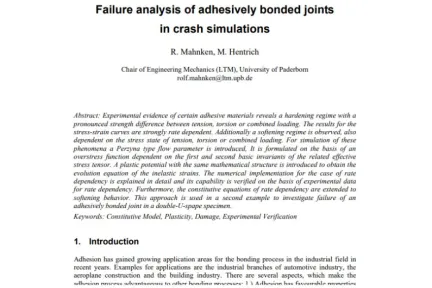
Failure analysis of adhesively bonded joints in crash simulations

Experimental evidence of certain adhesive materials reveals a hardening regime with a pronounced strength difference between tension, torsion or combined loading. The results for the stress-strain curves are strongly rate dependent. Additionally a softening regime is observed, also dependent on the stress state of tension, torsion or combined loading. For simulation of these phenomena a Perzyna type flow parameter is introduced, It is formulated on the basis of an overstress function dependent on the first and second basic invariants of the related effective stress tensor.

Customer Papers

Failure analysis of adhesively bonded joints in crash simulations
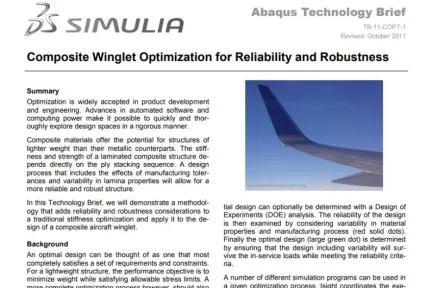
Composite Winglet Optimization for Reliability and Robustness

Optimization is widely accepted in product development and engineering. Advances in automated software and computing power make it possible to quickly and thoroughly explore design spaces in a rigorous manner. In this Technology Brief, we will demonstrate a methodology that adds reliability and robustness considerations to a traditional stiffness optimization and apply it to the design of a composite aircraft winglet.

Customer Papers

Composite Winglet Optimization for Reliability and Robustness
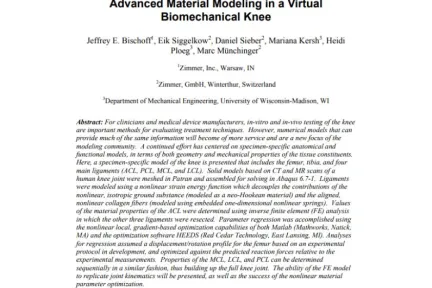
Advanced Material Modeling in a Virtual Biomechanical Knee

For clinicians and medical device manufacturers, in-vitro and in-vivo testing of the knee are important methods for evaluating treatment techniques. However, numerical models that can provide much of the same information will become of more service and are a new focus of the modeling community. A continued effort has centered on specimen-specific anatomical and functional models, in terms of both geometry and mechanical properties of the tissue constituents. Here, a specimen-specific model of the knee is presented that includes the femur, tibia, and four main ligaments. Solid models based on CT and MR scans of a human knee joint were meshed in Patran and assembled for solving in Abaqus 6.7-1.

Customer Papers

Advanced Material Modeling in a Virtual Biomechanical Knee
有 250 个结果

客户成功故事

有 151 个结果
有 4 个结果

SIMULIA 自学

我们提供数百个自学模块,以便您能够在方便的时间不断学习

博客

欢迎阅读 SIMULIA 博客,了解最新报道以及我们专家的最新创新。

有 701 个结果

了解 SIMULIA 可以为您带来哪些价值

与 SIMULIA 专家交流,了解我们的解决方案如何在各种规模的企业中实现无缝协作和可持续创新。

开始使用

现为学生、学术机构、专业人士和企业提供各类课程与培训。查找适合您的 SIMULIA 培训。 

获取帮助

查找有关软硬件认证、软件下载、用户文档、支持联系人和服务项目的信息