有 1506 个结果
An Exploration of Stochastic Fatigue Effects of Micro-cracks in Polymer Composites

There is increasing interest in the use of organic matrix composite materials in aerospace, as it is commonly stated that composite materials show good fatigue properties. This is rather difficult to quantify. Fatigue testing to obtain a S/N curve or a Range-Mean diagram for a composite material is fraught with difficulties; test specimens are prone to significant manufacture variation and it is time consuming to get data for high fatigue life. It is recognized that microcracks exist in composite components that would normally be considered “undamaged”. It has also been found that such cracks show evidence of crack growth during fatigue testing, although such growth is tiny in the length scale of the component.

Customer Papers
An Exploration of Stochastic Fatigue Effects of Micro-cracks in Polymer Composites
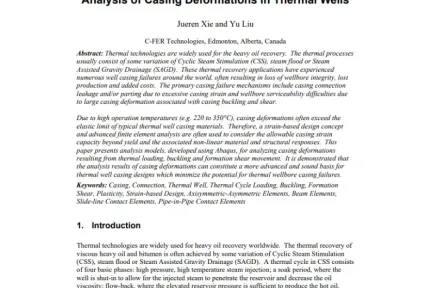
Analysis of Casing Deformations in Thermal Wells

Thermal technologies are widely used for the heavy oil recovery. The thermal processes usually consist of some variation of Cyclic Steam Stimulation (CSS), steam flood or Steam Assisted Gravity Drainage (SAGD). These thermal recovery applications have experienced numerous well casing failures around the world, often resulting in loss of wellbore integrity, lost production and added costs. The primary casing failure mechanisms include casing connection leakage and/or parting due to excessive casing strain and wellbore serviceability difficulties due to large casing deformation associated with casing buckling and shear.

Customer Papers

Analysis of Casing Deformations in Thermal Wells
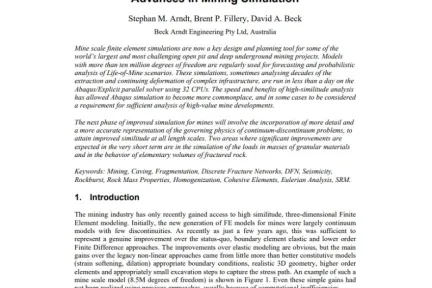
Advances in Mining Simulation

Mine scale finite element simulations are now a key design and planning tool for some of the world’s largest and most challenging open pit and deep underground mining projects. Models with more than ten million degrees of freedom are regularly used for forecasting and probabilistic analysis of Life-of-Mine scenarios. These simulations, sometimes analysing decades of the extraction and continuing deformation of complex infrastructure, are run in less than a day on the Abaqus/Explicit parallel solver using 32 CPUs. The speed and benefits of high-similitude analysis has allowed Abaqus simulation to become more commonplace, and in some cases to be considered a requirement for sufficient analysis of high-value mine developments.

Customer Papers

Advances in Mining Simulation
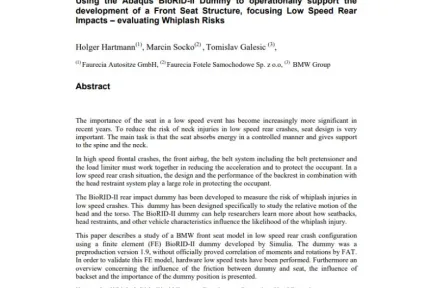
Using the Abaqus BioRID-II Dummy to operationally support the development of a Front Seat Structure, focusing Low Speed Rear Impacts – evaluating Whiplash Risks

This paper describes a study of a BMW front seat model in low speed rear crash configuration using a finite element (FE) BioRID-II dummy developed by Simulia. The dummy was a preproduction version 1.9, without officially proved correlation of moments and rotations by FAT. In order to validate this FE model, hardware low speed tests have been performed. Furthermore an overview concerning the influence of the friction between dummy and seat, the influence of backset and the importance of the dummy position is presented.

Customer Papers

Using the Abaqus BioRID-II Dummy to operationally support the development of a Front Seat Structure, focusing Low Speed Rear Impacts – evaluating Whiplash Risks
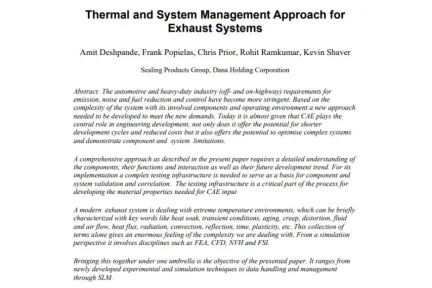
Thermal and System Management Approach for Exhaust Systems

The automotive and heavy-duty industry (off- and on-highway) requirements for emission, noise and fuel reduction and control have become more stringent. Based on the complexity of the system with its involved components and operating environment a new approach needed to be developed to meet the new demands. Today it is almost given that CAE plays the central role in engineering development, not only does it offer the potential for shorter development cycles and reduced costs but it also offers the potential to optimise complex systems and demonstrate component and system limitations.

Customer Papers

Thermal and System Management Approach for Exhaust Systems
Elasto-Plastic Constitutive Model for Finite Element Simulation of structural Adhesives

Considered by the automotive industry as a good solution to bond car body parts together, structural adhesives must be integrated in the early design process of vehicles, hence in the finite element analysis. A first difficulty when modeling structural adhesives comes from their complex mechanical pressure-dependent behaviour as well as their load-dependent strength. These aspects make them impossible to describe by classical material constitutive models such as von Mises or exponent Drucker-Prager, in the general case.

Customer Papers

Elasto-Plastic Constitutive Model for Finite Element Simulation of structural Adhesives
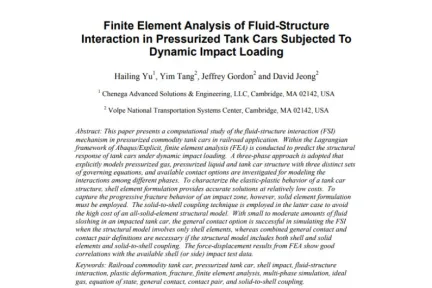
Finite Element Analysis of Fluid-Structure Interaction in Pressurized Tank ars Subjected To Dynamic Impact Loading

This paper presents a computational study of the fluid-structure interaction (FSI) mechanism in pressurized commodity tank cars in railroad application. Within the Lagrangian framework of Abaqus/Explicit, finite element analysis (FEA) is conducted to predict the structural response of tank cars under dynamic impact loading. A three-phase approach is adopted that explicitly models pressurized gas, pressurized liquid and tank car structure with three distinct sets of governing equations, and available contact options are investigated for modeling the interactions among different phases.

Customer Papers

Finite Element Analysis of Fluid-Structure Interaction in Pressurized Tank ars Subjected To Dynamic Impact Loading
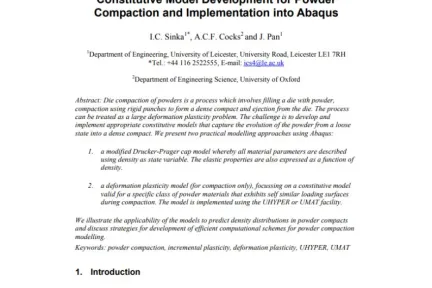
Constitutive Model Development for Powder Compaction and Implementation into Abaqus

Die compaction of powders is a process which involves filling a die with powder, compaction using rigid punches to form a dense compact and ejection from the die. The process can be treated as a large deformation plasticity problem. The challenge is to develop and implement appropriate constitutive models that capture the evolution of the powder from a loose state into a dense compact. We illustrate the applicability of the models to predict density distributions in powder compacts and discuss strategies for development of efficient computational schemes for powder compaction modelling.

Customer Papers

Constitutive Model Development for Powder Compaction and Implementation into Abaqus
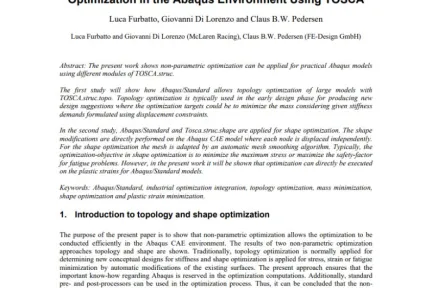
Optimization in the Abaqus Environment Using TOSCA

The first study will show how Abaqus/Standard allows topology optimization of large models with TOSCA.struc.topo. Topology optimization is typically used in the early design phase for producing new design suggestions where the optimization targets could be to minimize the mass considering given stiffness demands formulated using displacement constraints. In the second study, Abaqus/Standard and Tosca.struc.shape are applied for shape optimization. The shape modifications are directly performed on the Abaqus CAE model where each node is displaced independently. For the shape optimization the mesh is adapted by an automatic mesh smoothing algorithm.

Customer Papers

Optimization in the Abaqus Environment Using TOSCA
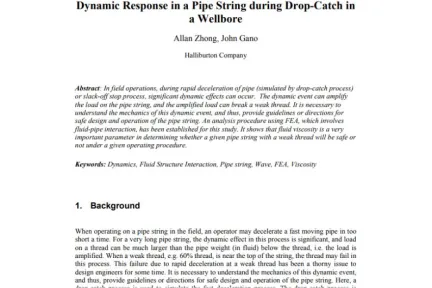
Dynamic Response in a Pipe String during Drop-Catch in a Wellbore

In field operations, during rapid deceleration of pipe (simulated by drop-catch process) or slack-off stop process, significant dynamic effects can occur. The dynamic event can amplify the load on the pipe string, and the amplified load can break a weak thread. It is necessary to understand the mechanics of this dynamic event, and thus, provide guidelines or directions for safe design and operation of the pipe string. An analysis procedure using FEA, which involves fluid-pipe interaction, has been established for this study. It shows that fluid viscosity is a very important parameter in determining whether a given pipe string with a weak thread will be safe or not under a given operating procedure.

Customer Papers

Dynamic Response in a Pipe String during Drop-Catch in a Wellbore
Modelling of an Improvement Device for a Tension Test Machine in Crippling Tests

An analysis of the crippling test applied to thin profiles is considered in this paper by using a standard tension test machine. Crippling tests are compression tests leading to crush collapse. This kind of tests cannot be properly performed in the standard test machine because of an inefficient transmission of the compression load to the specimen. To accomplish a more accurate test an improvement device is designed and modelled.

Customer Papers

Modelling of an Improvement Device for a Tension Test Machine in Crippling Tests
Realistic Modeling of Structural Steels with Yield Plateau Using AbaqusStandard

A new model for structural steel with capabilities to model yield plateau, as well as cyclic behavior is introduced. The model is incorporated into Abaqus/Standard through UMAT. Numerical results are presented for an application in earthquake engineering, where a steel bridge pier is excited with a quasi-static cyclic lateral load. Hysteresis loops and buckling patterns obtained from the computational model are compared with published experimental results.

Customer Papers

Realistic Modeling of Structural Steels with Yield Plateau Using AbaqusStandard
有 246 个结果

客户成功故事

有 150 个结果
有 6 个结果

SIMULIA 自学

我们提供数百个自学模块,以便您能够在方便的时间不断学习

博客

欢迎阅读 SIMULIA 博客,了解最新报道以及我们专家的最新创新。

有 694 个结果

了解 SIMULIA 可以为您做些什么

与 SIMULIA 专家交谈,了解我们的解决方案如何在各种规模的企业中实现无缝协作和可持续创新。

启动开发

课程面向学生、学术界、专业人士和企业开放。查找适合您的 SIMULIA 培训。

获得帮助

查找有关软硬件认证、软件下载、用户文档、支持联系人和服务项目的信息