有 1511 个结果
Periprosthetic stress shielding in patello-femoral arthroplasty: a numerical analysis

Total knee replacement gives proven good results for isolated patello-femoral osteoarthritis, but patello-femoral arthroplasty may be more appropriate because only the joint compartment is replaced. Although the femoral component of a patello-femoral prosthesis is smaller than in total knee arthroplasty, it is unknown whether strain-adaptive periprosthetic bone remodeling occurs following patello-femoral arthroplasty. The aim of the study was to evaluate and compare the stress shielding effect of prosthetic replacement with Finite Element modeling.

Customer Papers
Periprosthetic stress shielding in patello-femoral arthroplasty: a numerical analysis
Automotive Brake Squeal Analysis Using a Complex Modes Approach

A methodology to study friction-induced squeal in a complete automotive disc brake assembly is presented. The analysis process uses a nonlinear static simulation sequence followed by a complex eigenvalue extraction to determine the dynamic instabilities that are manifested as unwanted noise. The effects of assembly loads; nonuniform contact pressure between the brake linings and disc; velocity-, temperature-, and pressure-dependent friction coefficients; friction-induced damping; and lining wear can be included. The methodology is demonstrated with a representative disc brake assembly. Good correlation between the analysis results and available experimental data is achieved.

Solution Briefs

Automotive Brake Squeal Analysis Using a Complex Modes Approach
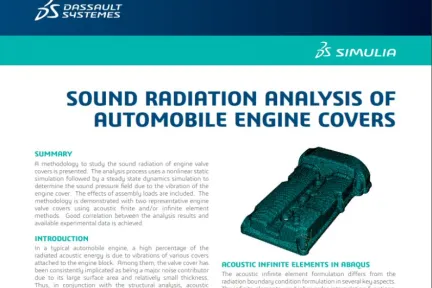
Sound Radiation Analysis of Automobile Engine Covers

A methodology to study the sound radiation of engine valve covers is presented. The analysis process uses a nonlinear static simulation followed by a steady state dynamics simulation to determine the sound pressure field due to the vibration of the engine cover. The effects of assembly loads are included. The methodology is demonstrated with two representative engine valve covers using acoustic finite and/or infinite element methods. Good correlation between the analysis results and available experimental data is achieved.

Solution Briefs

Sound Radiation Analysis of Automobile Engine Covers
XFEM Analyses of Critical Cracks in a Pressure Tap for a 40mm Gun Breech

Critical flaw size was estimated using the Extended Finite Element Method (XFEM) capabilities in the general purpose finite element program ABAQUS. Results suggest that the pressure loads were not high enough to initiate a crack or propagate cracks within the critical defect size limits of the breech for pressure loads currently used in test and evaluation. The results are consistent with the 150+ successful shots that have been completed and the 1000+ shots completed on a similar breech with similar pressure taps.

Customer Papers

XFEM Analyses of Critical Cracks in a Pressure Tap for a 40mm Gun Breech
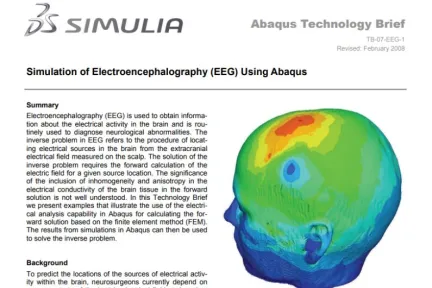
Simulation of Electroencephalography Using Abaqus

In this Technology Brief we present some results from simulations performed on a model of a human head [4]. The distributions of electrical potentials and currents within the model are calculated for known source locations in the brain. The electrical conductivity in the model is considered to be inhomogeneous as well as anisotropic.

Solution Briefs

Simulation of Electroencephalography Using Abaqus
Simulation of the Quasi-static Crushing of a Fabric Composite Plate

In this Technology Brief, we describe a methodology for modeling the crushing behavior of composite structures using Abaqus/Explicit. Very good quantitative and qualitative agreement between the numerical results and experimental data is shown, demonstrating the utility of Abaqus/ Explicit for assessing the crashworthiness of composite structures and reducing the amount of costly experimental testing.

Solution Briefs

Simulation of the Quasi-static Crushing of a Fabric Composite Plate
Shock Response and Acoustic Radiation Analysis

In this technology brief two related but distinct analyses are examined. First, the shock response of an example structure due to a shock event is considered. Second, the steady-state acoustic field established due to machineryinduced vibrations within and around the structure is estimated.

Solution Briefs

Shock Response and Acoustic Radiation Analysis
Dynamic Design Analysis Method Response Spectrum Analysis with Abaqus

The Dynamic Design Analysis Method (DDAM) is a U.S. Navy methodology for qualifying shipboard equipment and supporting structures for survival of shock loading due to underwater explosions (UNDEX). The DDAM is a regimented collection of procedures that utilize estimates of the peak linear dynamic response of ship equipment and structures obtained from normal mode response spectrum analyses. The response spectra are usually based upon empirically obtained Shock Design Values (SDVs) that are dependent on the type of ship, mounting location, direction of attack, response frequencies, and overall survivability requirements.

Solution Briefs

Dynamic Design Analysis Method Response Spectrum Analysis with Abaqus
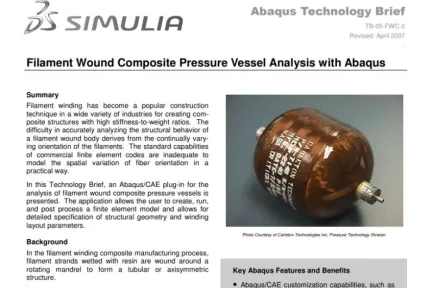
Filament Wound Composite Pressure Vessel Analysis with Abaqus

In this Technology Brief, an Abaqus/CAE plug-in for the analysis of filament wound composite pressure vessels is presented. The application allows the user to create, run, and post process a finite element model and allows for detailed specification of structural geometry and winding layout parameters.

Solution Briefs

Filament Wound Composite Pressure Vessel Analysis with Abaqus
Optimisation of Welds with Manufacturing Considerations

Fatigue is the main in-service failure mode for automotive chassis & suspension parts, especially weld fatigue. Over the years, Tata Steel Automotive Engineering (TSAE) has developed techniques for CAE durability assessment including the optimisation of seam-welded chassis/suspension structures. Seam weld optimisation at TSAE has previously been based on a constant weld length and constant gap between welds for each weld run. This method has two drawbacks; weld patterns generated are regular in nature, reducing the flexibility to position welds where they are most effective and· excessively short welds are often left at the end of a run of welds. The objective was to develop an improved optimisation technique using Isight that always produced a manufacturing feasible design and allowed more flexible and irregular positioning of welds. Manufacturing constraints considered were minimum weld length, minimum gap length and minimising the number of start/stop operations.

Customer Papers

Optimisation of Welds with Manufacturing Considerations
有 250 个结果

客户成功故事

有 151 个结果
有 4 个结果

SIMULIA 自学

我们提供数百个自学模块,以便您能够在方便的时间不断学习

博客

欢迎阅读 SIMULIA 博客,了解最新报道以及我们专家的最新创新。

有 701 个结果

了解 SIMULIA 可以为您带来哪些价值

与 SIMULIA 专家交流,了解我们的解决方案如何在各种规模的企业中实现无缝协作和可持续创新。

开始使用

现为学生、学术机构、专业人士和企业提供各类课程与培训。查找适合您的 SIMULIA 培训。 

获取帮助

查找有关软硬件认证、软件下载、用户文档、支持联系人和服务项目的信息