
Circularity in Every Turn of the Blade
Discover how a leading wind turbine blade supplier used CATIA on the 3DEXPERIENCE platform to optimize blade design, cut waste and reduce its carbon footprint.
How One Industry Leader Advances Wind Turbine Blade Design To Minimizes Material Waste
When a wind turbine blade supplier wanted to reduce its fiberglass waste, Dassault Systèmes offered an automated simulation solution to make it a reality.
The global push for decarbonization is driving the wind power industry forward. Yet, like any other sector, this growing market still consumes significant resources, contributing to its own carbon footprint.
For one leading wind turbine supplier, the key challenge is slashing resource consumption — an essential step toward truly sustainable renewable energy.
With over 40 years of experience in wind turbine blade manufacturing, the company recognized that staying competitive requires continuous innovation. So, it wasted no time to take decisive action to turn things around.
By adopting an integrated composite solution for design, simulation and manufacturing, the company has successfully reduced scrap and optimized material usage.
Instead of manually cutting flat patterns for molding, the company now simulates the process — precisely modeling the cutouts of fiberglass and other materials.
The results? 4% less fiberglass waste per wind turbine blade — directly lowering emissions and conserving resources while driving a faster, more sustainable production process.
Discover how Dassault Systèmes' CATIA solution helped this global supplier minimize waste, shrink its carbon footprint and take meaningful steps toward a decarbonized future.
About the Customer
Use Case: Deployment of CATIA on the 3DEXPERIENCE® platform to optimize wind turbine blade design by precisely modeling cutouts in flat material patterns, reducing waste and enhancing design fidelity and quality while lowering costs.
Industry
Wind energy
Company size
9,800 employees
Location
Strong presence in 10 countries worldwide
The Challenge
The customer's key challenges stemmed directly from its:
I. Business Needs
a. Reduce environmental impact by minimizing material waste and lowering emissions to align with decarbonization targets
b. Cut operational costs and increase production capacity for better profit margins and faster time to market
II. Operational Requirements
Adopt technology with simulation capabilities and advanced patterning techniques to minimize the material input needed for each wind turbine blade and streamline overall operations.
The Solution
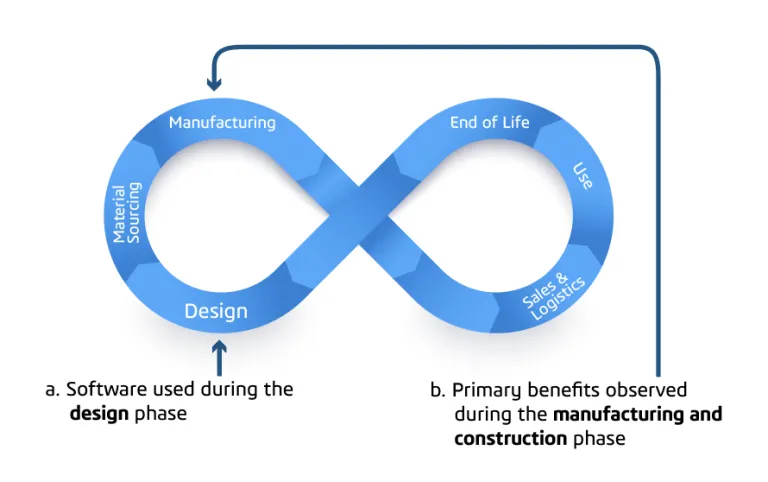
Dassault Systèmes' approach addressed a crucial part of the process to achieve this objective:
a. Software used during the design phase
b. Primary benefits observed during the manufacturing and construction phase
The Outcome
By leveraging CATIA's advanced composite capabilities, the wind turbine supplier successfully transformed its design process. As a result, it drastically reduced material waste - reinforcing sustainability and promoting circularity in every blade.
With precise modeling of cutouts in rolled-out flat material patterns, the company optimized material usage, cutting fiberglass waste from 15% to just 8%. But the benefits went beyond material savings.

With CATIA's integrated design, simulation and manufacturing capabilities, the company embraced flat patterning and laser projection technology, effectively cutting fiberglass mass per blade by 4%. This strategic shift helped the company minimize scrap, maximize resource efficiency and reduce raw materials consumption per blade. These improvements, in turn, translate into a measurable decrease in emissions, directly lowering the company's carbon footprint.

The End Result
Methods
The avoided emission estimation was estimated following the:
- EU Taxonomy (Regulation Guideline), ISO 14067, 11044 and Guidance of WBCSD Net Zero Initiative Guidelines.
- Methodology based on the comparison of two scenarios for one given functional unit (ISO 14067:2018 and ISO 14064-2:2019).
- 3DS methodology has been certified by an independent third party and elaborated in compliance with the EU Taxonomy (Regulation Guideline), ISO 14067, 11044 and Guidance of WBCSD Net Zero Initiative Guidelines. The end result expressed in tCO2e remains an estimation.
Measuring the Sustainability Benefits of Our Solutions
Discover how we accurately quantify the sustainability benefits of our solutions for customers, using a certified methodology. Through real-world use cases, see how we support organizations in their sustainability transition, delivering tangible, measurable results.
Frequently Asked Questions
Sources
1Each of these case studies is a past or current project for which emissions avoided or reduced have been estimated following EU Taxonomy (Regulation Guideline), ISO 14067, 11044 and Guidance of WBCSD Net Zero Initiative Guidelines. The 3DS approach and these calculations, along with the allocated contribution of the software, have been certified by an independent third party. External View URD 2023, Chapter 2.
Related Content
Regulatory Compliance
Drive profitability and meet consumer demands while ensuring regulatory compliance with the 3DEXPERIENCE® platform.
Generate Clean Energy Profitably With Sustainable Wind Turbines
Accelerate sustainable wind turbine and learn about zero-waste goals & circular design principles to minimize the environmental impact of turbine manufacturing.
Circular Economy
How circular economy practices can help your business dare to be bold through new business models that preserve the environment for future generations.
Circularity in Action
It’s time for concerted action. Here’s how to make the circular economy achievable, scalable and profitable.