How Biomimicry Drives Circular Innovation
Nature has solved complex problems for billions of years. Biomimicry transforms these lessons into sustainable innovations.
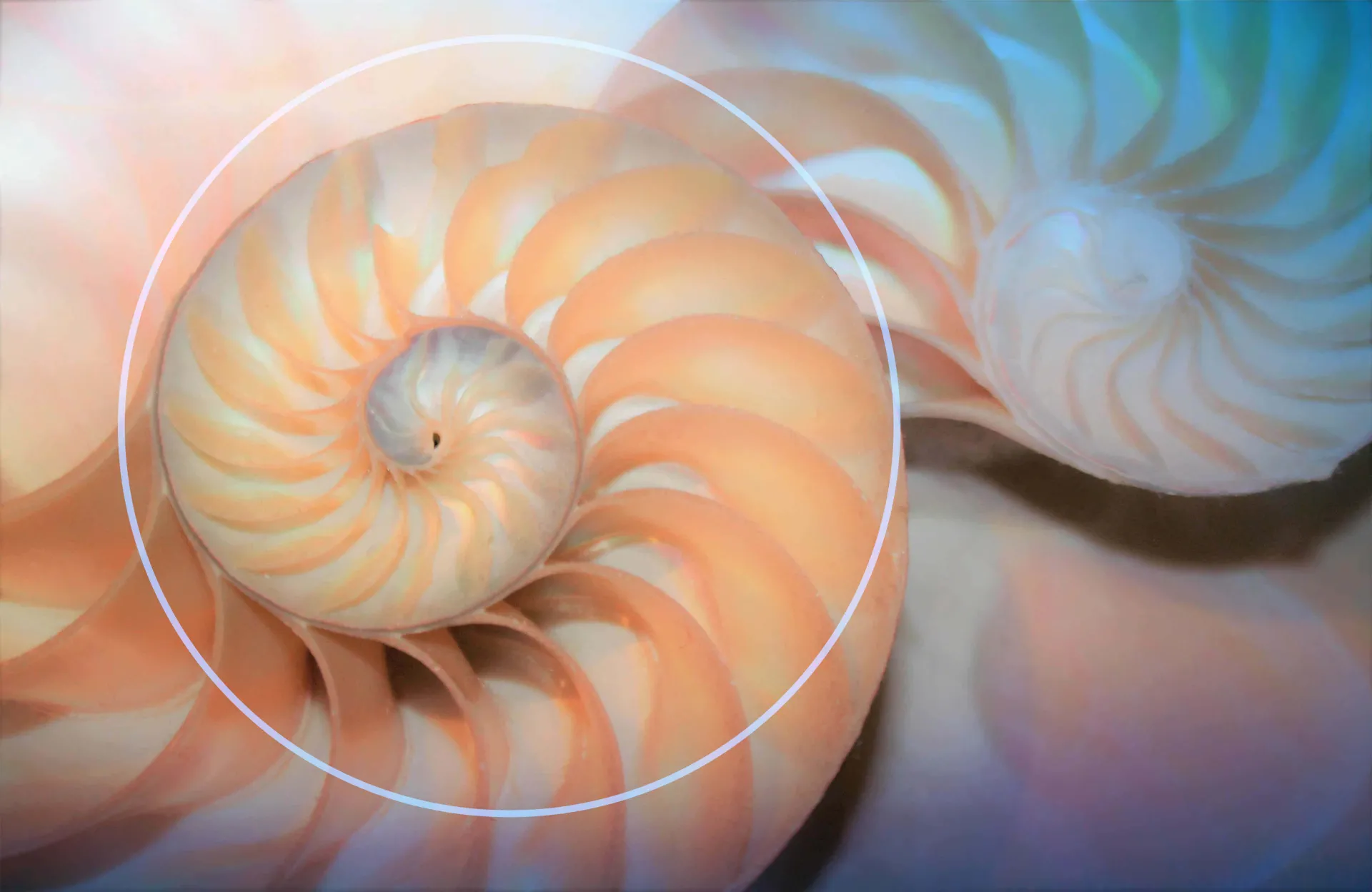
What if the answers to some of today’s biggest challenges were hiding in plain sight? Well, when it comes to sustainable and circular economy, they are. Consider a leaf. It functions as a solar panel, water pipeline and cooling system all in one. Or what about the self-sustaining environment of a coral reef, or the lightweight yet almost unbreakable strength of a seashell? Nature has spent billions of years perfecting designs that are efficient, resilient and endlessly adaptable. It’s little wonder that many of humanity’s greatest innovations can be traced back to the natural world.
So why not take nature’s designs as a starting point for circular innovation?
Engineers and designers are doing just that through biomimicry – an approach that takes inspiration from strategies in the natural world and applies them to human challenges. By studying how ecosystems cycle resources, adapt and regenerate, they’re uncovering new ways to make, use and reuse products. And in doing so, they are finding exciting ways to drive circular economy practices where resources are kept in use and systems continuously regenerate.
What is Circular Innovation and How Does it Link to Biomimicry?
Circular innovation is about designing products, processes and systems so that resources flow in closed loops, just as they do in nature. Circular economy is the opposite of most modern design approaches, which still follow a linear path: make something, use it, then throw it away. Here, waste is seen as unavoidable, and sustainability often comes as an afterthought.
Biomimicry turns this thinking on its head. Instead of asking “What can we build?” it asks “How would nature solve this?” With this perspective, we begin to see waste as a flaw that can be designed out.
The Biomimicry Institute sets out three guiding principles of biomimicry:

Emulate
Learn directly from nature’s strategies and processes.

Ethos
Create conditions that actively support biodiversity and prevent damage to it.
Reconnect
Deepen our relationship with the natural world to guide wiser choices.
How Biomimicry Supports Biodiversity
It goes without saying that not every “nature-inspired” design is sustainable. A product shaped like a leaf but made from toxic plastic is “bio-inspired,” not regenerative. To truly support biodiversity, companies must therefore:
- Go beyond appearances by imitating processes and systems, not just forms
- Anticipate all, including unintended, consequences with lifecycle assessments and systems thinking
- Invest in biodiversity through regenerative sourcing, conservation programs or habitat restoration.
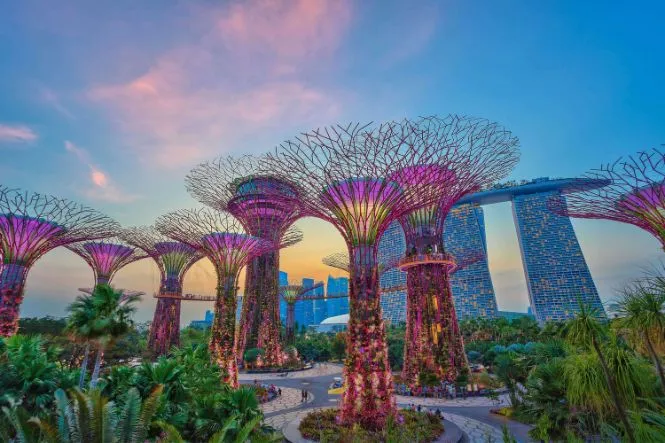
Singapore’s Gardens by the Bay shows what happens when ecological principles guide design. Its striking 50 meter-high Supertrees are both impressive architectural landmarks and carefully engineered models of biodiversity. Each vertical structure is a mini ecosystem, capturing rainwater, cooling air, generating solar power and supporting almost 163,00 plants covering over 200 species. Combined with the park’s aquatic systems, which filter and recycle water to sustain biodiversity, they form a closed-loop environment that echoes how natural ecosystems cycle resources.
Examples like this demonstrate that the most successful biomimicry solutions work in both directions: drawing inspiration from nature while actively helping to protect the ecosystems that make innovation possible.
Engineering Inspired by Nature
Nature’s library of solutions is vast and proven. Velcro came from studying burdock burrs clinging to fur. Mussels, which hold fast to rocks in powerful waves, inspired waterproof adhesives. Lotus leaves, which shed dirt with every raindrop, gave rise to self-cleaning surfaces. Today, efforts are being made to take these lessons further and adapt such designs to make them even more sustainable, energy efficient and better aligned with the needs of a regenerative, circular economy.
In Dassault Systèmes’ 3DEXPERIENCE Lab, innovators are testing how biomimicry can lead to design and engineering breakthroughs. Artist Kate Reed designs wearable technology guided by biomimicry’s principles to create pieces that are adaptable and resource conscious. French startup EEL Energy has developed a tidal generator, which mimics fish movements to capture energy from water currents. In another project, autonomous marine vehicles emulate sea turtles to clear up plastic waste from oceans. Their rigid body structure and buoyancy control, which lets them hold position while swimming, make them ideally suited for tracking and containing floating debris.
These aren’t just clever tricks borrowed from nature. They’re proof that biomimicry is a design methodology with broad applications across energy, materials science, consumer products and more.
Applying Circular Biomimicry to Systems
When biomimicry is applied at the systems level, there are even greater possibilities to unlock circular, regenerative models in industry and cities, where waste from one process becomes a resource for another.
For businesses, this involves looking at their supply chains as ecosystems. Here, materials are recaptured and reused, just as forests recycle every fallen leaf. In materials science, the shift from toxic, energy-intensive formulas to benign alternatives is gaining momentum. For example, researchers are developing spider silk-inspired fibers and adhesives – produced through bacterial fermentation and water-based spinning – that are strong, flexible and biodegradable, and use less energy and fewer harmful chemicals than nylon, polyester and conventional synthetic adhesives. Dassault Systèmes’ BIOVIA solutions support this transition by simulating these safer, bio-inspired materials. At the same time, lightweight structures modeled on natural forms like honeycomb or bone can be designed in CATIA or SOLIDWORKS to reduce material use while boosting strength and reducing overall costs and emissions.
Cities, too, can take their cue from natural ecosystems. Rain gardens mimic wetlands to manage stormwater, turning runoff into a resource that supports biodiversity. Building designs modeled on termite mounds regulate temperature naturally, cutting down on the need for energy-intensive air conditioning.
Digital Tools Make Biomimicry Practical and Scalable
Translating biology into real-world design isn’t simple. A mussel’s adhesive ability or a termite mound’s ventilation system cannot simply be copied; they must be studied, modeled, adapted and scaled.
Dassault Systèmes provides the advanced digital capabilities to make this possible:
Generative Design
Explores geometry guided by performance requirements and real-world conditions, often resembling organic forms
Additive Manufacturing
Makes it possible to produce complex structures like bone cavities or nautilus shells that traditional methods cannot.
Simulation
Makes it possible to adapt nature’s designs for human use. Engineers analyze how natural objects achieve certain characteristics, test designs virtually, and select optimal geometries and materials to replicate natural performance
Virtual Twins
Replicate entire products and systems in the virtual world, allowing teams to test and refine biomimetic concepts before physically building them, and then continuously monitor performance throughout their lifecycle
Lifecycle Assessment Capabilities
Help scientists design benign chemistries and measure environmental impact across a product’s life.
Towards a Regenerative Future
Biomimicry encourages us to see nature as a mentor with billions of years of valuable experience in resilience and renewal.
As businesses across all sectors step up their sustainability efforts and move towards the circular economy, biomimicry provides many of the solutions we’re looking for. Ecosystems have thrived for billions of years by cycling resources, creating optimal conditions for life and adapting to change. By learning from them, and applying nature’s principles responsibly with the right tools, businesses and communities can build systems and products that continuously sustain and restore.
Indeed, the future of innovation may not actually come down to our ability to invent something entirely new, but instead from rediscovering what the natural world has known all along.
FAQ on Biomimicry and Circular Economy
Related Content
Biodiversity Through Circularity
With virtual twin-powered strategies, businesses can protect biodiversity while unlocking new revenue streams.
Biomimicry
Explore the stories of two innovators drawing inspiration from marine life to produce green energy, and to clean up floating plastic in the ocean.
Restore Biodiversity with Technology
As biodiversity faces growing threats, can technology truly reshape how we preserve and restore ecosystems through innovative solutions?