There are 1483 results
A Study on Predicting the Long-term Creep Behavior of Plastics using the Short-term Creep Test

The creep performance of plastics is one of the main criteria for a variety of applications with strict dimensional stability needs, including electrical/electronic parts and various automotive applications. However obtaining or generating accurate creep data is very difficult for both resin suppliers and product designers because the creep property is time dependent, which means it takes over several weeks or even a year time span. Hence a faster and more reliable method of predicting creep behavior of plastics is required when designing plastic products that will encounter long-term loading. This work presents an easy method for predicting the long-term creep behavior of plastics using the short-term creep experimental data.

Customer Papers
A Study on Predicting the Long-term Creep Behavior of Plastics using the Short-term Creep Test
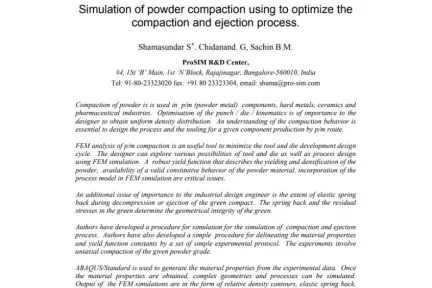
Simulation of powder compaction using to optimize the compaction and ejection process.

Compaction of powder is is used in p/m (powder metal) components, hard metals, ceramics and pharmaceutical industries. Optimisation of the punch / die / kinematics is of importance to the designer to obtain uniform density distribution. An understanding of the compaction behavior is essential to design the process and the tooling for a given component production by p/m route. FEM analysis of p/m compaction is an useful tool to minimize the tool and die development design cycle. The designer can explore various possibilities of tool and die as well as process design using FEM simulation. A robust yield function that describes the yielding and densification of the powder, availability of a valid constitutive behavior of the powder material, incorporation of the process model in FEM simulation are critical issues.

Customer Papers

Simulation of powder compaction using to optimize the compaction and ejection process.
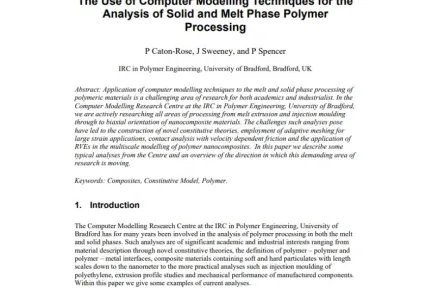
The Use of Computer Modelling Techniques for the Analysis of Solid and Melt Phase Polymer Processing

Application of computer modelling techniques to the melt and solid phase processing of polymeric materials is a challenging area of research for both academics and industrialist. In the Computer Modelling Research Centre at the IRC in Polymer Engineering, University of Bradford, we are actively researching all areas of processing from melt extrusion and injection moulding through to biaxial orientation of nanocomposite materials. The challenges such analyses pose have led to the construction of novel constitutive theories, employment of adaptive meshing for large strain applications, contact analysis with velocity dependent friction and the application of RVEs in the multiscale modelling of polymer nanocomposites. In this paper we describe some typical analyses from the Centre and an overview of the direction in which this demanding area of research is moving.

Customer Papers

The Use of Computer Modelling Techniques for the Analysis of Solid and Melt Phase Polymer Processing
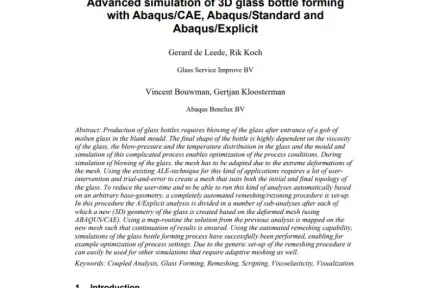
Advanced simulation of 3D glass bottle forming with AbaqusCAE, AbaqusStandard and AbaqusExplicit

Production of glass bottles requires blowing of the glass after entrance of a gob of molten glass in the blank mould. The final shape of the bottle is highly dependent on the viscosity of the glass, the blow-pressure and the temperature distribution in the glass and the mould and simulation of this complicated process enables optimization of the process conditions. During simulation of blowing of the glass, the mesh has to be adapted due to the extreme deformations of the mesh. Using the existing ALE-technique for this kind of applications requires a lot of userintervention and trial-and-error to create a mesh that suits both the initial and final topology of the glass.

Customer Papers

Advanced simulation of 3D glass bottle forming with AbaqusCAE, AbaqusStandard and AbaqusExplicit
Three Dimensional Numerical Modelling of Foundation Systems for Offshore Wind Energy Plants

Offshore wind energy plants promise to become an important source of energy in the near future. It is expected that within 10 years, wind parks with a total capacity of thousands of megawatts will be installed in European seas. The foundation of such offshore wind energy plants plays an important role in the stability of these structures. High demands have to be made concerning foundation design and construction methods to find economical and technically optimal solutions. Two foundation concepts which can be used in this field are the monopile and the tripod.

Customer Papers

Three Dimensional Numerical Modelling of Foundation Systems for Offshore Wind Energy Plants
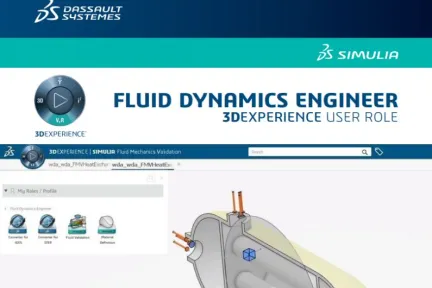
FLUID DYNAMICS ENGINEER 3DEXPERIENCE USER ROLE

Fluid Dynamics Engineer provides designers and design engineers with the ability to validate fluid performance for internal and external flows. The users can make use of the obtained results to optimize their designs for flow distribution, thermal performance, pressure loss and turbulence. Computational Fluid Dynamics (CFD) technology is employed during the product design process with minimal knowledge of CFD principles and applications.

Brochures

FLUID DYNAMICS ENGINEER 3DEXPERIENCE USER ROLE
Simulation of Descaling during Continuous Hot Rolling

Oxidation of the steel surface is always present during hot rolling and the oxide has to be eliminated before deformation to avoid imprinting and damaging the surface. It is normal practice to use high pressure water jets (descaling) to break and remove the oxide layer formed at different stages. The design of the descaling stations is carried out by trail and error without a systematic way to confirm the benefits of a given design. A model was developed using the commercial software ABAQUSTM/Standard in order to evaluate the mechanical integrity of the secondary oxide found on low carbon steel during hot rolling.

Customer Papers

Simulation of Descaling during Continuous Hot Rolling
Realistic micromechanical modeling and simulation of boron modified titanium alloys

Finite element simulations of micro-mechanical response are performed on real and computer simulated microstructures of boron modified titanium alloys containing in-situ formed Titanium Boride (TiB) phase. The microstructure model incorporates realistic particle TiB whisker morphologies/shapes and anisotropic whisker orientations. Surface-to-surface contact with finite sliding is used to model the interaction between the Vickers indenter and the sample. The computed constitutive equations are then used in 2-D and 3-D microstructural models with realistic phase morphologies/spatial distribution to simulate the global elastic-plastic mechanical response of the composite. The results are compared with the experimental data.

Customer Papers
Realistic micromechanical modeling and simulation of boron modified titanium alloys
Fatigue Damage Analysis of an Elastomeric Tank Track Component

The backerpad on the Abrams tank track system is an elastomeric cushion that protects the track and has direct contact with the tank’s wheels. The backerpad’s service life is limited by harsh operating conditions, and system designers are challenged to extend that limit. Accordingly, an analysis is demonstrated here of an experimental backerpad’s fatigue performance under the action of a tank roadwheel repeatedly rolling over the pad. First, the elastomer is characterized via tests that define its fatigue behavior. Next, the multiaxial, variable amplitude duty cycle of the pad through a representative rollover event is computed in ABAQUS/Explicit. Finally, the material characterization and duty cycle are analyzed via the fe-safe/Rubber fatigue life solver to estimate damage accumulation in each finite element of the model.

Customer Papers

Fatigue Damage Analysis of an Elastomeric Tank Track Component
SIMULATION PROCESS AND OPTIMIZATION 3DEXPERIENCE USER ROLE

Simulation Process & Optimization provides a framework for engineering teams to integrate all of the tools they use into re-usable, deployable processes. This reduces time-consuming and error prone tasks to improve productivity and consistency while enabling design exploration studies to find better designs and democratization to expand the user-base for simulation. Lastly, capturing these processes in 3DEXPERIENCE provides the traceability organizations need when making critical business decisions.

Brochures

SIMULATION PROCESS AND OPTIMIZATION 3DEXPERIENCE USER ROLE
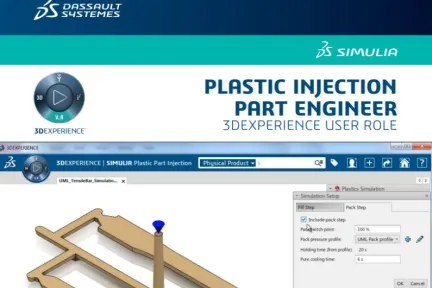
PLASTIC INJECTION PART ENGINEER 3DEXPERIENCE USER ROLE

Plastic Injection Part Engineer brings easy-to-use injection molding simulation directly to the designers of plastic parts and injection molds. It simulates how melted plastic flows during the injection molding process to predict manufacturing-related defects on plastic parts. You can quickly evaluate manufacturability while you design, to eliminate costly part redesign, improve part quality, and accelerate time to market. Plastic part designers and product developers can analyze and modify designs at the same time as optimizing for form, fit, and function.

Brochures

PLASTIC INJECTION PART ENGINEER 3DEXPERIENCE USER ROLE
Modelling of Large Open Pit Stability Using ABAQUS

The Largest, Deep Open Pits are steadily approaching depths of a kilometre. The complexity of the mining process and damage phenomena for these pits are amongst the most challenging applications of finite element simulation. Although significant advances have been made in the many areas related to mechanics of pit slopes, computer resources have limited the use of numerical modelling for open pit problems to two-dimensions or overly simplified 3d models.

Customer Papers

Modelling of Large Open Pit Stability Using ABAQUS
There are 245 results

Customer stories

There are 130 results

From the communities

There are 5 results

SIMULIA Self Learning

We provide hundreds of self-learning modules so you can continue to learn at your convenience

Blogs

Read the SIMULIA blog on the latest news and innovations from our experts.

There is no result

Learn What SIMULIA Can Do for You

Speak with a SIMULIA expert to learn how our solutions enable seamless collaboration and sustainable innovation at organizations of every size.

Get Started

Courses and classes are available for students, academia, professionals and companies. Find the right SIMULIA training for you. 

Get Help

Find information on software & hardware certification, software downloads, user documentation, support contact and services offering