
4th Wind And Drivetrain Conference Wind and Drivetrain Update
4th Wind And Drivetrain Conference Wind and Drivetrain Update
E-seminars
Find everything that you need on SIMULIA
4th Wind And Drivetrain Conference Wind and Drivetrain Update
E-seminars
Tagungsprogramm/Event Program European SIMULIA Multibody Simulation UGM Deutsches SIMULIA-Anwendertreffen/German RUM European SIMULIA Durability User Group Meeting
E-seminars

Due to size effect in nanotechnology, an appropriate pressure-dependent model is required to define the material yielding in ceramics. Current pressure-dependent models, such as the Mohr-Coulomb and Drucker-Prager (DP) models, have specific shapes and thus cannot be flexibly applied to ceramic materials. This study develops a constitutive model, an integration algorithm, and consistent tangent operators for a piecewise Drucker-Prager (PDP) model. The constitutive model with considering strain hardening with yield flows is derived. The integration algorithm is developed based on return mapping (to smooth portion, apex and corner). The consistent tangent operators are established for each return mapping case.
Customer Papers
How Multibody-System Simulation Models can Support the Design of Wind Turbines
E-seminars
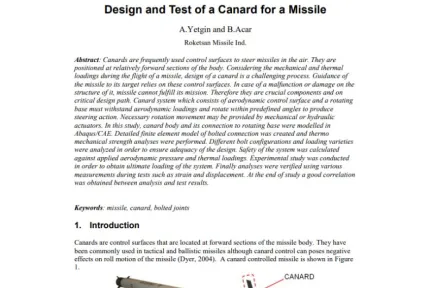
Canards are frequently used control surfaces to steer missiles in the air. They are positioned at relatively forward sections of the body. Considering the mechanical and thermal loadings during the flight of a missile, design of a canard is a challenging process. Guidance of the missile to its target relies on these control surfaces. In case of a malfunction or damage on the structure of it, missile cannot fulfill its mission. Therefore they are crucial components and on critical design path. Canard system which consists of aerodynamic control surface and a rotating base must withstand aerodynamic loadings and rotate within predefined angles to produce steering action. In this study, canard body and its connection to rotating base were modelled in Abaqus/CAE.
Customer Papers
Influence of High-Speed Axis Tilt on Gear Force of Wind Turbine Gearbox
E-seminars

Wind energy is competing with fossil fuels in many areas of the world. Smart City projects are springing up all across the globe and together with these projects also comes the huge demand for Clean Energy to power these cities, Wind Energy being one of them. According to an article in MIT Technology Review, for wind power, the bigger is the better. Higher altitudes have steadier winds, while longer turbine blades generate more power. However, bigger wind turbines raise questions on Smart City planning that needs to be answered every day. The 3DEXPERIENCE platform not only brings the technology to do design integrated simulation scenarios to give quick feedbacks but also a complete environment to connect all the stakeholders to the innovation process and tools to instantly collaborate and share ideas.
Customer Papers
FTire More Than Rubber and Cord Thermal, Flexible Rim, and RealTime
E-seminars
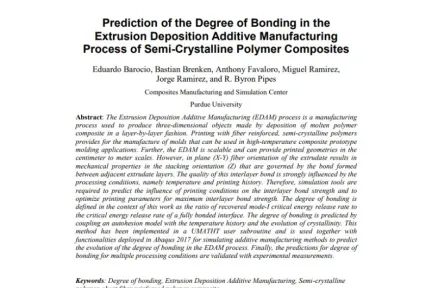
The Extrusion Deposition Additive Manufacturing (EDAM) process is a manufacturing process used to produce three-dimensional objects made by deposition of molten polymer composite in a layer-by-layer fashion. Printing with fiber reinforced, semi-crystalline polymers provides for the manufacture of molds that can be used in high-temperature composite prototype molding applications. Further, the EDAM is scalable and can provide printed geometries in the centimeter to meter scales. However, in plane (X-Y) fiber orientation of the extrudate results in mechanical properties in the stacking orientation (Z) that are governed by the bond formed between adjacent extrudate layers. The quality of this interlayer bond is strongly influenced by the processing conditions, namely temperature and printing history.
Customer Papers
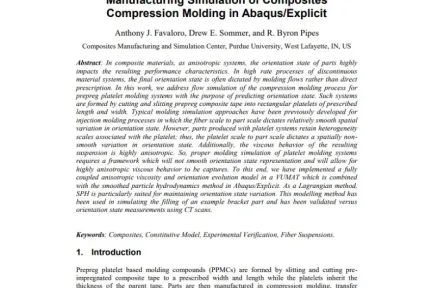
In composite materials, as anisotropic systems, the orientation state of parts highly impacts the resulting performance characteristics. In high rate processes of discontinuous material systems, the final orientation state is often dictated by molding flows rather than direct prescription. In this work, we address flow simulation of the compression molding process for prepreg platelet molding systems with the purpose of predicting orientation state. Such systems are formed by cutting and slitting prepreg composite tape into rectangular platelets of prescribed length and width. Typical molding simulation approaches have been previously developed for injection molding processes in which the fiber scale to part scale dictates relatively smooth spatial variation in orientation state.
Customer Papers
We provide hundreds of self-learning modules so you can continue to learn at your convenience
Read the SIMULIA blog on the latest news and innovations from our experts.
Speak with a SIMULIA expert to learn how our solutions enable seamless collaboration and sustainable innovation at organizations of every size.
Courses and classes are available for students, academia, professionals and companies. Find the right SIMULIA training for you.
Find information on software & hardware certification, software downloads, user documentation, support contact and services offering