There are 1483 results
Integration von Richtungsfeldern mit Standard-Optionen in Abaqus

Die zweidimensionale Differenzialgleichung y ́=f(x,y) kann als Richtungsfeld interpretiert werden. Bei ihrer Integration können kommerzielle Finite Elemente (FE) Programme ohne zusätzlichen Programmieraufwand genützt werden, sofern diese Programme Optionen zur Berechnung orthotroper Wärmeleitungsprobleme haben. Die zu integrierende Differenzialgleichung mit beliebiger Berandung wird als FE–Modell mit thermischen 2D–Elementen idealisiert. Ihre orthotropen Wärmeleitfähigkeiten werden mit k1=1 und k2=0 vorgegeben.

E-seminars
Integration von Richtungsfeldern mit Standard-Optionen in Abaqus
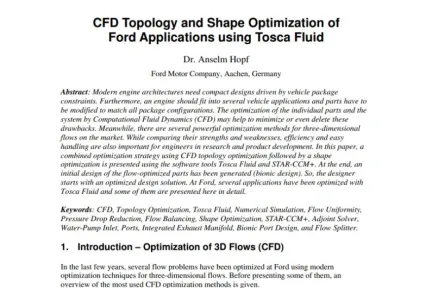
CFD Topology and Shape Optimization of Ford Applications using Tosca Fluid

Modern engine architectures need compact designs driven by vehicle package constraints. Furthermore, an engine should fit into several vehicle applications and parts have to be modified to match all package configurations. The optimization of the individual parts and the system by Computational Fluid Dynamics (CFD) may help to minimize or even delete these drawbacks. Meanwhile, there are several powerful optimization methods for three-dimensional flows on the market. While comparing their strengths and weaknesses, efficiency and easy handling are also important for engineers in research and product development. In this paper, a combined optimization strategy using CFD topology optimization followed by a shape optimization is presented using the software tools Tosca Fluid and STAR-CCM+.

E-seminars

CFD Topology and Shape Optimization of Ford Applications using Tosca Fluid
Multi-Stage, Multi-Wellbore Hydraulic Fracturing Simulation in Naturally Fractured Reservoirs Using Cohesive Zone Model

Microseismic surveys have demonstrated the abundance of natural fractures where shear slippage occurs due to hydraulic fracturing. These natural fractures and their intersection with hydraulic fractures significantly complicate the optimization of hydraulic fracturing strategies especially in shale resources with multiple simultaneous or sequential stimulation stages. The clusters’ hydraulic connection within a stage may substantially influence the hydraulic fracture propagation pattern considering the highly variable perforation efficiencies of clusters. These complexities promote the proposed developments in our poro-elastic cohesive zone models for hydraulic fracturing in Abaqus.

Tech Notes

Multi-Stage, Multi-Wellbore Hydraulic Fracturing Simulation in Naturally Fractured Reservoirs Using Cohesive Zone Model
There are 245 results

Customer stories

There are 130 results

From the communities

There are 6 results

SIMULIA Self Learning

We provide hundreds of self-learning modules so you can continue to learn at your convenience

Blogs

Read the SIMULIA blog on the latest news and innovations from our experts.

There is no result

Learn What SIMULIA Can Do for You

Speak with a SIMULIA expert to learn how our solutions enable seamless collaboration and sustainable innovation at organizations of every size.

Get Started

Courses and classes are available for students, academia, professionals and companies. Find the right SIMULIA training for you. 

Get Help

Find information on software & hardware certification, software downloads, user documentation, support contact and services offering