



The FDA Enrichment In Silico Clinical Trial Project
A collaboration between Dassault Systèmes and the U.S. FDA on a groundbreaking application of virtual twins and generative AI in healthcare
EBooks
High-fidelity cardiac digital twin for in silico clinical trials. Simulate heart-device interaction to accelerate innovation, reduce costs, and improve safety.
The SIMULIA Living Heart Human Model brings the human heart to life as a high-fidelity, multiphysics digital twin, capturing the full complexity of its four-chamber anatomy and motion.
As a validated cardiac digital twin, it integrates structural mechanics, electrical activation, and physiological motion to reproduce realistic electromechanical behavior. This enables accurate virtual evaluation of cardiovascular devices, including valves, stents, and defibrillators, under physiologically relevant conditions.
By supporting predictive in silico testing while reducing reliance on physical prototypes and animal studies, this approach accelerates innovation, lowers development costs, and improves confidence in device safety and effectiveness.
The Living Heart Model provides a powerful platform for medical device simulation, allowing engineers to model cardiac defects and diseased states, explore treatment options, and assess cardiovascular devices such as pacemakers, artificial valves, and vascular implants.
Devices can be evaluated under realistic physiological conditions to:
Understand baseline cardiac behavior with human heart simulations
Interactively update model parameters to study disease states and explore treatment options
Evaluate and improve cardiovascular devices (stents, artificial valves, pacemakers, etc.) within the beating heart
Improve decision making by virtually testing device and/or treatment options on patient-specific models or large cohorts of virtual patients
The CAD geometry is created natively in CATIA, allowing for high customizability through uniform scaling, parameter and manual morphing. It is based on new medical images of an average healthy male, with compliant geometry thereby facilitating extensions for CFD/FSI simulations.
Mesh quality and element selection have been optimized for improved performance. Myocardial tissue calibration and pericardial effects are enhanced for better fidelity, along with flexible methodologies for customizing fiber orientations. An adaptable model for simulating blood flow is implemented.
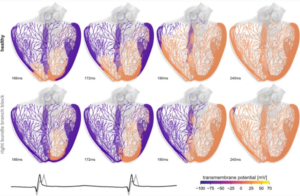
The model response aligns with broader set of demographic metrics, with a direct procedure for pre-loaded heart geometry and improved valve morphology, particularly for the tricuspid valve. A new Purkinje network and electrical calibration generate accurate electrical activation and six-channel ECG.
Enhanced support for model definition through 3DEXPERIENCE reduces keyword edits, while a comprehensive user guide and expanded training materials (including those on geometry adaptation) improve usability. Grid job submission is supported on advanced hardware without core limits.
Explore a groundbreaking study utilizing advanced 3D modeling to evaluate a novel annuloplasty ring for mitral regurgitation correction. This simulation integrates electro-mechanical and fluid dynamics, offering precise insights into heart valve function and treatment efficacy.
Discover how advanced 3D simulations are transforming pacemaker lead evaluation. From insertion to curvature dynamics, explore groundbreaking insights into cardiac device performance.
Explore advanced simulations evaluating stent deployment, durability, and fatigue under cardiac cycles. From precise 3D modeling to Goodman fatigue analysis, these studies reveal critical insights into stent performance and safety.
The Living Heart Project is a collaborative initiative led by Dassault Systèmes to develop and validate a realistic virtual model of the human heart. It brings together medical device companies, researchers, and clinicians to advance in silico testing and simulation-driven innovation. The project supports faster development, improved device validation, and the adoption of simulation in cardiovascular research and clinical applications.
The Living Heart Model was developed within the Living Heart Project, a translational initiative to advance the use of simulation in the delivery of safe and effective cardiovascular devices and clinical treatments.
Explore the technological advancements, innovative methodologies, and evolving industry demands that are reshaping the world of Cardiac Digital Twin Simulation.
A collaboration between Dassault Systèmes and the U.S. FDA on a groundbreaking application of virtual twins and generative AI in healthcare
EBooks
Doctors team with engineers to create virtual twins and usher in a new era of precision and personalized care.
Article
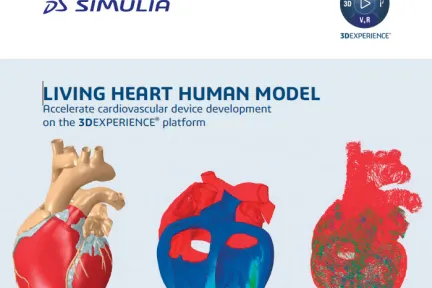
The Living Heart Human Model is a breakthrough computational model capable of simulating the realistic electromechanical behavior of a beating human heart.
Brochures
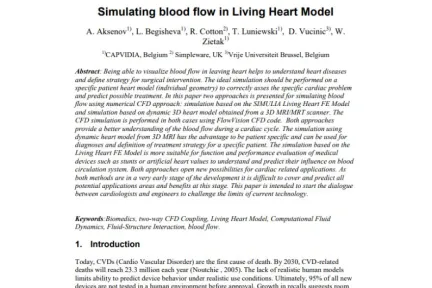
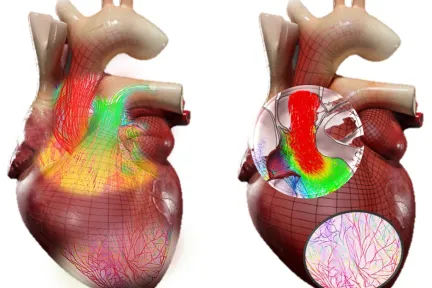
Being able to visualize blood flow in leaving heart helps to understand heart diseases and define strategy for surgical intervention. The ideal simulation should be performed on a specific patient heart model (individual geometry) to correctly asses the specific cardiac problem and predict possible treatment. In this paper two approaches is presented for simulating blood flow using numerical CFD approach: simulation based on the SIMULIA Living Heart FE Model and simulation based on dynamic 3D heart model obtained from a 3D MRI/MRT scanner. The CFD simulation is performed in both cases using FlowVision CFD code. Both approaches provide a better understanding of the blood flow during a cardiac cycle.
Customer Papers
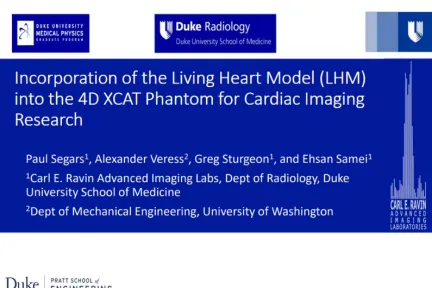
Incorporation of the Living Heart Model (LHM) Incorporation of the Living Heart Model (LHM) into the 4D XCAT Phantom for Cardiac Imaging Research
Solution Briefs
According to the American Heart Association, more than 850,000 people per year...
Article
Press Release
February 26, 2025
The Living Heart Project began in 2014 by uniting experts with a common goal to build a virtual twin of the heart. Its success inspired the Living Brain, Living Lungs and now the Living Liver.
E-seminar
The SIMULIA Living Heart Human Model provides a unique testing environment where a pacemaker lead can be virtually inserted and mechanically deformed during the cardiac cycle. Once the mechanical deformation results are obtained, the long-term durability of the implant can be assessed. The virtual nature of the test provides a physiologically accurate methodology to test new and existing devices without exposing patients to un-necessary risk.
Tech Notes
The SIMULIA Living Heart Human Model provides a unique testing environment where a stent can be deployed virtually in coronary arteries and deformed mechanically during the cardiac cycle. Once the mechanical deformation results are obtained, the long-term durability of the stent can be assessed. The virtual nature of the test provides a physiologically accurate methodology to test new and existing devices without exposing patients to unnecessary risk.
Tech Notes
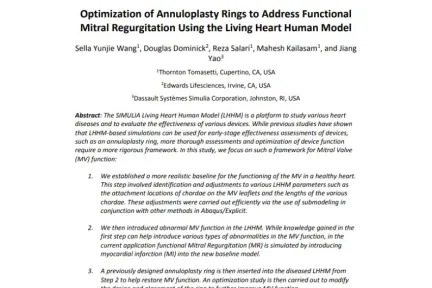
The SIMULIA Living Heart Human Model (LHHM) is a platform to study various heart diseases and to evaluate the effectiveness of various devices. While previous studies have shown that LHHM‐based simulations can be used for early‐stage effectiveness assessments of devices, such as an annuloplasty ring, more thorough assessments and optimization of device function require a more rigorous framework. In this study, we focus on such a framework for Mitral Valve (MV) function. This study demonstrates that the Living Heart Human Model can be used as a platform to better understand cardiac functioning of healthy hearts, which then allows the potential to introduce disease states, and to simulate effectiveness of potential treatment options in increasingly rigorous manners.
Customer Papers
SIMULIA Multiphysics simulation drives Life Sciences innovation, helping companies to virtually test and optimize cutting-edge medical devices and treatments.
Finite Element Analysis for Mechanical Engineering and Civil Engineering
Speak with a SIMULIA expert to learn how our solutions enable seamless collaboration and sustainable innovation at organizations of every size.
Courses and classes are available for students, academia, professionals and companies. Find the right SIMULIA training for you.
Find information on software & hardware certification, software downloads, user documentation, support contact and services offering