1495개의 결과가 있습니다.
An Abaqus Extension for Welding Simulations

An Abaqus Extension, in the form of an Abaqus/CAE Plug-In, has been developed for modeling welding. The Plug-In enables an easy, efficient, model-tree based approach to setup all aspects of a welding model from within Abaqus/CAE by automating most of the repetitive, timeconsuming tasks associated with building a welding model in a traditional CAE environment. Examples of tasks supported by the Plug-In include weld-bead and pass definitions, automatic definition of steps and boundary conditions for each pass, automatic (but editable) creation of node sets for each pass to enable definition of temperature sensors, and set-up of both the thermal and mechanical analysis models.

Customer Papers
An Abaqus Extension for Welding Simulations
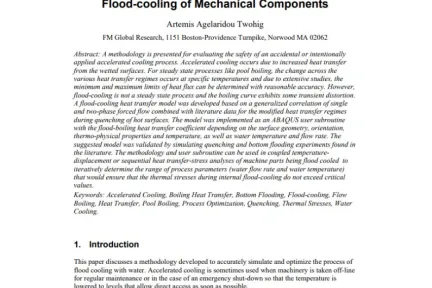
Flood-cooling of Mechanical Components

A methodology is presented for evaluating the safety of an accidental or intentionally applied accelerated cooling process. Accelerated cooling occurs due to increased heat transfer from the wetted surfaces. For steady state processes like pool boiling, the change across the various heat transfer regimes occurs at specific temperatures and due to extensive studies, the minimum and maximum limits of heat flux can be determined with reasonable accuracy. However, flood-cooling is not a steady state process and the boiling curve exhibits some transient distortion. A flood-cooling heat transfer model was developed based on a generalized correlation of single and two-phase forced flow combined with literature data for the modified heat transfer regimes during quenching of hot surfaces.

Customer Papers

Flood-cooling of Mechanical Components
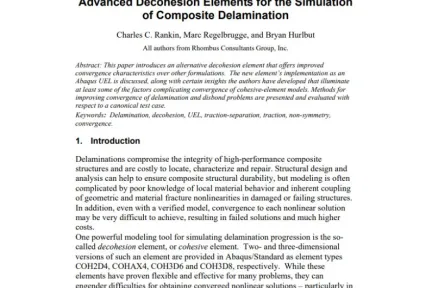
Advanced Decohesion Elements for the Simulation of Composite Delamination

This paper introduces an alternative decohesion element that offers improved convergence characteristics over other formulations. The new element’s implementation as an Abaqus UEL is discussed, along with certain insights the authors have developed that illuminate at least some of the factors complicating convergence of cohesive-element models. Methods for improving convergence of delamination and disbond problems are presented and evaluated with respect to a canonical test case.

Customer Papers

Advanced Decohesion Elements for the Simulation of Composite Delamination
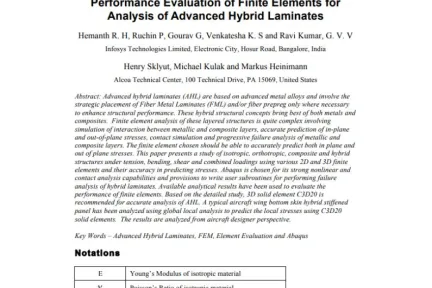
Performance Evaluation of Finite Elements for Analysis of Advanced Hybrid Laminates

Advanced hybrid laminates (AHL) are based on advanced metal alloys and involve the strategic placement of Fiber Metal Laminates (FML) and/or fiber prepreg only where necessary to enhance structural performance. Finite element analysis of these layered structures is quite complex involving simulation of interaction between metallic and composite layers, accurate prediction of in-plane and out-of-plane stresses, contact simulation and progressive failure analysis of metallic and composite layers. The finite element chosen should be able to accurately predict both in plane and out of plane stresses. This paper presents a study of isotropic, orthotropic, composite and hybrid structures under tension, bending, shear and combined loadings using various 2D and 3D finite elements and their accuracy in predicting stresses.

Customer Papers

Performance Evaluation of Finite Elements for Analysis of Advanced Hybrid Laminates
An Evaluation of Associative Interface for SolidWorks and ABAQUSCAE

In the modern design and manufacturing world, shorter development cycle times are being demanded. In addition, engineers are being asked to perform more analyses and studies to improve their products. To meet the challenge, engineers will seek more ways to increase robustness and productivity. With the continued integration of computational tools, such as the associative import between SolidWorks and Abaqus/CAE, it is possible to analyze and reiterate designs, materials, and structures in a more productive and efficient fashion.

Customer Papers

An Evaluation of Associative Interface for SolidWorks and ABAQUSCAE
FEA Capturing Both Brittle and Ductile Crack Propagation

A finite element analysis methodology was developed to simulate brittle crack initiation, ductile or brittle crack propagation and ductile crack arrest in a single simulation using ABAQUS. Ductile fracture was modeled by employing element deletion when the equivalent plastic strain reached a critical value. Within the same FEM, brittle fracture was modeled by incorporating cohesive behavior between contact surfaces defined along the expected crack face. While this method was not as accurate as an FEM incorporating J integral calculations, its simplicity allowed simultaneous incorporation of brittle and ductile fracture.

Customer Papers

FEA Capturing Both Brittle and Ductile Crack Propagation
Friction and Fretting Study of Thin Sheet Metal

Modern sealing technology in powertrain and exhaust applications of the automotive and heavy-duty industries utilizes Multi-Layer-Steel (MLS) gaskets for cylinder head gaskets (CHG) and exhaust gaskets. In light of more stringent requirements towards emissions and fuel economy, the increased application of shear forces on those gaskets due to vibration and thermal expansion have a major influence on the durability and wear of the gasket layers.

Customer Papers

Friction and Fretting Study of Thin Sheet Metal
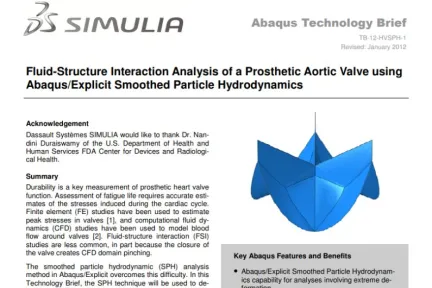
Fluid-Structure Interaction Analysis of a Prosthetic Aortic Valve using Abaqus/Explicit Smoothed Particle Hydrodynamics

Durability is a key measurement of prosthetic heart valve function. Assessment of fatigue life requires accurate estimates of the stresses induced during the cardiac cycle. Finite element (FE) studies have been used to estimate peak stresses in valves, and computational fluid dynamics (CFD) studies have been used to model blood flow around valves. Fluid-structure interaction (FSI) studies are less common, in part because the closure of the valve creates CFD domain pinching. The smoothed particle hydrodynamic (SPH) analysis method in Abaqus/Explicit overcomes this difficulty. In this Technology Brief, the SPH technique will be used to determine the FSI response of a generic prosthetic heart valve.

Solution Briefs

Fluid-Structure Interaction Analysis of a Prosthetic Aortic Valve using Abaqus/Explicit Smoothed Particle Hydrodynamics
Multidisciplinary Design Optimization with CAD and CAE

Today, computational analysis is systematically used for the development of new models. However, traditional simulations and optimization studies require an exchange of data between the CAD and CAE applications that is extremely time-consuming and tedious. Improving CAD-CAE interoperability and automating the optimization process is a key to reducing model development time.

Customer Papers

Multidisciplinary Design Optimization with CAD and CAE
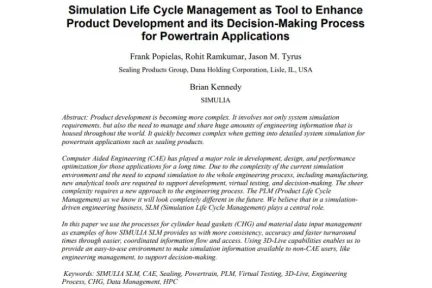
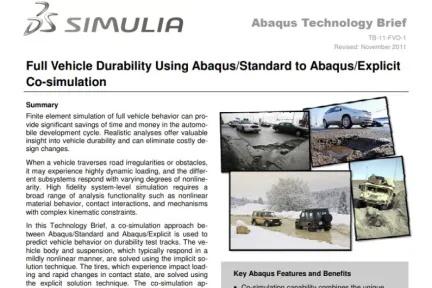
Full Vehicle Durability Using AbaqusStandard to AbaqusExplicit Co-simulation

In this Technology Brief, a co-simulation approach between Abaqus/Standard and Abaqus/Explicit is used to predict vehicle behavior on durability test tracks. The vehicle body and suspension, which typically respond in a mildly nonlinear manner, are solved using the implicit solution technique. The tires, which experience impact loading and rapid changes in contact state, are solved using the explicit solution technique. The co-simulation approach allows for an efficient analysis by capitalizing on the strengths of both solution techniques simultaneously.

Solution Briefs

Full Vehicle Durability Using AbaqusStandard to AbaqusExplicit Co-simulation
Dynamic Load Analysis and Optimization of a Fracture-Split Connecting Rod

This paper summarizes the methodology to design fracture-split (FS) connecting rod using CAE tools, ensuring product quality with reliability and rapid response in terms of study and implementation. FS connecting rod is first manufactured as single piece, then precisely cracked-off, aided by laser score-line, to produce jagged surfaces which provides perfect alignment, higher strength and keeps production costs low.

Customer Papers

Dynamic Load Analysis and Optimization of a Fracture-Split Connecting Rod
260개의 결과가 있습니다.

고객 사례

150개의 결과가 있습니다.
3개의 결과가 있습니다.

SIMULIA 자기 주도 학습

학습자가 편리하게 학습을 꾸준히 이어갈 수 있도록 수백 개의 자기 주도 학습 모듈을 제공합니다.

블로그

SIMULIA 블로그에서 당사 전문가들이 전하는 최신 뉴스와 혁신에 대해 알아보세요.

775개의 결과가 있습니다.

SIMULIA의 지원 서비스 알아보기

SIMULIA 전문가와 상담하여 당사의 솔루션이 모든 규모의 조직에서 원활한 협업과 지속 가능한 혁신을 실현하는 방법에 대해 알아보세요.

시작하기

학생, 교육, 전문가 및 회사를 위한 교육 과정과 강의가 제공됩니다. 당신에게 맞는 SIMULIA 교육을 찾아보세요. 

도움받기

소프트웨어 및 하드웨어 인증, 소프트웨어 다운로드, 사용자 설명서, 지원 연락처 및 서비스 제공에 대한 정보를 확인하세요.