1495개의 결과가 있습니다.
Enhancing operational flexibility of fossil power generating assets based on non-linear numerical thermo-mechanical damage and fracture analysis

A power generation toggle from the conventional sources to the becoming rapidly prioritisable renewable energy production poses a challenge for the fossil fired power plants. The strong dependency on the weather conditions makes such issues as e.g. non-predictable availability and variable loading to the ad hoc asset management tasks in terms of increasing operational flexibility. The paper focuses on the results of this tendency and their impact on the backbone of all power plants - power plant equipment –suffering from the accelerated accumulation of the combined creep-fatigue damage because of the more and more tightened transient start-up and shutdown conditions, increased heating rates and number of operational cycling.

Customer Papers
Enhancing operational flexibility of fossil power generating assets based on non-linear numerical thermo-mechanical damage and fracture analysis
Automated systematic strength calculation of high duty bolted joints

FE modeling of high duty bolted joints, such as those found in wind-turbines, is in many aspects a very complex task. On the one hand, the bolt analysis must comply with standardized guidelines, such as VDI 2230. On the other hand, FE models are usually highly detailed and contain a large number of bolt connections. This makes the whole design process error-prone and cumbersome for the FE engineer, since modeling all these connections by hand usually takes a large amount of time and diligence.

Customer Papers

Automated systematic strength calculation of high duty bolted joints
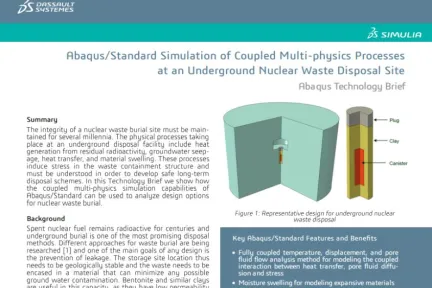
Abaqus/Standard Simulation of Coupled Multi-physics Processes at an Underground Nuclear Waste Disposal Site

The integrity of a nuclear waste burial site must be maintained for several millenia. The physical processes taking place at an underground disposal facility include seepage, heat transfer, and material swelling. These processes induce stress in the waste containment structure and must be understood in order to develop long-term disposal schemes. In this Technology Brief we show how the coupled multi-physics simulation capabilities of Abaqus/Standard can be used to analyze design options for nuclear waste burial.

Tech Notes

Abaqus/Standard Simulation of Coupled Multi-physics Processes at an Underground Nuclear Waste Disposal Site
Sequentially coupled thermal-stress analysis of a new steelconcrete composite slab under fire

The paper describes the numerical simulations required to estimate the performance of a composite slab using a re-entrant profiled steel sheet, prior to conducting a loaded fire test to verify the performance predicted by the simulations and obtain a fire rating according to accepted international standards. The purpose of the simulations was to optimize the design of the composite slab, by eliminating unnecessary reinforcement bars. Heat transfer analysis involving convection, conduction and boundary radiation was undertaken on a detailed solid modelled slab as part of a new steel-concrete slab product development. The simulation accounted for the thermal contact resistance at the cold-formed steel-concrete interface.

Customer Papers

Sequentially coupled thermal-stress analysis of a new steelconcrete composite slab under fire
Simulating the Pouch Forming Process Using a Detailed Fluid-Structure Interaction

A deeper understanding of the interaction between machine, packaging material and liquid product during the forming process of pouches is enabled by the use of numerical simulation. Tetra Pak pouch forming system forms the pouches in a continuous fashion starting from a tube of packaging material filled with the liquid to be packaged. Simulating the pouch forming, including a detailed fluid-structure interaction is the goal of this paper. The simulation is performed coupling Abaqus for the structural side and FlowVision for the fluid side through a Direct Coupling interface. The definition of the problem as well the results of the simulation are presented in the paper.

Customer Papers

Simulating the Pouch Forming Process Using a Detailed Fluid-Structure Interaction
Finite Element Analysis of Casing and Casing Connections for Shale Gas Wells

The application of horizontal drilling and hydraulic fracturing has enabled operators to rapidly develop shale gas procution from deep shale formations over the past decade. It has, however, presented significant challenges to casing and casing connection designs due to the complicated and extreme load conditions within these wells. Advanced Finite Element Analysis (FEA) is therefore required to understand casing deformation using Abaqus for analyzing casing and casing connections under shale gas well load scenarios, such as horizontal well installation, perforating and hydraulic fracturing pressures, and formation shear movement. Analysis examples are provided.

Customer Papers

Finite Element Analysis of Casing and Casing Connections for Shale Gas Wells
Air Blast Loaded Safety Devise Dynamical Response Analysis

Equipment of many oil and gas processing plants in Russian Federation is considerably worn-out. This cause the decrease of reliability and durability of equipment, and to rise of accident rate. An air explosion is the one of the most dangerous cases for plants in oil and gas industry, usually caused by uncontrolled emission and inflammation of oil products. Air explosion can lead to significant danger for life and health of plant staff, so it needs necessity of safety device usage. New type of safety device designed. Numerical simulation is necessary to analyze design parameters and performance of safety device, subjected to air blast loading. Coupled fluid-structure interaction analysis performed to determine strength of protective devise and its performance.

Customer Papers

Air Blast Loaded Safety Devise Dynamical Response Analysis
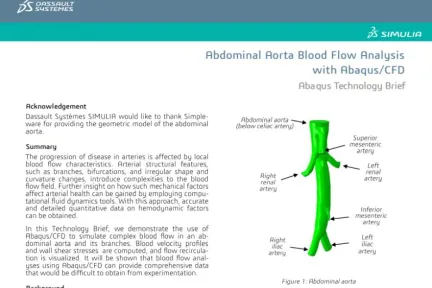
Abdominal Aorta Blood Flow Analysis with Abaqus/CFD

In this Technology Brief, we demonstrate the use of Abaqus/CFD to simulate complex blood flow in an abdominal aorta and its branches. Blood velocity profiles and wall shear stresses are computed, and flow recirculation is visualized. It will be shown that blood flow analyses using Abaqus/CFD can provide comprehensive data that would be difficult to obtain from experimentation.

Tech Notes

Abdominal Aorta Blood Flow Analysis with Abaqus/CFD
MAN Diesel & Turbo - Industrial Equipment Case Study

A century ago this year, the first ocean-going diesel ship in the world, the M/S Selandia, embarked on her maiden voyage. She was a technological wonder, and both her hull and engines were built by Burmeister & Wain (B&W) of Copenhagen, Denmark. B&W is now a part of MAN Diesel & Turbo—a company with 12,000 employees worldwide—and the marine low-speed business unit is located in Copenhagen. The unit has capitalized on B&W’s historic expertise to produce new engines that can weigh up to 2800 metric tons and tower 16 meters high. Once such behemoth engines are installed, they have to be serviced in place—and they must require servicing as infrequently as possible.

Tech Notes

MAN Diesel & Turbo - Industrial Equipment Case Study
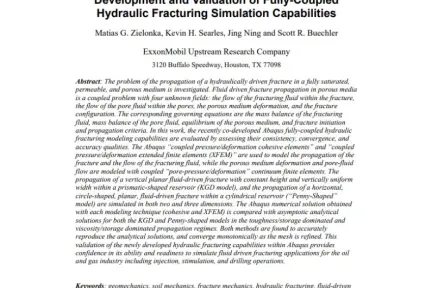
Development and Validation of Fully-Coupled Hydraulic Fracturing Simulation Capabilities

The problem of the propagation of a hydraulically driven fracture in a fully saturated, permeable, and porous medium is investigated. Fluid driven fracture propagation in porous media is a coupled problem with four unknown fields: the flow of the fracturing fluid within the fracture, the flow of the pore fluid within the pores, the porous medium deformation, and the fracture configuration. The corresponding governing equations are the mass balance of the fracturing fluid, mass balance of the pore fluid, equilibrium of the porous medium, and fracture initiation and propagation criteria. In this work, the recently co-developed Abaqus fully-coupled hydraulic fracturing modeling capabilities are evaluated by assessing their consistency, convergence, and accuracy qualities.

Customer Papers

Development and Validation of Fully-Coupled Hydraulic Fracturing Simulation Capabilities
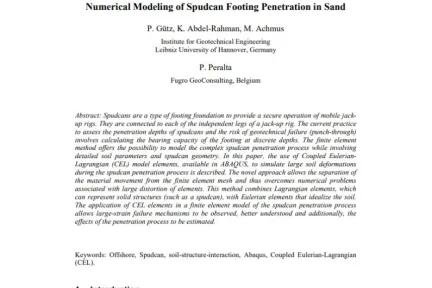
Numerical Modeling of Spudcan Footing Penetration in Sand

Spudcans are a type of footing foundation to provide a secure operation of mobile jackup rigs. They are connected to each of the independent legs of a jack-up rig. The current practice to assess the penetration depths of spudcans and the risk of geotechnical failure (punch-through) involves calculating the bearing capacity of the footing at discrete depths. The finite element method offers the possibility to model the complex spudcan penetration process while involving detailed soil parameters and spudcan geometry. In this paper, the use of Coupled EulerianLagrangian (CEL) model elements, available in ABAQUS, to simulate large soil deformations during the spudcan penetration process is described.

Customer Papers

Numerical Modeling of Spudcan Footing Penetration in Sand
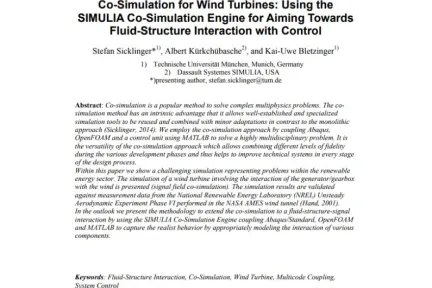
Co-Simulation for Wind Turbines: Using the SIMULIA Co-Simulation Engine for Aiming Towards Fluid-Structure Interaction with Control

Within this paper we show a challenging simulation representing problems within the renewable energy sector. The simulation of a wind turbine involving the interaction of the generator/gearbox with the wind is presented (signal field co-simulation). The simulation results are validated against measurement data from the National Renewable Energy Laboratory (NREL) Unsteady Aerodynamic Experiment Phase VI performed in the NASA AMES wind tunnel (Hand, 2001). In the outlook we present the methodology to extend the co-simulation to a fluid-structure-signal interaction by using the SIMULIA Co-Simulation Engine coupling Abaqus/Standard, OpenFOAM and MATLAB to capture the realist behavior by appropriately modeling the interaction of various components.

Customer Papers

Co-Simulation for Wind Turbines: Using the SIMULIA Co-Simulation Engine for Aiming Towards Fluid-Structure Interaction with Control
260개의 결과가 있습니다.

고객 사례

150개의 결과가 있습니다.
3개의 결과가 있습니다.

SIMULIA 자기 주도 학습

학습자가 편리하게 학습을 꾸준히 이어갈 수 있도록 수백 개의 자기 주도 학습 모듈을 제공합니다.

블로그

SIMULIA 블로그에서 당사 전문가들이 전하는 최신 뉴스와 혁신에 대해 알아보세요.

775개의 결과가 있습니다.
[Tip] Abaqus 문제해결 길잡이 – 기타

– 기타 에러 메시지 – ***ERROR: THREE FACTORIZATIONS IN A ROW FAILED. CHECK THE MODEL. 강성 행렬의 역행렬을 구하기 위한 Factorization 과정 중의 에러입니다. 주로 강성 행렬이 Positive Definite

기사

[Tip] Abaqus 문제해결 길잡이 – 기타
[Tip] Abaqus 문제해결 길잡이 – 요소

요소의 과도 변형 경고요소의 변형이 과도하게 커지면 해석을 지속할 수 없습니다.***WARNING:EXCESSIVE DISTORTION ... ELEMENTS위와 같은 경고 메시지가 발생할 경우 아래의 항목을 체크해 봅니다.큰 변형에 의한 요소의 뒤틀림.ODB 파일을

기사

[Tip] Abaqus 문제해결 길잡이 – 요소
[Tip] Abaqus 문제해결 길잡이 – 접촉에 기인하는 불안정 (2/2)

접촉 해석 시 수렴 문제접촉 해석 시, 중간 과정 중에 수렴 해를 찾지 못하는 경우나 채터링(Chattering, Contact Open과 Closed 상태가 반복되는 현상)이 발생하여 SDI가 허용하는 최대 회수(50)를 넘어서는 경우가 있습니다. 이 것은 접촉 조건과 평형

기사

[Tip] Abaqus 문제해결 길잡이 – 접촉에 기인하는 불안정 (2/2)
[Tip] Abaqus 문제해결 길잡이 – 수치적 특이성

구속 부족과 강체 모드일반적인 정적 해석(*STATIC)에서는 강체 모드가 있는 경우, 해석이 진행되지 않는 경우가 많습니다. 강체 모드는 특정 방향으로 자유롭게 움직인다는 뜻으로, 평형 상태가 무한대가 있기 때문에 "해"가 너무 많은 이유로 해를 구할 수 없게 됩니다. 이

기사

[Tip] Abaqus 문제해결 길잡이 – 수치적 특이성
[Tip] Abaqus 문제해결 길잡이 – 정적 해석에서의 수렴 문제

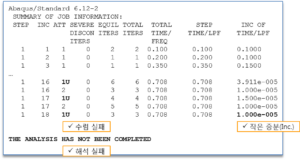
.MSG 파일과 .STA 파일의 이해 Abaqus는 기본적으로 비선형 해석을 수행하기 위한 개념으로 만들어졌습니다. 비선형 해석은 최종 상태를 한 번에 풀기 어렵고, 작은 증분(Inc.)으로 나누어 단계적으로 풀게 됩니다. 각각의 증분에서도 여러 번의 축차(Iter.)를

기사

[Tip] Abaqus 문제해결 길잡이 – 정적 해석에서의 수렴 문제
[Tip] Abaqus 문제해결 길잡이 – 해석파일의 작성

모델이 복잡하고, 해석 절차가 어려울수록 해석 중 발생하는 오류를 찾아내기는 몹시 어렵습니다. 체계적으로 모델의 완성도를 검토하고, 빠르게 신뢰성 높은 해석 결과를 얻기 위한 방법으로 SIMULIA 팀에서 알려 드리는 내용을 참고해 보시기 바랍니다.단순 모델부터처음부터 복잡한

기사

[Tip] Abaqus 문제해결 길잡이 – 해석파일의 작성

SIMULIA의 지원 서비스 알아보기

SIMULIA 전문가와 상담하여 당사의 솔루션이 모든 규모의 조직에서 원활한 협업과 지속 가능한 혁신을 실현하는 방법에 대해 알아보세요.

시작하기

학생, 교육, 전문가 및 회사를 위한 교육 과정과 강의가 제공됩니다. 당신에게 맞는 SIMULIA 교육을 찾아보세요. 

도움받기

소프트웨어 및 하드웨어 인증, 소프트웨어 다운로드, 사용자 설명서, 지원 연락처 및 서비스 제공에 대한 정보를 확인하세요.