1495개의 결과가 있습니다.
LIVING HEART HUMAN MODEL: CARDIOVASCULAR STENT DEPLOYMENT AND CARDIAC CYCLE SIMULATION

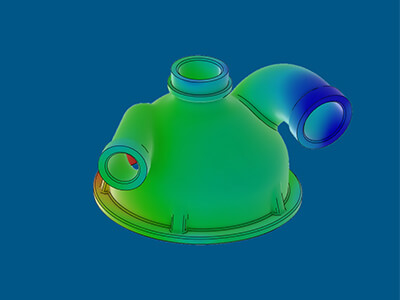
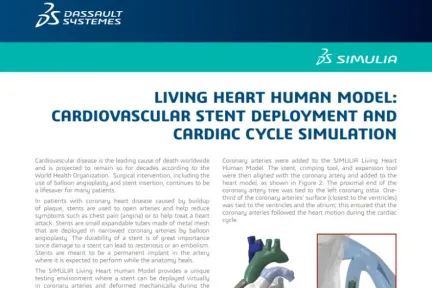
The SIMULIA Living Heart Human Model provides a unique testing environment where a stent can be deployed virtually in coronary arteries and deformed mechanically during the cardiac cycle. Once the mechanical deformation results are obtained, the long-term durability of the stent can be assessed. The virtual nature of the test provides a physiologically accurate methodology to test new and existing devices without exposing patients to unnecessary risk.

Tech Notes
LIVING HEART HUMAN MODEL: CARDIOVASCULAR STENT DEPLOYMENT AND CARDIAC CYCLE SIMULATION
Modeling Natural Fracture Activation Using a Poro-elastic Fracture Intersection Model

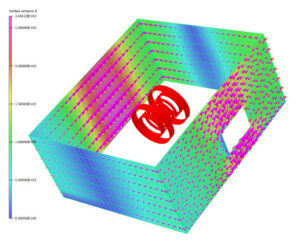
Using this model, natural fracture opening and shear slippage are investigated depending on horizontal stress contrast, adjoining fissure conductivity, and hydraulic-natural fracture intersection angle. Modeling results demonstrate the complexities of hydraulic fracture growth through the intersection with natural fracture such as selective branching and throttling at the intersection. Our fracturing simulation results agree with the analytical criteria for fracture crossing or arrest at the intersection.

Customer Papers

Modeling Natural Fracture Activation Using a Poro-elastic Fracture Intersection Model
FEA Prediction of Off-Road Tire Temperature Distribution

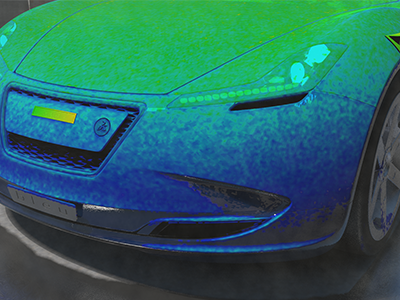
Excessive heat generation and retention in ultra-large dump truck tires is among the most common causes of tire failures in the surface mining industry. Accurate prediction of an operating tire temperature profile involves the use of advanced numerical models and solution schemes to mimic the complete elastomeric materials response to operating conditions. The internally generated heat in a tire is a function of its viscoelastic energy dissipation during rolling. Previous research studies have inaccurately predicted off-the-road (OTR) tire heat generation rates and temperatures by the use of linear viscoelasticity to approximate the rather nonlinear viscoelastic rubber material. This paper presents an accurate approach to predicting OTR tire temperature distributions taking into account the true mechanical response of the filled rubber compounds used in tires.

Customer Papers

FEA Prediction of Off-Road Tire Temperature Distribution
Implementation of an elasto-viscoplastic constitutive law in Abaqus/Standard for an improved characterization of rock materials

Subsidence modeling is an important activity in the oil and gas industry, for the environmental and operational implications associated to this phenomenon. Abaqus/Standard has been used for many years in Eni as the main numerical simulator for studying the geomechanical behavior of reservoirs. The results of a large campaign of acquisition of subsidence monitoring data in conjunction with the advanced analysis of laboratory experiments have shown that, in some cases, an improved mechanical characterization can be tailored to better capture the complex behavior of the reservoir rock under the effect of underground fluid withdrawal.

Customer Papers

Implementation of an elasto-viscoplastic constitutive law in Abaqus/Standard for an improved characterization of rock materials
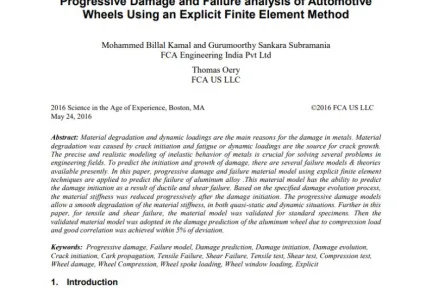
Progressive Damage and Failure analysis of Automotive Wheels Using an Explicit Finite Element Method

Material degradation and dynamic loadings are the main reasons for the damage in metals. Material degradation was caused by crack initiation and fatigue or dynamic loadings are the source for crack growth. The precise and realistic modeling of inelastic behavior of metals is crucial for solving several problems in engineering fields. To predict the initiation and growth of damage, there are several failure models & theories available presently. In this paper, progressive damage and failure material model using explicit finite element techniques are applied to predict the failure of aluminum alloy.

Customer Papers

Progressive Damage and Failure analysis of Automotive Wheels Using an Explicit Finite Element Method
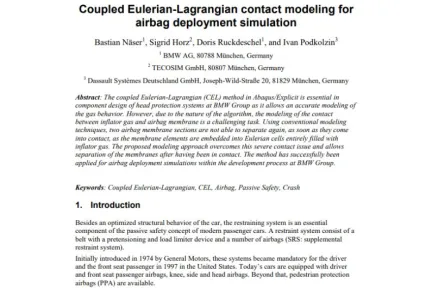
Coupled Eulerian-Lagrangian contact modeling for airbag deployment simulation

The coupled Eulerian-Lagrangian (CEL) method in Abaqus/Explicit is essential in component design of head protection systems at BMW Group as it allows an accurate modeling of the gas behavior. However, due to the nature of the algorithm, the modeling of the contact between inflator gas and airbag membrane is a challenging task. Using conventional modeling techniques, two airbag membrane sections are not able to separate again, as soon as they come into contact, as the membrane elements are embedded into Eulerian cells entirely filled with inflator gas. The proposed modeling approach overcomes this severe contact issue and allows separation of the membranes after having been in contact. The method has successfully been applied for airbag deployment simulations within the development process at BMW Group.

Customer Papers

Coupled Eulerian-Lagrangian contact modeling for airbag deployment simulation
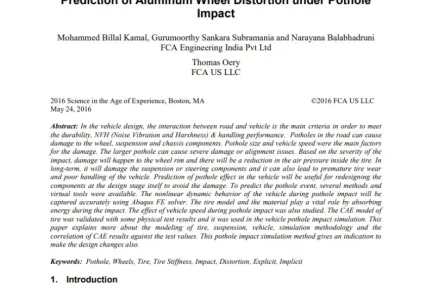
Prediction of Aluminum Wheel Distortion under Pothole Impact

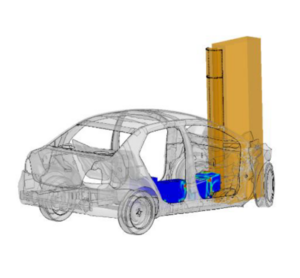
In the vehicle design, the interaction between road and vehicle is the main criteria in order to meet the durability, NVH (Noise Vibration and Harshness) & handling performance. Potholes in the road can cause damage to the wheel, suspension and chassis components. Pothole size and vehicle speed were the main factors for the damage. The larger pothole can cause severe damage or alignment issues. Based on the severity of the impact, damage will happen to the wheel rim and there will be a reduction in the air pressure inside the tire. In long-term, it will damage the suspension or steering components and it can also lead to premature tire wear and poor handling of the vehicle.

Customer Papers

Prediction of Aluminum Wheel Distortion under Pothole Impact
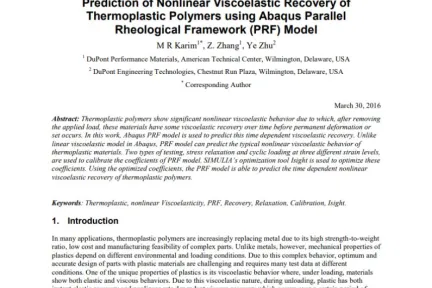
Prediction of Nonlinear Viscoelastic Recovery of Thermoplastic Polymers using Abaqus Parallel Rheological Framework Model

Thermoplastic polymers show significant nonlinear viscoelastic behavior due to which, after removing the applied load, these materials have some viscoelastic recovery over time before permanent deformation or set occurs. In this work, Abaqus PRF model is used to predict this time dependent viscoelastic recovery. Unlike linear viscoelastic model in Abaqus, PRF model can predict the typical nonlinear viscoelastic behavior of thermoplastic materials. Two types of testing, stress relaxation and cyclic loading at three different strain levels, are used to calibrate the coefficients of PRF model. SIMULIA’s optimization tool Isight is used to optimize these coefficients. Using the optimized coefficients, the PRF model is able to predict the time dependent nonlinear viscoelastic recovery of thermoplastic polymers.

Customer Papers

Prediction of Nonlinear Viscoelastic Recovery of Thermoplastic Polymers using Abaqus Parallel Rheological Framework Model
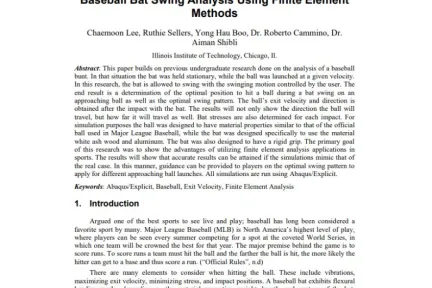
Baseball Bat Swing Analysis Using Finite Element Methods

This paper builds on previous undergraduate research done on the analysis of a baseball bunt. In that situation the bat was held stationary, while the ball was launched at a given velocity. In this research, the bat is allowed to swing with the swinging motion controlled by the user. The end result is a determination of the optimal position to hit a ball during a bat swing on an approaching ball as well as the optimal swing pattern. The ball’s exit velocity and direction is obtained after the impact with the bat. The results will not only show the direction the ball will travel, but how far it will travel as well.

Customer Papers

Baseball Bat Swing Analysis Using Finite Element Methods
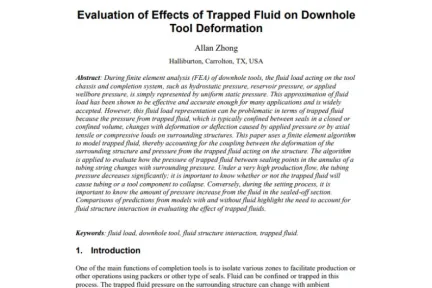
Evaluation of Effects of Trapped Fluid on Downhole Tool Deformation

During finite element analysis (FEA) of downhole tools, the fluid load acting on the tool chassis and completion system, such as hydrostatic pressure, reservoir pressure, or applied wellbore pressure, is simply represented by uniform static pressure. This approximation of fluid load has been shown to be effective and accurate enough for many applications and is widely accepted. However, this fluid load representation can be problematic in terms of trapped fluid because the pressure from trapped fluid, which is typically confined between seals in a closed or confined volume, changes with deformation or deflection caused by applied pressure or by axial tensile or compressive loads on surrounding structures.

Customer Papers

Evaluation of Effects of Trapped Fluid on Downhole Tool Deformation
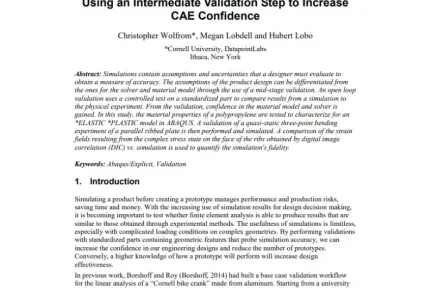
Using an Intermediate Validation Step to Increase CAE Confidence

Simulations contain assumptions and uncertainties that a designer must evaluate to obtain a measure of accuracy. The assumptions of the product design can be differentiated from the ones for the solver and material model through the use of a mid-stage validation. An open loop validation uses a controlled test on a standardized part to compare results from a simulation to the physical experiment. From the validation, confidence in the material model and solver is gained. In this study, the material properties of a polypropylene are tested to characterize for an *ELASTIC *PLASTIC model in ABAQUS. A validation of a quasi-static three-point bending experiment of a parallel ribbed plate is then performed and simulated. A comparison of the strain fields resulting from the complex stress state on the face of the ribs obtained by digital image correlation (DIC) vs. simulation is used to quantify the simulation's fidelity.

Customer Papers

Using an Intermediate Validation Step to Increase CAE Confidence
260개의 결과가 있습니다.

고객 사례

150개의 결과가 있습니다.
3개의 결과가 있습니다.

SIMULIA 자기 주도 학습

학습자가 편리하게 학습을 꾸준히 이어갈 수 있도록 수백 개의 자기 주도 학습 모듈을 제공합니다.

블로그

SIMULIA 블로그에서 당사 전문가들이 전하는 최신 뉴스와 혁신에 대해 알아보세요.

775개의 결과가 있습니다.

SIMULIA의 지원 서비스 알아보기

SIMULIA 전문가와 상담하여 당사의 솔루션이 모든 규모의 조직에서 원활한 협업과 지속 가능한 혁신을 실현하는 방법에 대해 알아보세요.

시작하기

학생, 교육, 전문가 및 회사를 위한 교육 과정과 강의가 제공됩니다. 당신에게 맞는 SIMULIA 교육을 찾아보세요. 

도움받기

소프트웨어 및 하드웨어 인증, 소프트웨어 다운로드, 사용자 설명서, 지원 연락처 및 서비스 제공에 대한 정보를 확인하세요.