1495개의 결과가 있습니다.
Simulation of caulking process using Abaqus Explicit

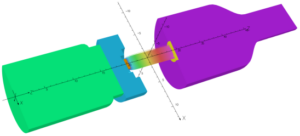
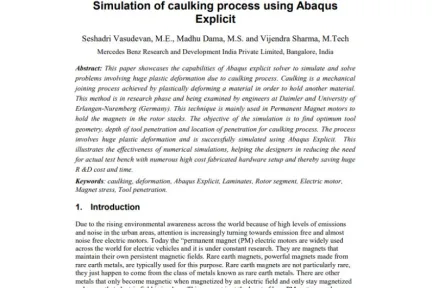
This paper showcases the capabilities of Abaqus explicit solver to simulate and solve problems involving huge plastic deformation due to caulking process. Caulking is a mechanical joining process achieved by plastically deforming a material in order to hold another material. This method is in research phase and being examined by engineers at Daimler and University of Erlangen-Nuremberg (Germany). This technique is mainly used in Permanent Magnet motors to hold the magnets in the rotor stacks. The objective of the simulation is to find optimum tool geometry, depth of tool penetration and location of penetration for caulking process. The process involves huge plastic deformation and is successfully simulated using Abaqus Explicit. This illustrates the effectiveness of numerical simulations, helping the designers in reducing the need for actual test bench with numerous high cost fabricated hardware setup and thereby saving huge R &D cost and time.

Customer Papers
Simulation of caulking process using Abaqus Explicit
A Simplified 3D Numerical Scheme for Accurate Calculation of Critical Value of Pressure Drawdown of Weak Sand Formation

The critical value of pressure drawdown (CVPDD) is a key parameter for controlling the production rate for most of the wells in weak sand formations and depends on the form of completion used, particularly in cases of high-pressure/high-temperature (HP/HT). This paper presents a simplified three-dimensional (3D) calculation of CVPDD on the basis of maximum plastic strain for a given well in offshore Gulf of Mexico. A fully-coupled, poro-elastoplastic model was adopted to simulate the porous flow that occurred simultaneously with matrix inelastic deformation. A submodeling technique was adopted to address the discrepancy between the scale of the oil field and that of the wellbore section.

Customer Papers

A Simplified 3D Numerical Scheme for Accurate Calculation of Critical Value of Pressure Drawdown of Weak Sand Formation
Model Order Reduction Methods for Explicit FEM

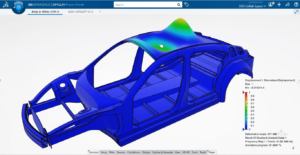
Abaqus/Explicit is a well-established and widely used FEM solver for crash and pedestrian safety simulations. However, due to the large number of degrees of freedom, simulation time is still a limiting factor especially in context of structural optimization. In typical crash simulation, a large portion of the model undergoes only elastic deformation. Hence, model order reduction (MOR) methods can bring a significant decrease in the computational time. While Abaqus/Standard already offers several reduction methods, MOR is currently not applicable for Abaqus/Explicit. The purpose of this work is to enable MOR for explicit finite element models by use of superelements. Reduced mass and stiffness matrices are generated by Abaqus/Standard and transferred to the explicit solver through a VUEL subroutine.

Customer Papers

Model Order Reduction Methods for Explicit FEM
Thermal - Fluid Co-Simulation of DNA Sequencing Thermocycler

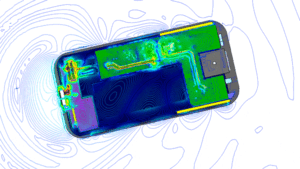
Sequencing and amplification of DNA involves a precisely controlled thermal incubation cycle. Upscaling of traditional thermocyclers can be problematic due to nonuniformities induced across large incubation plates. Multiple chip profiles are studied to compare edge effects and promote uniform thermal histories across the incubation plate. Thermal performance is evaluated via steady-state heating within Abaqus/Standard. Transient cooling is modeled via Abaqus co-simulation by coupling thermal and fluid models.

Customer Papers

Thermal - Fluid Co-Simulation of DNA Sequencing Thermocycler
Multi-Scale Modelling of Textile Reinforced Tissue Engineered Heart Valves

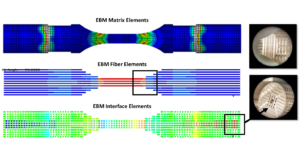
Transcatheter aortic valve implantation of fibrin-based tissue engineered heart valves with a tubular leaflet construct have been developed as an alternative to invasive traditional surgical heart valve implantation, but currently need reinforcement to withstand pressures found in the aortic position. To increase valve strength, a PET textile reinforcement has been introduced to the fibrin scaffold. However, care must be taken when using a textile reinforcement. Increasing reinforcement may increase the strength, but also increases stiffness which can interfere with the functionality of the valve, prohibiting full valve closure. In order to predict the behavior of the valve, improve design, and eventually optimize valve performance by tailoring the textile reinforcement, a 4-tiered hierarchical multi-scale modelling framework has been created.

Customer Papers
Multi-Scale Modelling of Textile Reinforced Tissue Engineered Heart Valves
Predicting and Designing Integrated Safety Syringe for Shelf Life Using Advanced Nonlinear Constitutive Models in ABAQUS

The Medical device industry is a highly regulated industry with patient safety being paramount. Ensuring the highest quality and patient safety demands that the device performs as desired from the time it is manufactured, through the shelf life of the product, and during use. Plastics used in medical devices can undergo degradation in mechanical properties over time during the product shelf life depending on the design of the device. It is therefore important to take this aspect of plastic behavior into account during material selection and device design. Plastics under constant load for long periods of time exhibit creep deformations. Testing devices for creep can be a lengthy process often leading to delay in design iterations to yield the optimum design and subsequently time to market.

Customer Papers

Predicting and Designing Integrated Safety Syringe for Shelf Life Using Advanced Nonlinear Constitutive Models in ABAQUS
Simulating blood flow in Living Heart Model

Being able to visualize blood flow in leaving heart helps to understand heart diseases and define strategy for surgical intervention. The ideal simulation should be performed on a specific patient heart model (individual geometry) to correctly asses the specific cardiac problem and predict possible treatment. In this paper two approaches is presented for simulating blood flow using numerical CFD approach: simulation based on the SIMULIA Living Heart FE Model and simulation based on dynamic 3D heart model obtained from a 3D MRI/MRT scanner. The CFD simulation is performed in both cases using FlowVision CFD code. Both approaches provide a better understanding of the blood flow during a cardiac cycle.

Customer Papers

Simulating blood flow in Living Heart Model
A FINITE ELEMENT MODEL OF THE INTERVERTEBRAL DISC

The aim of this study was to develop an FE model of the IVD that replicated the in vivo failure modes experienced clinically. The model created in this study utilized four distinct materials - the cartilaginous end plate (CEP), Nucleus Pulposus (NP), and two distinct layers of the Annulus Fibrosis (AF) - to represent the constituents of the IVD. The geometry of the model was based on average dimensions provided by computerized axial tomography. Material properties were assigned to each component based on published values from the literature. The model was validated by comparison to force/displacement data from mechanical testing.

Customer Papers

A FINITE ELEMENT MODEL OF THE INTERVERTEBRAL DISC
Stiffness Mapping in Biological Materials based on MRI Imaging and Topology Optimization

Magnetic resonance imaging (MRI) is a preeminent technology to visualize the internal tissue structure, in addition to other physical phenomena like flow and diffusion. One specialized MRI technique, termed displacements under applied loading by MRI (dualMRI), was developed to measure displacements and strain in musculoskeletal tissues, hydrogels, and engineered constructs. However, deformation information does not directly describe spatial distributions of tissue stiffness, which is critical to the understanding of disease progression. In this study, the inverse simulation was validated on displacements results derived from forward simulations where materials properties and boundary conditions were known.

Customer Papers

Stiffness Mapping in Biological Materials based on MRI Imaging and Topology Optimization
260개의 결과가 있습니다.

고객 사례

150개의 결과가 있습니다.
3개의 결과가 있습니다.

SIMULIA 자기 주도 학습

학습자가 편리하게 학습을 꾸준히 이어갈 수 있도록 수백 개의 자기 주도 학습 모듈을 제공합니다.

블로그

SIMULIA 블로그에서 당사 전문가들이 전하는 최신 뉴스와 혁신에 대해 알아보세요.

775개의 결과가 있습니다.
SIMULIA

SIMULIA provides realistic multiphysics simulation, design exploration, and optimization capabilities for designers, engineers and researchers.

Article

SIMULIA
미래 전망: 전기 자동차(EV) 혁명

SIMULIA Community News에서 언급했듯이, 전기 자동차(EV)는 인간 이동성에서 점점 더 큰 역할을 하는 방향으로 진화하고 있습니다. 내연 기관(ICE)이 곧 사라지지는 않겠지만, 특히 인구 증가와 도시 확장에 따라 환경에 미치는 영향에 대한 인식은

기사

미래 전망: 전기 자동차(EV) 혁명

SIMULIA의 지원 서비스 알아보기

SIMULIA 전문가와 상담하여 당사의 솔루션이 모든 규모의 조직에서 원활한 협업과 지속 가능한 혁신을 실현하는 방법에 대해 알아보세요.

시작하기

학생, 교육, 전문가 및 회사를 위한 교육 과정과 강의가 제공됩니다. 당신에게 맞는 SIMULIA 교육을 찾아보세요. 

도움받기

소프트웨어 및 하드웨어 인증, 소프트웨어 다운로드, 사용자 설명서, 지원 연락처 및 서비스 제공에 대한 정보를 확인하세요.