1495개의 결과가 있습니다.
Analysis of 3D Steel-Concrete Composite Buildings using Abaqus

Research on robustness analyses of steel-concrete composite building structures has been performed over the last two decades with few simplifications in composite building frame components. This is because the detailed modelling of the nonlinear behaviour of steelconcrete composite slabs and joints is rather tedious and involves interaction between floor beams, slab and beam-to-column joint behaviour. Past research on progressive collapse analysis of building frames has reported that full three-dimensional (3D) building frame analysis is computationally expensive and consumes substantial computational resources in order to predict the non-linear dynamic response of buildings.

Customer Papers
Analysis of 3D Steel-Concrete Composite Buildings using Abaqus
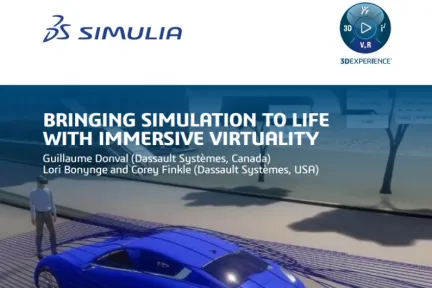
BRINGING SIMULATION TO LIFE WITH IMMERSIVE VIRTUALITY

Immersive Virtuality allows us to observe things that simply cannot be seen in the real world, such as the cooling patterns of an additive manufacturing process, the under-the-hood deformation that occurs during a vehicle crash test, air flow around a jet engine, or even the blood flow through a beating human heart. By facsimileing these processes in an observable and measurable way, we can gain valuable insights for improvement, and share these findings in engaging and memorable ways. As a result, innovators can expect improved decision making, and findings, at each stage of the development process.

White Papers

BRINGING SIMULATION TO LIFE WITH IMMERSIVE VIRTUALITY
Modeling of Wave Propagation through Soft Electrically Tunable Metamaterials

In this paper, we present our numerical simulation capability, developed within the Abaqus/Standard environment, for modeling steady-state wave propagation through soft dielectric elastomer composites. Specifically, we will discuss (a) a nonlinear user-element subroutine (UEL) to simulate the coupled electric-displacement response of these soft materials, (b) a user MPC subroutine to enforce complex-valued Bloch-Floquet constraints, as well as to impose appropriate updated Lagrangian boundary conditions on the representative volume element (RVE), and (c) a method within the UEL to lower the dispersion error in the solution by modifying the mass matrix.

Customer Papers

Modeling of Wave Propagation through Soft Electrically Tunable Metamaterials
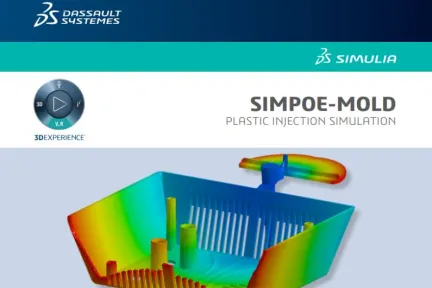
SIMPOE-MOLD PLASTIC INJECTION SIMULATION

For companies that design plastic parts or injection molds or manufacture plastic parts, SimpoeMold helps users predict and avoid manufacturing defects during the earliest stages of part and mold design, eliminating costly mold rework, improving part quality, decreasing time to market and optimizing production cycle times. The Simpoe-Mold plastic injection simulation solution is targeted towards all players involved in the plastic industry, whether they are product designers, mold designers, mold makers or plastic part manufacturers. Simpoe-Mold allows simulation with shell and solid mesh, with or without inserts, and it can handle complex shapes. Simpoe-Mold also allows simulation of more advanced processes, such as gas-assisted injection, co-injection molding, bi-refringance, overmolding, multishot or multi-domain injection.

Customer Papers

SIMPOE-MOLD PLASTIC INJECTION SIMULATION
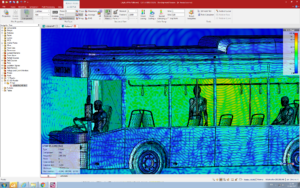
Simulation of a Multi-pass Groove Weld and Clad Plate Using Abaqus 2D Weld GUI and Comparison with Measurements

The computer simulation of multiple layering of welds is necessary to determine the distortion and residual stresses from the welding process. The welding simulation requires thermal and structural solutions, which are usually carried out in two simulations. Once solved, the thermal transient model temperature results are read into the structural model to solve for component stresses.

Customer Papers
Simulation of a Multi-pass Groove Weld and Clad Plate Using Abaqus 2D Weld GUI and Comparison with Measurements
Automated framework to estimate probability of mechanical failure in handheld electronic devices

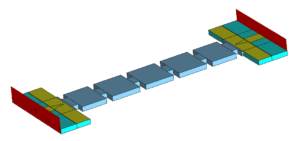
An automated framework for numerical simulation is developed to estimate the probability of brittle failure for a cell-phone display subjected to accelerated life cycle testing (ALT). SIMULIA Isight and the Abaqus-Python interface are used to predict the field-failure rate (FFR). The framework’s adaptable definition of inputs and output parameters can be extended to other common failures in handheld devices such as the denting and cracking of the housing walls, the cracking and delamination of the solder-joints in surface mounted devices, and the shock based criteria for packaged components.

Customer Papers
Automated framework to estimate probability of mechanical failure in handheld electronic devices
Analysis Tools for Accelerated Development of Composite Materials

Composite materials continue to rapidly improve in terms of structural performance. These materials offer the promise of significant weight reduction in many products—particularly aerospace structures, where weight minimization is critical to both cost and overall performance. Despite this potential, however, several challenges prevent composite materials from being used as widely and pervasively as traditional materials. Preliminary design concept evaluation of a structure with a novel material is difficult without a lengthy, expensive test program to provide the requisite material properties, but manufacturers are justifiably reluctant to invest this time and money without confidence that the material under consideration merits such expense.

Customer Papers

Analysis Tools for Accelerated Development of Composite Materials
Analysis of Dynamically Loaded Rolling Bearing Cages with Abaqus/Explicit

The main functions of rolling bearing cages are the separation and distribution of rolling elements. The cage is not directly affected by the loads acting on the bearing but by the dynamic interaction with other bearing components. Critical conditions for the cage can occur during operating conditions with shock loads or vibrations. For the strength assessment of the cage, a dynamic simulation is often necessary. One option is a dynamic FEA of the whole bearing, however, that can be very expensive. A model reduction is possible by means of adequate connector elements. An alternative to that is a multi body simulation (MBS) of the bearing and a subsequent dynamic FEA of the cage for a single impact with the impact speed result of the MBS. This allows an effective fatigue analysis for the cage. The outcome could be verified by measurement of cage motion and strains on different test rigs. As a result, this shows that Abaqus/Explicit is a powerful tool for the analysis of dynamically loaded cages.

Customer Papers

Analysis of Dynamically Loaded Rolling Bearing Cages with Abaqus/Explicit
Applicability of Modal Dynamic Method in Seismic and Aircraft Crash Analyses of NPP Structures.

This work is considered to overview the applicability of modal dynamic method in seismic and aircraft crash analysis of NPP structures. Soil-structure interaction is taken into account; problem of 20%-limiting of modal composite damping is researched; results of different methods (Direct integration method, modal method, and upgraded modal method, when projected damping matrix is fully populated) are compared on test model and on real structure model. Simple test was solved theoretically and in ABAQUS, global damping matrices, acquired by modal and direct integration methods are compared. It is worth noting that both methods are approved for use in dynamic analysis of NPP structures by ASCE 4-98, but in most cases direct integration method gives more conservative results.

Customer Papers

Applicability of Modal Dynamic Method in Seismic and Aircraft Crash Analyses of NPP Structures.
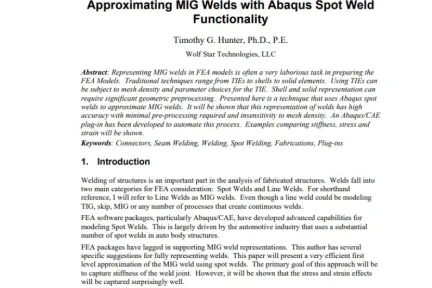
Approximating MIG Welds with Abaqus Spot Weld Functionality

Representing MIG welds in FEA models is often a very laborious task in preparing the FEA Models. Traditional techniques range from TIEs to shells to solid elements. Using TIEs can be subject to mesh density and parameter choices for the TIE. Shell and solid representation can require significant geometric preprocessing. Presented here is a technique that uses Abaqus spot welds to approximate MIG welds. It will be shown that this representation of welds has high accuracy with minimal pre-processing required and insensitivity to mesh density. An Abaqus/CAE plug-in has been developed to automate this process. Examples comparing stiffness, stress and strain will be shown.

Customer Papers

Approximating MIG Welds with Abaqus Spot Weld Functionality
260개의 결과가 있습니다.

고객 사례

150개의 결과가 있습니다.
3개의 결과가 있습니다.

SIMULIA 자기 주도 학습

학습자가 편리하게 학습을 꾸준히 이어갈 수 있도록 수백 개의 자기 주도 학습 모듈을 제공합니다.

블로그

SIMULIA 블로그에서 당사 전문가들이 전하는 최신 뉴스와 혁신에 대해 알아보세요.

775개의 결과가 있습니다.
What’s New in Isight 2022

In today’s computer-aided product development and manufacturing environment, designers and engineers are...

Article

What’s New in Isight 2022
원통형 배터리의 열 폭주

Introduction 리튬이온 배터리는 휴대폰뿐만 아니라 전기차에도 널리 사용됩니다. 매일 사용하기에 매우 편리하지만 항상 안전 문제가 있습니다. 바로 열 폭주입니다. 열 폭주는 배터리 화학 반응이 에너지를 방출, 온도를 더욱 높여

기사

원통형 배터리의 열 폭주

SIMULIA의 지원 서비스 알아보기

SIMULIA 전문가와 상담하여 당사의 솔루션이 모든 규모의 조직에서 원활한 협업과 지속 가능한 혁신을 실현하는 방법에 대해 알아보세요.

시작하기

학생, 교육, 전문가 및 회사를 위한 교육 과정과 강의가 제공됩니다. 당신에게 맞는 SIMULIA 교육을 찾아보세요. 

도움받기

소프트웨어 및 하드웨어 인증, 소프트웨어 다운로드, 사용자 설명서, 지원 연락처 및 서비스 제공에 대한 정보를 확인하세요.