1495개의 결과가 있습니다.
Parametric Study of Helical Baffle Type Heat Exchanger using 3DEXPERIENCE Platform

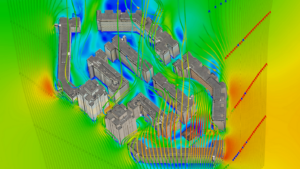
Heat exchangers are essential components in many engineering processes in industries. Helical baffle and segmental baffle are two major types of shell and tube heat exchangers. Helical baffle heat exchangers offer lower pressure drops and higher heat transfer efficiency as compared to segmental baffles. In present work, numerical simulations are performed on a helical baffle heat exchanger using 3DEXPERIENCE flow simulation application to predict heat transfer and pressure drop. Since helical baffle inclination angle is an important design parameter, a parametric study is carried out to evaluate its effect on pressure drop and heat transfer. Optimum baffle angle found in the present study is baffle angle of 350 for which pressure drop and heat transfer is best.

Customer Papers
Parametric Study of Helical Baffle Type Heat Exchanger using 3DEXPERIENCE Platform
FEA Modelling of Expandable Sand Screens Interactions with Rock Formations

Expandable sand screens are a sand control system, which is used to control the ingress of solids in oil and gas reservoirs with weak and unconsolidated formations. There are two different variations of expandable screens; a system based on a slotted basepipe which are easy to expand compliant to the formation but is relatively low in strength and a system based on a drilled basepipe which is very strong but is more difficult to expand compliantly. The model was used to study the effects of formation screen interactions in inclined wellbores, through multiple rock layers. The model is also routinely used to study new applications for potential problems.

Customer Papers

FEA Modelling of Expandable Sand Screens Interactions with Rock Formations
A Study of Durability Analysis Methodology for Engine Valve Considering Head Thermal Deformation and Dynamic Behavior

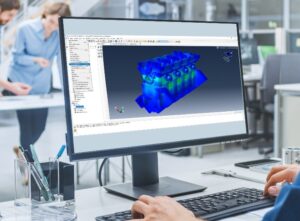
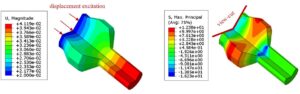
Automotive engine valves draw the air and fuel into the cylinders and allow the exhaust gas out. The valves are under various loads during the engine running: a combustion pressure, a spring force, thermal loads and the impact force due to valve closing speed. Their combined loads sometimes lead a valve fracture. In this paper, the failure behavior in the exhaust valve is investigated with the finite element methods. An implicit time integration method is used to simulate the transient dynamic behavior of the valve. The stresses results by FEA were in good agreement with the measured data under a valve train rig test.This study showed the durability of the valve neck, the most common failure position, is subject to various factors such as the partial contact due to the thermal deformation of the valve seat, the degradation of material strength due to high temperature, the dynamic load when the valve closes.

Customer Papers

A Study of Durability Analysis Methodology for Engine Valve Considering Head Thermal Deformation and Dynamic Behavior
Heavy Duty Structural Analysis using Abaqus in the Cloud

Concrete anchors are critical fastening elements in transferring structural load to concrete foundation. In this case study, cast-in-place mechanical anchors with local reinforcement were modeled using SIMULIA Abaqus. Steel anchor bolt and rebars were modeled using elasticplastic material, and concrete slab was modeled using concrete damage plasticity model. Because of the large model, contact, and damage failure procedure were involved, parallel computing had to be employed to speed up the solution process. The UberCloud HPC Experiment provided a great opportunity to tap into HPC resource in the cloud.

Customer Papers

Heavy Duty Structural Analysis using Abaqus in the Cloud
Analysis of Clothing Pressure on the Human Body in Motion

In a previous study, the authors presented the development of knitted fabric models for finite element analysis to simulate the large deformation behavior of garments and the distribution of clothing pressure on the human body in a stationary position. This paper describes an extension of the investigation to a study of the human body in motion. The study accomplished a fully automatic simulation of the clothing pressure change in T-shirts during jogging. The analysis technique is expected to be utilized in the development of a stabilized electrocardiogram measurement for a person during exercise.

Customer Papers

Analysis of Clothing Pressure on the Human Body in Motion
Automated Translation of Non-Symmetric BGA Design into Copper-Featured Three-Dimensional Abaqus Models

Package technology is constantly improving in order to keep up with the advances in silicon technology. Multi layered packages exhibit several failure modes that can be predicted using modern software tools. This paper provides a methodology for creating a high-fidelity model of the interposer with all the conductor geometries in Abaqus/CAE. The two failure modes that are explored with this model are package warpage prediction due to actual copper imbalance and filled microvia delamination. Each layer can meshed based on the actual geometry in the layout design. Package warpage is caused by copper imbalance between the two sides of the interposer.

Customer Papers

Automated Translation of Non-Symmetric BGA Design into Copper-Featured Three-Dimensional Abaqus Models
A model for Self-Pierce Rivet Process of a Boron Steel

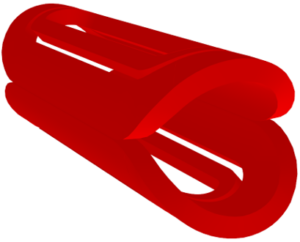
Self piercing riveting (SPR) is a cold joining technique used in the automotive industry replacing the resistance spot welding. SPR creates a strong mechanical attachment between two or more similar or dissimilar sheets using a semi tubular rivet forge with a die. The number of sheet material combinations is increasing as vehicle design becomes more complex. Improving the mechanical properties of the rivet will enable greater versatility of standard rivet and die combinations. A 3D model of a prototype rivet during forging was developed, different die velocities and material hardness were analyzed aiming to validate the performance of a Boron steel (10B37), focus was set on the rivet, different mesh densities were assessed, the material behavior was input via tensile testing data obtained with wire samples according to ASTM E8 standard, while the die was assumed in all cases analytical rigid, also the influence of friction was studied.

Customer Papers

A model for Self-Pierce Rivet Process of a Boron Steel
Crack Analysis in Molybdenum Glass Melting Electrode

Molybdenum’s high melting point, high electrical conductivity, resistance to sagging at glass bath temperatures, and resistance to attack by most glasses make it an ideal material for glass melting electrodes. However, dissolution of molybdenum electrodes still occurs during glass melting and processing. A single piece molybdenum electrode was found to have cracked at the end of its service life. Post-mortem analyses also showed melting of the molybdenum material in the crack region. Finite element simulations using Abaqus were used to evaluate the crack formation. This study involved coupled thermal-mechanical modeling to predict the crack size and location. The FEA model was qualitatively successful in predicting the crack morphology based on very limited operational knowledge. The simulation results were compared with experimental results to evaluate necessary design changes for improving electrode life.

Customer Papers

Crack Analysis in Molybdenum Glass Melting Electrode
Ductile Tearing Instability Assessment of a Cracked Reactor Pressure Vessel Nozzle for Larger Critical Crack Size Compared to the FAD Method

The critical flaw size is computed for a cracked nozzle in a reactor pressure vessel using a ductile tearing instability assessment and is compared to the Failure Assessment Diagram method. A material resistance J-R curve and elastic-plastic finite element analyses are used to evaluate the crack stability. The expectation is that the critical crack size will be larger from the tearing instability assessment compared to the FAD assessment, since the rising J-R curve gives higher toughness as stable tearing occurs. A reactor pressure vessel nozzle geometry with a postulated surface crack is used as an example to examine the analysis details and common difficulties encountered when creating the crack model, obtaining the necessary elastic-plastic FEA convergence to compute the J-integral values, and determining the tearing stability point.

Customer Papers
Ductile Tearing Instability Assessment of a Cracked Reactor Pressure Vessel Nozzle for Larger Critical Crack Size Compared to the FAD Method
Evaluation of Brain Stresses during Car Crashes using the SAE Baja Racecar Test Vehicle

This report describes the result of a research project focused on driver’s brain damage evaluation during front impact of the Baja SAE race car to a wall. Two kinds of situation were considered in this analysis: a driver with and without a seat belt. The goal of this project is to check the amount of stress absorbed by the brain during impact and evaluate the role of the seat belt during impact. The analysis consists of a dynamic simulation of an impact of a car frame on a wall by using Finite Element Analysis (FEA) method. Models were meshed by using HyperMesh (a FEA pre-processing software). After finishing modeling, results were calculated and analyzed by using the Abaqus/Explicit (a computer aided engineering program) explicit solver. Results focus on the stresses, also will include energy, velocity, acceleration and displacements experienced by the following elements of model: brain, neck, dummy body and car frame. The results obtained from the analysis were displayed through charts.

Customer Papers
Evaluation of Brain Stresses during Car Crashes using the SAE Baja Racecar Test Vehicle
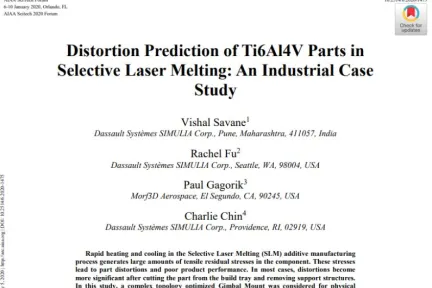
Distortion Prediction of Ti6Al4V Parts in Selective Laser Melting: An Industrial Case Study

Rapid heating and cooling in the Selective Laser Melting (SLM) additive manufacturing process generates large amounts of tensile residual stresses in the component. These stresses lead to part distortions and poor product performance. In most cases, distortions become more significant after cutting the part from the build tray and removing support structures. In this study, a complex topology optimized Gimbal Mount was considered for physical printing and finite element analysis of the print process. Th component was printed using Ti6Al4V material on an SLM machine and measurement points were taken on its outer profile. This data was compared with original geometry and simulation results. A good agreement was found between simulation and experimental results which was helpful in part development and establishing the technology.

Customer Papers

Distortion Prediction of Ti6Al4V Parts in Selective Laser Melting: An Industrial Case Study
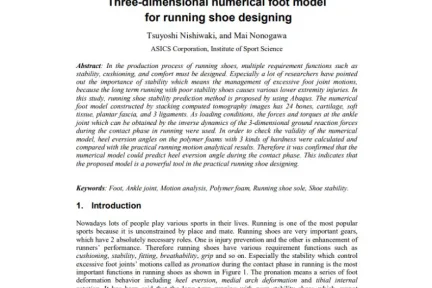
Three-dimensional numerical foot model for running shoe designing

In the production process of running shoes, multiple requirement functions such as stability, cushioning, and comfort must be designed. Especially a lot of researchers have pointed out the importance of stability which means the management of excessive foot joint motions, because the long term running with poor stability shoes causes various lower extremity injuries. In this study, running shoe stability prediction method is proposed by using Abaqus. The numerical foot model constructed by stacking computed tomography images has 24 bones, cartilage, soft tissue, plantar fascia, and 3 ligaments. As loading conditions, the forces and torques at the ankle joint which can be obtained by the inverse dynamics of the 3-dimensional ground reaction forces during the contact phase in running were used.

Customer Papers

Three-dimensional numerical foot model for running shoe designing
260개의 결과가 있습니다.

고객 사례

150개의 결과가 있습니다.
3개의 결과가 있습니다.

SIMULIA 자기 주도 학습

학습자가 편리하게 학습을 꾸준히 이어갈 수 있도록 수백 개의 자기 주도 학습 모듈을 제공합니다.

블로그

SIMULIA 블로그에서 당사 전문가들이 전하는 최신 뉴스와 혁신에 대해 알아보세요.

775개의 결과가 있습니다.

SIMULIA의 지원 서비스 알아보기

SIMULIA 전문가와 상담하여 당사의 솔루션이 모든 규모의 조직에서 원활한 협업과 지속 가능한 혁신을 실현하는 방법에 대해 알아보세요.

시작하기

학생, 교육, 전문가 및 회사를 위한 교육 과정과 강의가 제공됩니다. 당신에게 맞는 SIMULIA 교육을 찾아보세요. 

도움받기

소프트웨어 및 하드웨어 인증, 소프트웨어 다운로드, 사용자 설명서, 지원 연락처 및 서비스 제공에 대한 정보를 확인하세요.