1495개의 결과가 있습니다.
Coupled Euler-Lagrange Simulation of the JOLT HE Event

We simulated the Defense Threat Reduction Agency (DTRA)-sponsored Jointed Limestone Test (JOLT) using the Abaqus fully coupled Euler-Lagrange computation scheme. JOLT was a small-scale experiment consisting of over 37,000 individual cubes of limestone surrounding simulated tunnels. This test bed was loaded with ground shock generated by a spherical Comp B charge, thereby providing data for the study of computer codes used to compute the response of buried tunnels to explosive loading. We modeled the cubes as continuum blocks with contact, making for a dis-continuum simulation using a hybrid continuum code including Eulerian modeling of the explosive region and Lagrangian modeling of the remainder of the test bed. This paper has been approved for unlimited release under LA-UR-14-20056.

Customer Papers
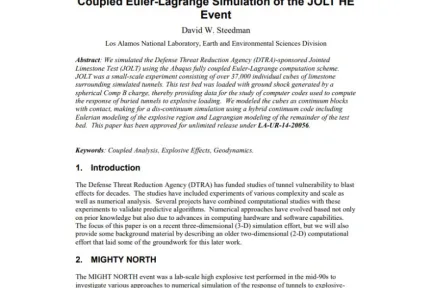
Coupled Euler-Lagrange Simulation of the JOLT HE Event
How to Select and Calibrate an Accurate Material Model for Polymers

The non-linear mechanical response of thermoplastics, rubbers, foams, and biomaterials can be challenging to accurately represent in a FE simulation. Recent versions of Abaqus/Standard and Abaqus/Explicit support a number of different viscoelastic and viscoplastic material models, including the new Parallel Rheological Framework model. These material models can provide accurate predictions of the response of different material classes, but in many applications it can still be challenging to select an appropriate material model and to calibrate it to experimental data. This paper discusses what experimental data is necessary to use these models, illustrates the importance of model validation, and demonstrates how the material models can quickly be calibrated using the MCalibration software.

Customer Papers

How to Select and Calibrate an Accurate Material Model for Polymers
Combining the eXtended Finite Element Method with Virtual Crack Closure Technique and Cohesive Surface Modeling to simulate delamination migration in cross-ply laminates

Using recently developed benchmarks, the performance of the eXtended Finite Element Method (XFEM), as implemented in Abaqus/Standard, is assessed and its main features highlighted. Subsequently, a strategy is proposed to model delamination migration using Abaqus/Standard that combines: the Cohesive Surface (CS) formulation and/or the Virtual Crack Closure Technique (VCCT) to model delamination with XFEM to capture migration. Finally, the proposed strategy is applied to model the Delamination Migration (DM) test and the results obtained are compared to experiments.

Customer Papers
Combining the eXtended Finite Element Method with Virtual Crack Closure Technique and Cohesive Surface Modeling to simulate delamination migration in cross-ply laminates
Static and Dynamic Simulation of Rubber Tracks using Multi-Body Dynamics to Study Pressure Contact on Treads

The study of large and complex structures that involve multiple bodies functioning kinematically together have been rather challenging until recent technological advancements were found. When one was faced with such a task, the most viable way to proceed was to make use of simplicity and assumptions to conduct analysis at the component of interest. In what is called “system-level” simulation, all components of a given structure or system are taken into consideration in the analysis, thus reducing the yield of error in the theorization of your model. Such analysis method must be used when studying the phenomena of tread wear in a rubber track as it rolls over an undercarriage type-motion system.

Customer Papers

Static and Dynamic Simulation of Rubber Tracks using Multi-Body Dynamics to Study Pressure Contact on Treads
Crack front stress intensity validation using two methods for a crack at a material boundary in a nozzle component

To evaluate if a crack might cause a structural failure, the crack front stress intensity is needed according to engineering standards like API 579-1/ASME FFS-1. The objective of this paper is to describe how the computed crack front stress intensity can be validated by using two separate approaches with Abaqus/Standard. This paper examines the details of modeling a crack located at a material boundary in a nozzle component, including the effect of different modulus values on the computed stress intensity. Being able to compute the stress intensity two ways and get the same value gives confidence that the mesh is sufficient to model the crack and provide accurate values for the fracture assessment.

Customer Papers

Crack front stress intensity validation using two methods for a crack at a material boundary in a nozzle component
Forensic Investigation of the Deepwater Horizon Blowout Preventer

The DWH oil spill was the largest offshore oil spill in United States history. A Joint Investigation Team (JIT) of the Departments of the Interior (DOI) and Homeland Security (DHS) was charged with investigating the explosion, loss of life, and blowout associated with the DWH drilling rig. Det Norske Veritas (U.S.A.), Inc. (DNV GL) was retained to perform a forensic investigation into the technical root causes of the inability of the blowout preventer to kill the well. This paper describes the overall investigative process and the specific role that finite element analysis and simulation played in the forensic investigation.

Customer Papers

Forensic Investigation of the Deepwater Horizon Blowout Preventer
Calcaneal Fixation Plate Test Method Development

The objective of this study was to develop a test method, using typical mechanical testing equipment, which would match the musculoskeletal loads on the calcaneus bone during gait. This study used the AnyBody Modeling System Foot Model to determine muscle, ligament, and joint contact forces during gait. Abaqus input files were created which contained all loads in the model as a function of gait. ScanIP was used to process the tessellated calcaneus, model a Sanders IIb fracture pattern, and generate an Abaqus mesh. The DePuy Synthes 3.5mm Locking Calcaneal Plate and corresponding screws were assembled to the calcaneus in Abaqus/CAE. The model was run using the Abaqus/Standard implicit solver.

Customer Papers

Calcaneal Fixation Plate Test Method Development
Laser Cut Nitinol Tubing Fatigue Coupon: FEA’s Role in Design, Testing, and Endurance Limit Determination

Nitinol medical device implants made from laser cut tubing (i.e. stents, valve structures, etc...) often require a fatigue assessment, which makes determining the material fatigue properties necessary. Towards the goal of determining the strain based endurance limit of medical grade super-elastic Nitinol tubing, a coupon was designed and evaluated via FEA using Abaqus software, produced via laser cutting, shape setting, and electro-polishing processes, and then fatigue tested to 10 million cycles. Extensive use of FEA was made to both design the coupon, but also to determine the strain versus alternating displacement amplitude for the coupon. Error due to dimensional tolerances was also quantified with FEA.

Customer Papers

Laser Cut Nitinol Tubing Fatigue Coupon: FEA’s Role in Design, Testing, and Endurance Limit Determination
Progressive damage modeling of CABIN for the validation of roll-over protective structure with testing results.

CAE has been an important tool in the process of construction and off-highway vehicles product development. Testing is performed on the cab structure to achieve the static loading criteria under ROPS and dynamic loading criteria under FOPS based on standards like ISO 3471. Finite element modeling, without taking into account the lost stiffness due to developed crack, over predicts the load carrying capability of the structure. Abaqus offers a general framework for material failure modeling to account for the degradation of stiffness under developed crack. The present work uses the Abaqus progressive damage and failure modeling technique to validate the test with FEA. The results of these simulations show good correlation at the failure location as observed during the Testing.

Customer Papers

Progressive damage modeling of CABIN for the validation of roll-over protective structure with testing results.
Virtual Simulation to Drive Product Designs for Wellbore Construction

This paper summarizes how Baker Hughes uses FEA based virtual simulations using Abaqus to drive the product designs for wellbore constructions tools used in oil and gas industry in the early design phase. Next generation wellbore constructions tools such as expandable liner hangers, packers, solid expandables and setting tools designs in multiple sizes are driven using virtual simulations to meet the desired performance requirements. Virtual simulation is tightly integrated in all the PDM phases of design and development from feasibility study to product launch. Using virtual simulations in the front end of the design cycle during feasibility studies or concept development helped to capture most of the design failure modes and design limitations with improved product performance before building costly prototypes.

Customer Papers

Virtual Simulation to Drive Product Designs for Wellbore Construction
Using Abaqus to Enable Accurate Stress Predictions of a Multi-Body System with Sliding Contact

This paper explores the problem of a multi-body articulating mannequin carried on a flexible linear motion base stage with sliding contact to examine the benefits of a single all-FEM approach. The sliding contact in the linear stage cannot be well represented by a modal body but has been modeled in Abaqus to simulate the response of this complex dynamic system. A detailed description of the model is included, along with specific design recommendations to enable this modeling approach to work in a highly dynamic design environment.

Customer Papers

Using Abaqus to Enable Accurate Stress Predictions of a Multi-Body System with Sliding Contact
On-going Project on Simulation Lifecycle Management at Ebara

Fluid Machinery & Systems Company, Ebara Corporation, is a turbomachinery manufacturing business group dealing with various types of pumps, compressors and turbines. The mission of our division is the development of fundamental technologies and the engineering support works for planning/developing/designing our products by using a wide variety of simulation applications such as computational fluid dynamics, structural analysis, vibration analysis, numerical optimization, etc... The engineering staffs had been performing their simulation works with their own way and the simulation & engineering know-how had not been fully shared.

Customer Papers

On-going Project on Simulation Lifecycle Management at Ebara
260개의 결과가 있습니다.

고객 사례

150개의 결과가 있습니다.
3개의 결과가 있습니다.

SIMULIA 자기 주도 학습

학습자가 편리하게 학습을 꾸준히 이어갈 수 있도록 수백 개의 자기 주도 학습 모듈을 제공합니다.

블로그

SIMULIA 블로그에서 당사 전문가들이 전하는 최신 뉴스와 혁신에 대해 알아보세요.

775개의 결과가 있습니다.

SIMULIA의 지원 서비스 알아보기

SIMULIA 전문가와 상담하여 당사의 솔루션이 모든 규모의 조직에서 원활한 협업과 지속 가능한 혁신을 실현하는 방법에 대해 알아보세요.

시작하기

학생, 교육, 전문가 및 회사를 위한 교육 과정과 강의가 제공됩니다. 당신에게 맞는 SIMULIA 교육을 찾아보세요. 

도움받기

소프트웨어 및 하드웨어 인증, 소프트웨어 다운로드, 사용자 설명서, 지원 연락처 및 서비스 제공에 대한 정보를 확인하세요.