1495개의 결과가 있습니다.
Analysis of Fatigue Life Estimate for the M119 Cradle Assembly with a Gouge Cut Defect

The M119 howitzer is a lightweight towed 105mm field artillery weapon system. It is an indirect-fire (gunfire delivered to a target that is not in a direct line of sight) weapon that primarily fires projectiles along a curved trajectory. This paper will discuss the impact of a manufactured tooling groove defect in the firing plate on the life cycle of the cradle. Results predicted that the cradle with the gouge cut in the firing plate would have a design life greater than 1000 cycles. Results are consistent with the 200+ successful shots that have been completed on fielded M119 howitzers with this gouge.

Customer Papers
Analysis of Fatigue Life Estimate for the M119 Cradle Assembly with a Gouge Cut Defect
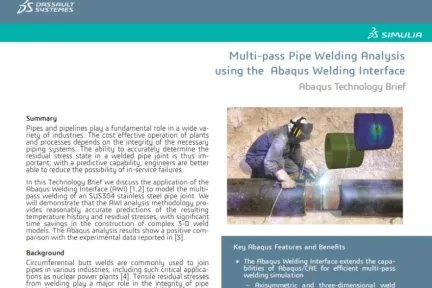
Multi-pass Pipe Welding Analysis using the Abaqus Welding Interface

In this Technology Brief we discuss the application of the Abaqus Welding Interface (AWI) to model the multipass welding of an SUS304 stainless steel pipe joint. We will demonstrate that the AWI analysis methodology provides reasonably accurate predictions of the resulting temperature history and residual stresses, with significant time stresses savings in the construction of complex 3-D weld models. The Abaqus analysis results show a positive comparison with the experimental data reported.

Tech Notes

Multi-pass Pipe Welding Analysis using the Abaqus Welding Interface
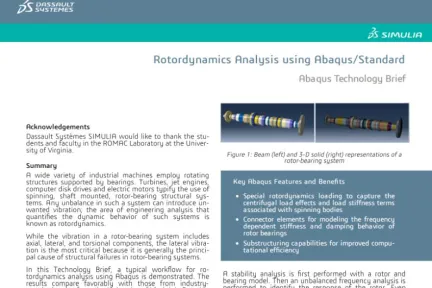
Rotordynamics Analysis using Abaqus/Standard

In this Technology Brief, a typical workflow for rotordynamics analysis using Abaqus is demonstrated. The results compare favorably witht those from industry-standard codes from the University of Virginia's Rotating Machinery and Controls Laboratory (commonly known as ROMAC). A substructuring application is also discussed

Tech Notes

Rotordynamics Analysis using Abaqus/Standard
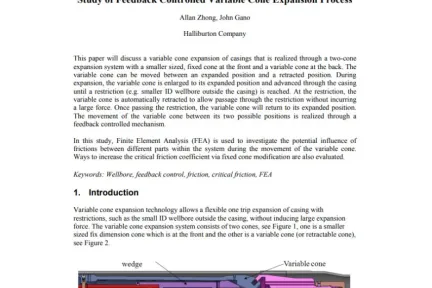
Study of Feedback Controlled Variable Cone Expansion Process

This paper will discuss a variable cone expansion of casings that is realized through a two-cone expansion system with a smaller sized, fixed cone at the front and a variable cone at the back. The variable cone can be moved between an expanded position and a retracted position. During expansion, the variable cone is enlarged to its expanded position and advanced through the casing until a restriction (e.g. smaller ID wellbore outside the casing) is reached. At the restriction, the variable cone is automatically retracted to allow passage through the restriction without incurring a large force. Once passing the restriction, the variable cone will return to its expanded position. The movement of the variable cone between its two possible positions is realized through a feedback controlled mechanism.

Customer Papers

Study of Feedback Controlled Variable Cone Expansion Process
Intermediate Crack Debonding Model of FRPStrengthened Concrete Beams Using XFEM

The use of fiber reinforced polymer (FRP) systems as externally bonded reinforcement has become very popular for the repair and strengthening of reinforced concrete (RC) structures as an alternative to the traditional techniques. One of the common failure modes of FRPstrengthened concrete beams is intermediate crack (IC) debonding of the FRP initiated at the tip of flexural or flexural/shear cracks in the substrate concrete; locations at which the interface is subjected to mixed-mode loading. This study presents a numerical analysis method using the extended finite element method (XFEM) implemented in Abaqus to model FRP intermediate crack debonding failure started at the tip of a flexural crack in a plain concrete beam specimen.

Customer Papers

Intermediate Crack Debonding Model of FRPStrengthened Concrete Beams Using XFEM
A Numerical Prediction of Particle Contaminations in the Seal Design for a Bearing by One Way Coupling

In recent years the tightening of fuel economy regulations and the trend towards environmentally friendly products increase demand for compact, lightweight and more efficient automotive transmissions. At the same time, the bearings in the transmission are always more often subject to harsh lubrication conditions. Contaminants in the lubricant have a strong lifereducing effect on rolling bearings. Past practices for protecting bearings from contamination include the use of lip seals make direct contact with raceway, but this solution lead to high frictional torque in the bearing system. Another practice includes the use of labyrinth isolators, but this solution also is not sufficient to prevent premature bearing failures due to contaminants.

Customer Papers

A Numerical Prediction of Particle Contaminations in the Seal Design for a Bearing by One Way Coupling
The Use of Abaqus in an Engine Bearing Design Environment

Abaqus is an integral part of the analysis process, proving data related to the structural stiffness of the housing, assembly deformations, inertia effects and journal/crankpin misalignment. This paper provides an overview of the different types of Abaqus analysis which have been developed and deployed in order to extract the required input data for SABRE-EHL. In addition to providing input data to SABRE-EHL, Abaqus can also be used to apply bearing pressures back onto the structural model. SABRE-EHL oil film pressures are mapped onto the Abaqus bearing mesh and used to perform a non-linear engine cycle analysis where housing stresses and detailed housing-bearing contact interactions can be investigated.

Customer Papers

The Use of Abaqus in an Engine Bearing Design Environment
Multi-disciplinary optimization of turbine components with the aid of surrogate modeling techniques

Turbomachinery components design and optimization process requires a multi disciplinary approach. These components are designed and optimized for aerodynamic efficiency with robust mechanical integrity requirements. Further analyses are also required for thermal stresses, rotor dynamics, acoustics and other design requirements. The analyses require different tools (in-house and commercial) which must be integrated within a fully automated process. The calculation time for these calculations, particularly for CFD, could be a limiting factor for the number of iterations used.

Customer Papers

Multi-disciplinary optimization of turbine components with the aid of surrogate modeling techniques
Application of Thermoplastic Polyester Elastomer for Honeycomb Shock Absorbing Components

Thermoplastic polyester elastomer (TPEE) possesses the properties of both rubber and engineering plastic. The most important feature of this material lies in its ability to combine the superior repulsion elasticity and flexibility of rubber with the rigidity of engineering plastic. This enables it to exhibit durability against fatigue, even when exposed repeatedly to large deformation. The most remarkable feature of TPEE is such that it can realize material properties with very small strain rate dependency. This paper attempts to develop shock absorbing components of small sizes with light weight for automobile applications.

Customer Papers

Application of Thermoplastic Polyester Elastomer for Honeycomb Shock Absorbing Components
Structural Mechanics of Steam Turbines: Facing challenges in FE-postprocessing with STARpost

This paper describes how Siemens Energy large scale steam turbines R&D has faced this challenge by developing ‘STARpost’ (i.e. Steam Turbine Analysis Routine – postprocessing), an efficient post-processing-plug-in for Abaqus/CAE: ‘STARpost’ automatically reads in the relevant temperature-dependent material data, assesses the existing stresses against the varying allowable stresses (for components with different materials and different calculation steps), provides many more field outputs beneficial for hot turbomachinery R&D and an environment for convenient visualization.

Customer Papers

Structural Mechanics of Steam Turbines: Facing challenges in FE-postprocessing with STARpost
260개의 결과가 있습니다.

고객 사례

150개의 결과가 있습니다.
3개의 결과가 있습니다.

SIMULIA 자기 주도 학습

학습자가 편리하게 학습을 꾸준히 이어갈 수 있도록 수백 개의 자기 주도 학습 모듈을 제공합니다.

블로그

SIMULIA 블로그에서 당사 전문가들이 전하는 최신 뉴스와 혁신에 대해 알아보세요.

775개의 결과가 있습니다.

SIMULIA의 지원 서비스 알아보기

SIMULIA 전문가와 상담하여 당사의 솔루션이 모든 규모의 조직에서 원활한 협업과 지속 가능한 혁신을 실현하는 방법에 대해 알아보세요.

시작하기

학생, 교육, 전문가 및 회사를 위한 교육 과정과 강의가 제공됩니다. 당신에게 맞는 SIMULIA 교육을 찾아보세요. 

도움받기

소프트웨어 및 하드웨어 인증, 소프트웨어 다운로드, 사용자 설명서, 지원 연락처 및 서비스 제공에 대한 정보를 확인하세요.