1495개의 결과가 있습니다.
Using Abaqus to Model Delamination in FiberReinforced Composite Materials

The strength of laminated fiber-reinforced composite materials depends on the combination of the orientations of the stacked plies with respect to the applied loads and the state of the bonding between adjacent plies. Prior work has focused on developing forming simulations using Abaqus to track fiber orientations as a stack of fabric plies conforms to the shape of a mold. Knowing the final fiber orientations, cured composite properties can be defined to model the behavior of a resin-infused solid structural composite part. In this paper, a failure criterion and damage properties are investigated to model delaminations in composite parts. Delaminations due to Mode I failure are studied by testing unidirectional coupon specimens.

Customer Papers
Using Abaqus to Model Delamination in FiberReinforced Composite Materials
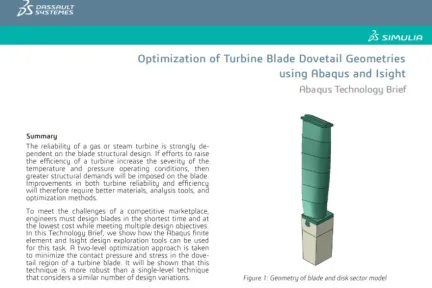
Optimization of Turbine Blade Dovetail Geometries using Abaqus and Isight

The reliability of a gas or steam turbine is strongly dependent on the blade structural design. It efforts to raise the efficiency of a turbine increase the severity of the temperature and pressure operating conditions, then greater structural demands will be imposed on the blade. Improvments iin both turbine reliability and efficiency will therefore require better materials, analysis tools, and optimization methods.

Tech Notes

Optimization of Turbine Blade Dovetail Geometries using Abaqus and Isight
Using Isight Simulation Automation Tools to Reduce the Cycle Time for Ship Structural Analysis Processes

Huntington Ingalls Industries – Ingalls Shipbuilding (HII) is required to perform several different types of structural shock and vibration analyses under the terms of US Navy shipbuilding contracts. Some of these required analyses include whipping, longitudinal strength, linearized stress, pipe shock test, bolt stress, equipment foundation, pipe hanger stress, and ship weight analysis. Historically, these analyses were run interactively by Ingalls Shipbuilding (i.e., without the benefit of Simulation Automation). The first section of this paper presents an overview of some of the ship structural analyses, the simulation automation Isight models created, and a summary of the predicted man-hour reductions. The second section of the paper discusses how Isight is predicted to enable meeting schedule demands.

Customer Papers

Using Isight Simulation Automation Tools to Reduce the Cycle Time for Ship Structural Analysis Processes
Using Abaqus to understand the orthotropic material interactions that enable zero thermal expansion laminates to be designed.

Poisson’s ratio effects, to a large extent, control the thermal expansion characteristics of angle-ply laminates. It is possible to design laminates, that have been manufactured from some highly orthotropic laminae, to exhibit a zero coefficient of expansion along one of its directions, even though none of the expansion coefficients of the laminae themselves are negative. It is often mistakenly believed that at least one of the expansion coefficients has to be negative in order for this effect to be achieved. However, it is the internal coupling of the individual expansion coefficients via the very high laminate Poisson’s ratio that actually enables this. The paper illustrates the effect via a simple Abaqus model and in so doing graphically cements the idea in the minds of the FEM analyst.

Customer Papers

Using Abaqus to understand the orthotropic material interactions that enable zero thermal expansion laminates to be designed.
Thrust Collar Bearing Design Optimization using Isight

ABB Turbochargers are required to fulfill the highest demands in terms of cost, reliability, performance and turbocharging efficiency, leading to the application of continuous improvement processes for all turbocharger components. The thrust bearing, for example, has to carry the whole axial force of the rotor with only minimal deformation of the collar surface over the turbocharger’s complete operating range. Moreover, requirements for mechanical integrity as well as limitations on installation space represent a set of constraints and targets that make the optimization of this component challenging – and an interesting benchmark for automatic optimization with Isight. This paper describes the parameter-based geometrical optimization of a thrust collar bearing.

Customer Papers

Thrust Collar Bearing Design Optimization using Isight
Strip Cooling Optimization by Means of Fully Coupled Thermo-Mechanical-Metallurgical 3D Model

Advanced High Strength Steels (AHSS) are the fastest growing segment of strip products due to their high demand in the automotive industry. Because they represents valid alternative to the use of expensive ferroalloys, steel producers are pushed to improve the processing routes and guarantee uniform properties conforming to specific targets. During the cooling phase on the Run Out Table (ROT), thermal and phase transformation inhomogeneities throughout the strip could lead to some sectors of this not conforming to target mechanical properties. Moreover, the differential shrinkage between neighboring fibers might induce plastic deformation leading to permanent loss of flatness.

Customer Papers

Strip Cooling Optimization by Means of Fully Coupled Thermo-Mechanical-Metallurgical 3D Model
Validation of Abaqus Virtual Simulation Model for an Expandable Liner Hanger

Expandable liner hangers used for wellbore construction within the oil and gas industry are complex mechanical systems. The consumable nature of the expandable products makes the accuracy and reliability of virtual simulation predictions important for reducing the time and cost to introduce a reliable and robust product to the competitive marketplace. This paper summarizes the seven-step methodology for validation of Abaqus virtual simulation model used for the performance predictions of an expandable liner hanger.

Customer Papers

Validation of Abaqus Virtual Simulation Model for an Expandable Liner Hanger
Chart Tracer Tool in Antenna Magus

The Chart Tracer tool forms part of the Data Conversion collection in the Antenna Magus Toolbox. It may be used to digitize data from images of Cartesian or Polar plots with linear or log-scale axes. Images in this document may differ from those on your computer if you are using a different version.

Tech Notes

Chart Tracer Tool in Antenna Magus
ABAQUS KNEE SIMULATOR

The Abaqus Knee Simulator is a validated computational modeling tool for performing basic to advanced knee implant analyses and simulations. This tool offers five fast and easy-to-setup workflows which reduce your reliance on time-consuming trials and expensive lab equipment, while still meeting regulatory requirements.

Brochures

ABAQUS KNEE SIMULATOR
Numerical Evaluation of Key Performance of Railroad Concrete Crossties

In recent years, concrete rail ties have received additional scrutiny with respect to their design criteria, manufacturing processes, in track performance and failure modes, owing to a number of railway track deterioration/failure events resulting from premature concrete tie failure. This paper employs a finite element analysis (FEA) framework to examine the key performance of pretensioned concrete crossties, including the pretension-released surface strain profile/transfer length, splitting/bursting propensity due to prestress transfer, and flexural loading and displacement capacities in rail seat positive and center negative bending modes.

Brochures

Numerical Evaluation of Key Performance of Railroad Concrete Crossties
Plugin for Tunneling and Geotechnical Analysis in Abaqus

Abaqus has one the best solutions for tunneling and geotechnical analysis due to the great non-linear capability. The Abaqus/CAE interface is not so friendly to define a tunneling analysis. It has a lot of steps and uses Model Change to remove and add elements, to simulate excavation a construction step). It’s also difficult to change material properties during analysis. For non Abaqus users could be very hard to define a model. This paper shows a plug-in for Abaqus/CAE that helps the user to define a tunneling, excavation and temporary structures, with support facility and other geotechnical analysis. The paper explores the steps to define a geotechnical analysis and Abaqus/CAE capabilities. It also includes two examples of the plugin usage: a tunnel and a retaining wall.

Customer Papers

Plugin for Tunneling and Geotechnical Analysis in Abaqus
Static and dynamic simulations for automotive interiors components using ABAQUS

Over the last years the car manufacturers have been working intensively to improve the quality of the interiors since it is extremely important to the customer’s perception of the car. The numerical simulation can help the development of the interiors components design in order to guarantee better structural performances and to increase the quality of the products and therefore it is important to develop new calculation methodologies. In this paper, we will present two methodologies developed to improve the quality and efficiency of dashboards.

Customer Papers

Static and dynamic simulations for automotive interiors components using ABAQUS
260개의 결과가 있습니다.

고객 사례

150개의 결과가 있습니다.
3개의 결과가 있습니다.

SIMULIA 자기 주도 학습

학습자가 편리하게 학습을 꾸준히 이어갈 수 있도록 수백 개의 자기 주도 학습 모듈을 제공합니다.

블로그

SIMULIA 블로그에서 당사 전문가들이 전하는 최신 뉴스와 혁신에 대해 알아보세요.

775개의 결과가 있습니다.

SIMULIA의 지원 서비스 알아보기

SIMULIA 전문가와 상담하여 당사의 솔루션이 모든 규모의 조직에서 원활한 협업과 지속 가능한 혁신을 실현하는 방법에 대해 알아보세요.

시작하기

학생, 교육, 전문가 및 회사를 위한 교육 과정과 강의가 제공됩니다. 당신에게 맞는 SIMULIA 교육을 찾아보세요. 

도움받기

소프트웨어 및 하드웨어 인증, 소프트웨어 다운로드, 사용자 설명서, 지원 연락처 및 서비스 제공에 대한 정보를 확인하세요.