
Corporate Social Responsibility
From empowering women in STEM to advancing circular economy practices and inclusive mobility, Dassault Systèmes is driving change through collaboration, creativity and cutting-edge technology.
Corporate Reports
From empowering women in STEM to advancing circular economy practices and inclusive mobility, Dassault Systèmes is driving change through collaboration, creativity and cutting-edge technology.
In the VIRTUAL WORLD
any stakeholder with a dream to improve the planet can seize opportunities to develop innovative and sustainable solutions…
...enhancing REAL LIFE
by applying their creativity to tackle the world’s most pressing physical and social challenges to promote equity and progress.
Climate change and social issues are growing concerns for students, nonprofits, companies and citizens. Dassault Systèmes is committed to tackling social inequalities and promoting circular economy practices through innovations like virtual twins. Addressing such challenges requires collaboration. We’re focused on developing solutions in partnership with our customers, and we’re proactively fostering dialogue internally and externally to cultivate impactful solutions. From sustainable packaging design that reduces plastic use while maintaining health standards to optimizing construction resources to digitizing clinical trials to lower emissions, we help industries and cities minimize environmental impact. We also support the circular economy by helping companies reduce waste, optimize inventories and refine production to conserve resources. We believe that only by working together can we shape a more sustainable future.
Industry leaders(1) across the spectrum turn to Dassault Systèmes for support in pursuing climate change targets and transitioning to circular economy practices. Our portfolio of solutions helps decarbonize products and operations, decrease material and energy consumption, cut costs and optimize impact in every sector.
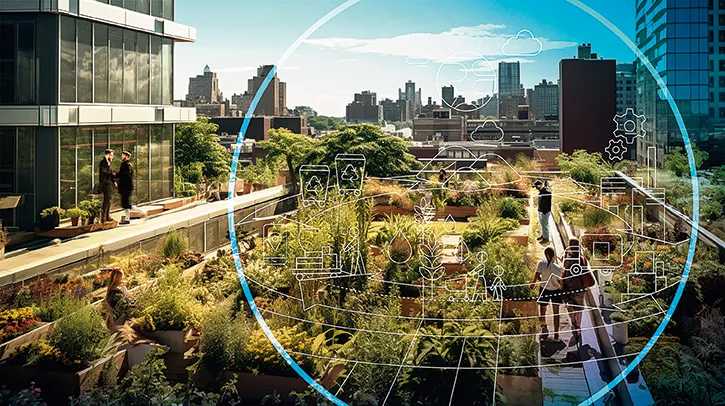
During London Climate Action Week 2024, we organized the Chief Sustainability Officer Summit, bringing together innovative minds from across the business world to tackle the challenges of tomorrow. The event put a specific focus on the all-important issue of biodiversity in the sustainability mandate. We welcomed over 90 attendees from multiple countries, representing diverse sectors and industries including: manufacturing, cosmetics, food & beverage, finance, pharmaceutical, chemicals, construction, technology and consulting.
Along with other CSOs and sustainability leaders, we were able to reflect on critical sustainability issues and to discuss concrete solutions for reconciling technology, the circular economy and biodiversity. What emerged from the day was a collective determination to go beyond words and transform our strategies into real, measurable action.
We demonstrate our commitment to female employees through 3DS WIN (Women’s INitiative). Driven by a dedicated team, including contributors from Human Resources and Internal Communications, this program unites a network for all employees passionate about fostering and inspiring growth and development of women at Dassault Systèmes(2).
STEM careers drive innovation and solve global challenges, yet women remain underrepresented in these fields. Dassault Systèmes is dedicated to closing this gap. Through initiatives like 3DS WIN, Girls’ Day and programs to develop inclusive leadership skills for future managers, we support equal opportunities and inspire the next generation to create a more inclusive future in STEM.
Studies show that girls lose interest in STEM subjects as young as age 11, often due to societal stereotypes and a lack of role models. In higher education, women account for less than 35% of STEM students worldwide, with fields like computer science and engineering seeing even lower participation rates. Without targeted efforts, this gender gap risks widening further, limiting diverse perspectives shaping innovation and technological advancements. Dassault Systèmes proudly and actively promotes STEM both internally and externally to inspire young girls to envision themselves in these future-focused careers. We launched several new initiatives in 2024 to further our efforts in sharing our careers and inspiring young girls to explore opportunities in STEM.
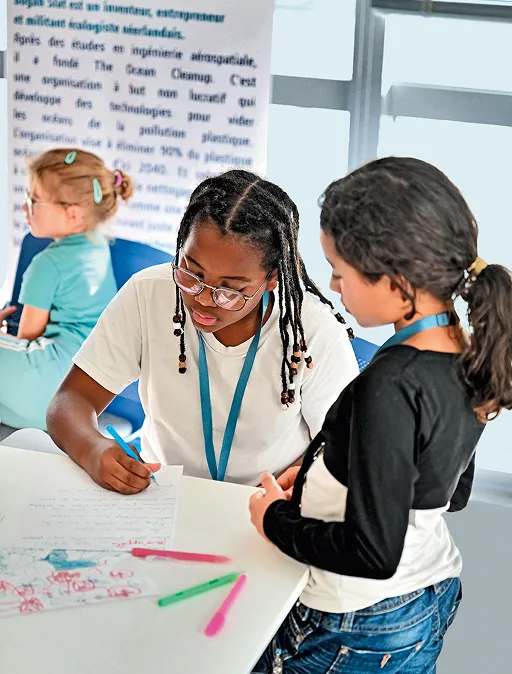
The Coding for the Future program reached 175 girls across 8 cities in Europe with one mission: making tech careers less intimidating!
These events are more than workshops: they are moments of empowerment. By demystifying technology and showcasing the possibilities in STEM, we continue to inspire the next generation of talent.
Fostering inclusion is a cornerstone of Dassault Systèmes’ commitment. We recognize that creating an environment where everyone can thrive requires collaboration, passion and shared efforts. That’s why we launched WIN Iberia: an extension of our global Women’s INitiative Network. WIN Iberia was created to connect and empower colleagues across our locations in Barcelona, Madrid and Valencia by providing a platform to drive meaningful initiatives around inclusion. By hosting hybrid events like our recent launch in Madrid, we’re bringing people together both in-person and online to share ideas, build relationships and create impactful change. And we’re just getting started: WIN Iberia is designed to grow and evolve with employees’ inputs, ensuring it reflects the needs and ambitions of our local team.
The essence of innovation lies in its ability to enhance human experience. That was the central theme of the most recent Act in our “The Only Progress is Human” campaign that focused on inclusive mobility. Through this initiative, we reaffirmed our commitment to shaping a world where technology is a conduit for human progress, paving the way for a society that is accessible and inclusive to all.
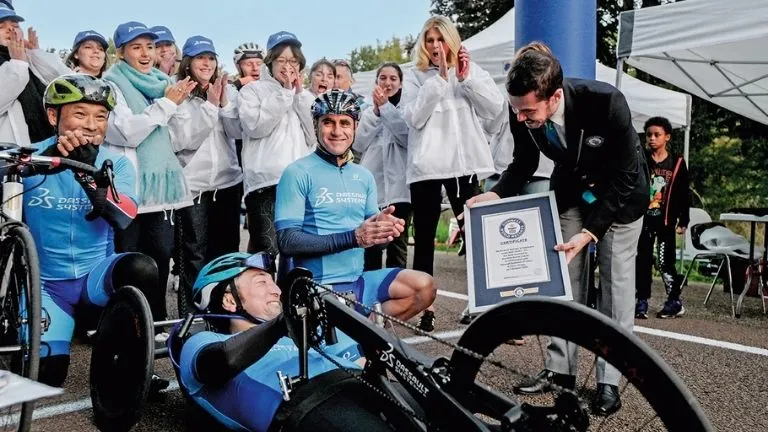
At the age of 22, Kanno Kazuhiko experienced a life-changing accident that severely injured his cervical vertebrae, resulting in quadriplegia. Despite this devastating injury, Kanno’s story is one of perseverance and triumph. He’s become an accomplished paracyclist, and on October 3, 2024, Kanno, also a dedicated Dassault Systèmes employee, set a new GUINNESS WORLD RECORDS™ for the farthest distance covered by handcycle in one hour: 28.331 km (17.6 miles).
To honor Kanno’s achievement and celebrate the synergy between human resilience and innovative technologies, we hosted a Mobility Night Ride. 3,000 people came together in the heart of Paris for an 11 km (6.8 mile) cycling and roller-skating party that traveled along iconic sights to celebrate the power of technology as a tool for empowerment and demonstrate what a city can look like if barriers to mobility for inhabitants and visitors are removed.
The Mobility Act represents the latest milestone in our mission to demonstrate that the only progress is human. This campaign underscores our passion to show how virtual twin experiences can drive sustainable innovations to address the world’s greatest societal challenges. It reflects our unwavering commitment to advancing the human experience, emphasizing the dynamic connection between technology and the resilience of the human spirit. And it was even more special because we were able to honor one of our own employees!
Kanno’s journey is about more than personal triumph; it’s also about raising awareness and advocating for systemic change in transportation and mobility solutions. Through his dedication, he has become a beacon of hope and a driving force for inclusivity, challenging us to rethink our approach and to design solutions that meet diverse needs. Kanno’s story also highlights also highlights the critical role of virtual twin technologies in developing both more inclusive technologies and more accessible urban environments. These are among the critical elements integral to shaping a future where mobility is a right for everyone, regardless of their physical ability. Kanno’s presence at the event symbolized the essence of our campaign, that progress is not measured by technological advancements but by the positive impact on human life. Initiatives like this allow us to demonstrate how virtual twins and the 3DEXPERIENCE platform empower innovators to create products and services that improve people’s and their communities’ lives.
We’re proud to champion a world where technology and humanity progress go hand in hand, rooted in our belief that genuine progress is measured by the betterment of human life. And we’re thrilled when we can show off the many talents of our employees around the world!
(1) All cases presented have been anonymized.
(2) Disclaimer: The actions and programs described in this section relate to the year 2024 and are applicable only to the extent permissible under local and national regulations. They are reviewed annually and can be adjusted, when necessary, in line with developments in the legal framework around the world, for example in the United States.
From empowering women in STEM to advancing circular economy practices and inclusive mobility, Dassault Systèmes is driving change through collaboration, creativity and cutting-edge technology.
Corporate Reports
Because experience is human, experience is about enjoying art, science and technology to imagine and create a better world for all. Discover us.
Corporate Reports
Discover the latest innovative projects developed with our solutions: PKvitality, FEops, BioSerenity, The Living Heart Project, Hugh Herr...
Corporate Reports
Everything we do is in service of having a positive impact on our world. Dassault Systèmes is firmly committed to doing our part to reach climate neutrality by 2040, and this guides how we operate as a company and what we offer our customers. We know that being a leader in sustainable technology means being a sustainable technology company ourselves. It’s not just about what we sell. It’s also about who we are and how we support our most valuable resource: our employees.
Corporate Reports
Meaningful actions, for today's world. The initiative shows how we can represent the imaginary as tangible and realizable elements.
CORPORATE
Dassault Systèmes is shedding light on 10 major challenges faced by humanity. Victoire de Margerie, Vice-President Corporate Equity, Marketing & Communications, has invited the world to discover how virtual universes can spark innovative ideas and game-changing solutions to age-old challenges. For each challenge, we respond with an Act that symbolizes and highlights our commitment to help our planet survive and thrive.
Corporate Reports
3D-enhanced maintenance and centralized management of structures in the cloud environment will open up a smart construction industry.
Corporate Reports
With vehicles providing growing levels of autonomy, quality and compliance are key challenges that the 3DEXPERIENCE platform helps to meet.
Corporate Reports
Discover the latest innovative projects: BioDapt's lower-limb prostheses, DAMAE Medical's device, LUCID Implants, modeling of cardiac configurations...
Corporate Reports
The 3DEXPERIENCE platform can be used by engineers to simulate airflows, as well as how a virus could spread in the air.
Corporate Reports