1503 résultats
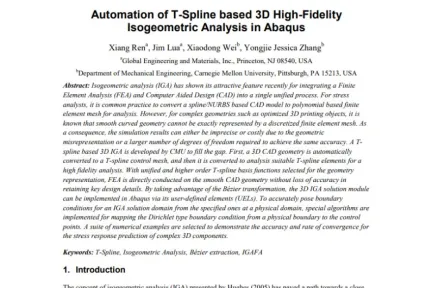
Automation of T-Spline based 3D High-Fidelity Isogeometric Analysis in Abaqus

Isogeometric analysis (IGA) has shown its attractive feature recently for integrating a Finite Element Analysis (FEA) and Computer Aided Design (CAD) into a single unified process. For stress analysts, it is common practice to convert a spline/NURBS based CAD model to polynomial based finite element mesh for analysis. However, for complex geometries such as optimized 3D printing objects, it is known that smooth curved geometry cannot be exactly represented by a discretized finite element mesh. As a consequence, the simulation results can either be imprecise or costly due to the geometric misrepresentation or a larger number of degrees of freedom required to achieve the same accuracy. A Tspline based 3D IGA is developed by CMU to fill the gap.

Customer Papers
Automation of T-Spline based 3D High-Fidelity Isogeometric Analysis in Abaqus
Human Foot Hitting a Soccer Ball Analysis Using Finite Element Methods

This paper is related to using Finite Element Analysis to analyze the stresses in the human foot bones when hitting a soccer ball. The result is a determination of the optimal position to hit the ball to have minimal stresses in the foot bones. The results will not only show the direction the ball will travel, but how far it will travel as well. The stresses in the human leg bones are determined for each impact and compared. The primary goal of this research was to show the advantages of utilizing finite element analysis applications in sports. The results will show that accurate results can be attained if the simulations mimic the real case. All simulations are ran using Abaqus/Explicit.

Customer Papers
Human Foot Hitting a Soccer Ball Analysis Using Finite Element Methods
Steam Turbine Critical Crack Evaluation and Ranking Cracks to Prioritize Inspection

Ranking the cracks by comparing their K values reveals the most severe crack location and crack shape. The critical crack size for the most severe crack case is determined using the Failure Assessment Diagram method. The evaluation points on the FAD plot are obtained using a combination of elastic K and elastic-plastic J-integral results. Determining the most severe crack location and critical crack size help inspectors prioritize where to look for cracking during the next scheduled maintenance and to select inspection methods to find cracks.

Customer Papers
Steam Turbine Critical Crack Evaluation and Ranking Cracks to Prioritize Inspection
3D PRINT -MATERIAL AND PROCESS MODEL AND EFFECT OF DEFECTS ON PART PERFORMANCE

Additive Manufacturing (AM) is helping to achieve significant time and fabrication cost savings, as well as creating complex geometries and material that are otherwise impossible using conventional manufacturing processes. 3D printed "AS-Built" metal parts are exhibiting surface roughness, warping, defects, and scatter in mechanical properties (strength, stiffness). Path Coverage visualization using machine printing pattern and orientation can detect the formation of voids and defects, which impact mechanical properties related to the as-built part as well as associated AM process simulation.

Customer Papers

3D PRINT -MATERIAL AND PROCESS MODEL AND EFFECT OF DEFECTS ON PART PERFORMANCE
An in-vivo experimental evaluation of Abaqus Knee Simulator for Total Knee Replacement

A large number of experimental in-vitro pre-clinical testing devices have been used in the evaluation of new implant designs for total knee replacement, but it is time-consuming and cost prohibitive to evaluate hundreds of design variations during design phase. In-silico knee simulator has provided an efficient way to perform component design evaluations under a variety of dynamic loadings, while it remains a challenge to evaluate the predictive accuracy due to the lack of in-vivo verification. The commercial software Abaqus, Isight and a specialized tool Abaqus Knee Simulator have been widely used to predict implanted knee mechanics. In the paper, a systematical in-vivo experimental evaluation has been carried out in Abaqus Knee Simulator with calibrated soft-tissue properties for gait cycle.

Customer Papers

An in-vivo experimental evaluation of Abaqus Knee Simulator for Total Knee Replacement
3D-FE Implementation of Evolutionary Cyclic Plasticity Model for Fully Mechanistic Fatigue Life Evaluation

Large uncertainties exist in the current methods of fatigue life evolution for nuclear components due to the overdependence on approaches that use empirical stress/strain-life (S~N) curves. Argonne National Laboratory (ANL), under the sponsorship of Department of Energy's Light Water Reactor sustainability (LWRS) program, seeks to develop a fully mechanistic approach for more accurate fatigue life estimation of nuclear components. To this end, ANL has developed evolutionary cyclic plasticity models for reactor steels based on uniaxial fatigue tests to capture the material aging behavior such as stress hardening/softening. In this paper, we introduce an implementation of the evolutionary cyclic plasticity model within the commercial finite element software ABAQUS through the use of an in-house developed user material subroutine.

Customer Papers

3D-FE Implementation of Evolutionary Cyclic Plasticity Model for Fully Mechanistic Fatigue Life Evaluation
Enhancing the Simulation of Complex Mechanical Systems with Machine Learning

Submarine hatches are complicated mechanical systems with many moving parts and interfaces. As a mission-critical system, they currently require shock qualification with explosive testing: the hatch must not be damaged beyond the point of operability. This approach is expensive, complex, and can only address a small set of conditions. Abaqus is used to predict posttest operational effectiveness in lieu of test results, but the complexity of the system makes the process too time-consuming to positively affect the design process. As such, ATA Engineering is developing a methodology to reduce solve times for these complex systems and hence enable design guidance earlier in the design cycle.

Customer Papers

Enhancing the Simulation of Complex Mechanical Systems with Machine Learning
Composites Modeling Capabilities of Abaqus

Composites occupy a noticeable place in the materials industry. Their characterization during the forming process as well as during their life cycle in different industrial fields impose an advanced knowledge of their mechanical and thermal behavior. A presentation of material parameters calibration using Isight coupled with Abaqus illustrates how the two tools can be joined together to solve the classical identification problems associated with new materials or non-linear constative laws. Tosca structure Bead optimization capabilities are shown through the optimization based on natural frequencies. Fatigue analysis has been performed using Fe-safe and shows the fatigue life contours.

Customer Papers

Composites Modeling Capabilities of Abaqus
Process Modeling and Validation for Metal Big Area Additive Manufacturing

Metal Big Area Additive Manufacturing (mBAAM) is a new additive manufacturing (AM) technology based on the metal arc welding. A continuously fed metal wire is melted by an electric arc that forms between the wire and the substrate, and deposited in the form of a bead of molten metal along the predetermined path. Objects are manufactured one layer at a time starting from the base plate. The final properties of the manufactured object are dependent on its geometry and the metal deposition path, in addition to depending on the basic welding process parameters. Computational modeling can be used to accelerate the development of the mBAAM technology as well as a design and optimization tool for the actual manufacturing process.

Customer Papers

Process Modeling and Validation for Metal Big Area Additive Manufacturing
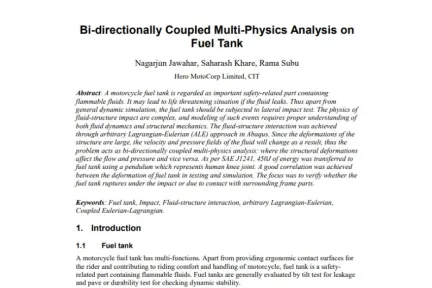
Bi-directionally Coupled Multi-Physics Analysis on Fuel Tank

A motorcycle fuel tank is regarded as important safety-related part containing flammable fluids. It may lead to life threatening situation if the fluid leaks. Thus apart from general dynamic simulation, the fuel tank should be subjected to lateral impact test. The physics of fluid-structure impact are complex, and modeling of such events requires proper understanding of both fluid dynamics and structural mechanics. The fluid-structure interaction was achieved through arbitrary Lagrangian-Eulerian (ALE) approach in Abaqus. A good correlation was achieved between the deformation of fuel tank in testing and simulation. The focus was to verify whether the fuel tank ruptures under the impact or due to contact with surrounding frame parts.

Customer Papers

Bi-directionally Coupled Multi-Physics Analysis on Fuel Tank
Parametric Study to Evaluate the Effect of Strut Geometry on PLLA Coronary Stent Recoil

Bioresorbable poly(L-lactic acid) (PLLA) stents present a clinically attractive treatment for coronary heart disease, providing a temporary scaffold that resorbs once the artery has healed. Polymeric stents are often mechanically inferior to their permanent metallic counterparts. However, their mechanical properties can be tailored through stretch-blow molding (SBM); a process that induces crystallinity and molecular orientation, subsequently altering the mechanical response of the polymer. This study aims to quantify the variation in mechanical properties of PLLA as a result of the SBM procedure and investigate the functionality of a stent constructed from this polymer.

Customer Papers

Parametric Study to Evaluate the Effect of Strut Geometry on PLLA Coronary Stent Recoil
257 résultats

Témoignages clients

150 résultats
4 résultats

Auto-apprentissage SIMULIA

Nous proposons plusieurs centaines de modules d'auto-apprentissage pour que vous puissiez continuer à apprendre à votre rythme.

Blogs

Lisez le blog SIMULIA pour connaître les dernières actualités et innovations de nos experts.

703 résultats

Découvrir comment SIMULIA peut vous aider

Contactez un expert SIMULIA pour découvrir comment nos solutions permettent une collaboration transparente et une innovation durable dans des entreprises de toutes tailles.

Commencer

Des formations et des cours sont disponibles pour les étudiants, le monde académique, les professionnels et les sociétés. Trouvez la formation SIMULIA qui vous convient. 

Obtenir de l'aide

Obtenez des informations sur la certification des logiciels et du matériel, les téléchargements de logiciels, la documentation utilisateur, les coordonnées du support et l'offre de services.