1503 résultats
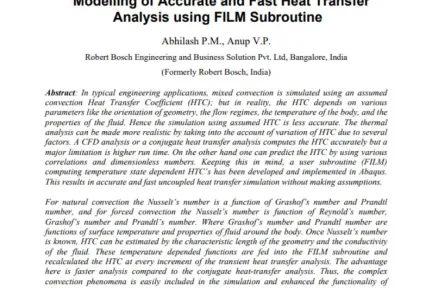
Modelling of Accurate and Fast Heat Transfer Analysis using FILM Subroutine

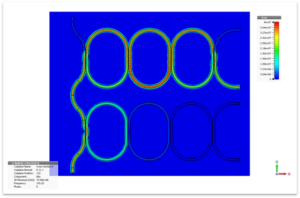
In typical engineering applications, mixed convection is simulated using an assumed convection Heat Transfer Coefficient (HTC); but in reality, the HTC depends on various parameters like the orientation of geometry, the flow regimes, the temperature of the body, and the properties of the fluid. This paper describes in detail how to calculate the temperature dependent HTC using FILM subroutine and the simulation results comparison with conjugate heat transfer analysis carried out in Abaqus.

Customer Papers
Modelling of Accurate and Fast Heat Transfer Analysis using FILM Subroutine
State of the Art Hytrel material modeling development for the design of Jounce Bumper

This paper describes the behavior and subsequent constitutive modelling of a Hytrel thermoplastic elastomer (TPC-ET) for a so-called Jounce bumper, which is a part of the vehicle’s shock absorber system. This component is subjected to large deformations (up to 100% strain) with significant permanent set and loss of stiffness. The objective of the analysis is to predict the component behavior after cyclic loading to obtain the load-displacement response curve of the Jounce bumper in operational conditions. The possibilities and limitations of the hyper-elastic model, including permanent-set and Mullins’ effect are discussed and numerical results compared to the test data from an actual component.

Customer Papers

State of the Art Hytrel material modeling development for the design of Jounce Bumper
Modelling Rubber Bushings Using the Parallel Rheological Framework

Bushings are anti‐vibration components used in vehicle suspension systems. They are typically made of rubber between two concentric metallic cylinders. Their analysis requires characterising their complex impedance (dynamic stiffness and phase angle). Their behaviour is often difficult to predict without testing a prototype. The rubber undergoes large strains, usually involving strain stiffening and Mullins effect, time dependency and, possibly, plasticity. Thus the behaviour depends on the loading frequency and amplitude, as well as the preload. To tackle the problem a methodology has been developed that combines Abaqus and Isight.

Customer Papers

Modelling Rubber Bushings Using the Parallel Rheological Framework
Example Nonparametric Optimization Cases for Additive Manufacturing Using Tosca and Abaqus

Two example nonparametric optimization cases for AM using TOSCA and ABAQUS are presented. For the first case, we optimized a disc brake caliper, where loading conditions were driven by the master cylinder, the contact areas of the disc rotor, and the envelope limitations within the wheel. The objective function, design constraints, and the targeted design response drove the outer topology of the caliper casting. TOSCA’s topology optimization established the primary geometry, and subsequent validation of the parametric reconstruction was performed in ABAQUS. The resulting optimized geometry removed 62% the caliper bridge volume from areas of low stress and replaced it (as needed) in high stress areas.

Customer Papers
Example Nonparametric Optimization Cases for Additive Manufacturing Using Tosca and Abaqus
Designing Cylinder Head Gaskets for New Generation Powertrains

The past decade has seen transformative changes in internal combustion engine technology. Revolutionary technological advances of powertrains include the replacement of traditional gasoline internal combustion engines with smaller displacement engines, the use of turbocharging to make smaller displacement engines more powerful and efficient, and the use of lightweight materials in both vehicle bodies and engines. Furthermore, the federal government’s CAFE standards mandate that OEMs develop more fuel-efficient vehicles with lower emissions.

Customer Papers

Designing Cylinder Head Gaskets for New Generation Powertrains
Fatigue Life Prediction Techniques for Polymers and Polymer Matrix Composites

To include the self-heating effect into the fatigue computation, information regarding hysteresis energy is required. As shown in Fig. 1, the hysteresis energy can be calculated by subtracting strain energies during the loading WL and unloading WU event. The calculated hysteresis energy includes information regarding both plastic deformation together with damage induced dissipations.

Customer Papers
Fatigue Life Prediction Techniques for Polymers and Polymer Matrix Composites
FlowVision & Abaqus 2-Way Strongly Coupled FSI Simulation of Automobile Tire Aquaplaning

Aquaplaning of automobile tires simultaneously incorporates various physical phenomena some of which are challenging to model with computer-aided simulation tools. Among those are complex patterned topology and rotational movement of tire, small clearance between ground and tire, free surface flow of water and air and inevitably the elastic nature of tire body and effect of its deformations on fluid flow characteristics.In order to overcome these challenges, Abaqus FE software from SIMULIA and FlowVision CFD package from Capvidia are strongly coupled for bidirectional fluid structure interaction (FSI) co-simulation. This approach is applied to a 205/55/R16 sized tire and same conditions are realized in experimental environment for comparison purposes.

Customer Papers

FlowVision & Abaqus 2-Way Strongly Coupled FSI Simulation of Automobile Tire Aquaplaning
LIVING HEART HUMAN MODEL: CARDIOVASCULAR STENT DEPLOYMENT AND CARDIAC CYCLE SIMULATION

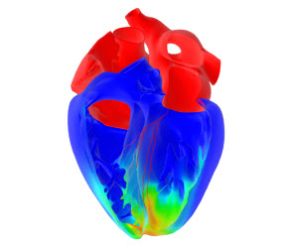
The SIMULIA Living Heart Human Model provides a unique testing environment where a stent can be deployed virtually in coronary arteries and deformed mechanically during the cardiac cycle. Once the mechanical deformation results are obtained, the longterm durability of the stent can be assessed. The virtual nature of the test provides a physiologically accurate methodology to test new and existing devices without exposing patients to unnecessary risk.

Solution Briefs

LIVING HEART HUMAN MODEL: CARDIOVASCULAR STENT DEPLOYMENT AND CARDIAC CYCLE SIMULATION
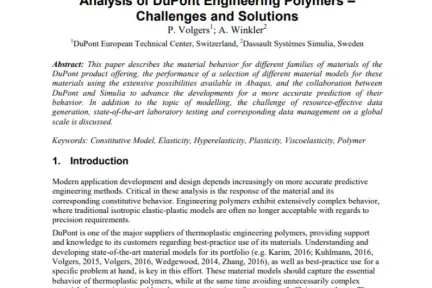
Analysis of DuPont Engineering Polymers – Challenges and Solutions

This paper describes the material behavior for different families of materials of the DuPont product offering, the performance of a selection of different material models for these materials using the extensive possibilities available in Abaqus, and the collaboration between DuPont and Simulia to advance the developments for a more accurate prediction of their behavior. In addition to the topic of modelling, the challenge of resource-effective data generation, state-of-the-art laboratory testing and corresponding data management on a global scale is discussed.

Customer Papers

Analysis of DuPont Engineering Polymers – Challenges and Solutions
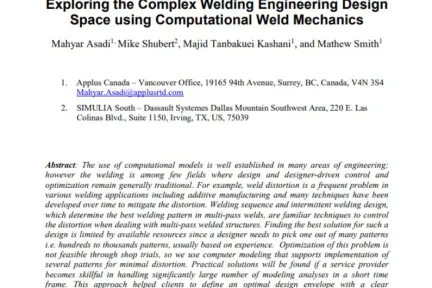
Exploring the Complex Welding Engineering Design Space using Computational Weld Mechanics

The use of computational models is well established in many areas of engineering; however the welding is among few fields where design and designer-driven control and optimization remain generally traditional. For example, weld distortion is a frequent problem in various welding applications including additive manufacturing and many techniques have been developed over time to mitigate the distortion. Welding sequence and intermittent welding design, which determine the best welding pattern in multi-pass welds, are familiar techniques to control the distortion when dealing with multi-pass welded structures.

Customer Papers

Exploring the Complex Welding Engineering Design Space using Computational Weld Mechanics
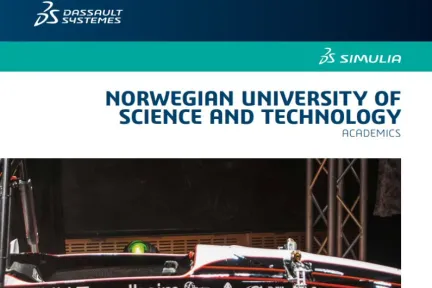
NORWEGIAN UNIVERSITY OF SCIENCE AND TECHNOLOGY ACADEMICS

University students participating the NTNU Revolve team, a contestant in the international Formula Student racing competition, needed a way to design strong, lightweight, and cost-effective vehicle components. Using Dassault Systèmes’ SIMULIA portfolio, including Abaqus FEA, Tosca topology optimization and Isight automation tools, students were able to develop highly competitive but safe component designs.

Tech Notes

NORWEGIAN UNIVERSITY OF SCIENCE AND TECHNOLOGY ACADEMICS
257 résultats

Témoignages clients

150 résultats
4 résultats

Auto-apprentissage SIMULIA

Nous proposons plusieurs centaines de modules d'auto-apprentissage pour que vous puissiez continuer à apprendre à votre rythme.

Blogs

Lisez le blog SIMULIA pour connaître les dernières actualités et innovations de nos experts.

703 résultats

Découvrir comment SIMULIA peut vous aider

Contactez un expert SIMULIA pour découvrir comment nos solutions permettent une collaboration transparente et une innovation durable dans des entreprises de toutes tailles.

Commencer

Des formations et des cours sont disponibles pour les étudiants, le monde académique, les professionnels et les sociétés. Trouvez la formation SIMULIA qui vous convient. 

Obtenir de l'aide

Obtenez des informations sur la certification des logiciels et du matériel, les téléchargements de logiciels, la documentation utilisateur, les coordonnées du support et l'offre de services.